Scope and prerequisites
ACT framework, February 2026 revision. Original classroom cases are not an official form; preserve the scored/field-test boundaries of each source form.
- Evaluate whether evidence 证据 supports a specific argument 论证
- Compare agreement and disagreement across paired texts
- Integrate a graph or table without replacing the passage’s claim
Prerequisites: Separate claims; rates and differences; representation limits.
Explain and choose the method
Identify each argument’s claim, evidence and limits separately before comparing texts. A criticism may concern method, cost or certainty rather than the goal itself. Relevance 相关性 asks whether evidence bears on the claim; sufficiency asks whether its amount and quality warrant the conclusion. A counterexample can weaken a universal claim without disproving a narrower one.
For paired texts, make a two-column mental map of shared concerns and distinct positions. An answer can misrepresent both authors by combining one author’s evidence with the other’s conclusion. When predicting a response, use the responding author’s stated principle; do not invent a view simply because the authors disagree elsewhere.
Read a visual’s title, axes, units, groups and notes before using its values. A table may summarise observed counts rather than rates; compare denominators before interpreting a difference. Link the exact visual finding to the claim in the passage. A numerical trend does not establish a causal mechanism unless the design and text supply that support.
The original paired case uses a compact table represented in words. It is targeted practice, not a full long Reading passage set. In a complete set, return between passage and visual as needed and answer the specified relationship rather than every interesting numerical pattern. Keep survey, pilot and measured outcome claims distinct.
Integration 综合 uses each source for the claim it actually supports. A retrieval-time table can test a claim about speed, but cannot establish historical value or safety. Two recommendations may be compatible when they serve different aims.
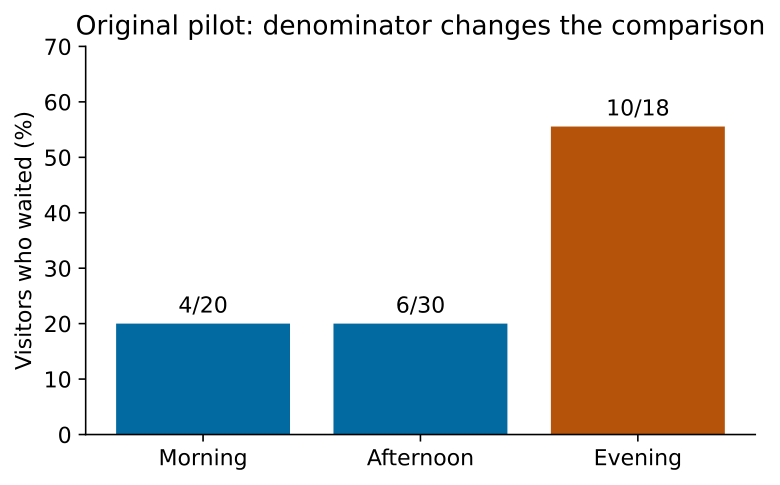
Existing worked example: Original Text A: “Extend opening hours first. The pilot recorded 18 evening visits across four evenings, so access after work is a real concern. Before buying more equipment, see whether a longer schedule spreads demand.” Text B: “Evening access matters, but schedule changes alone will not solve equipment queues. In the same pilot, ten of the eighteen evening visitors waited for a machine. Purchase decisions should use both attendance and waiting data.” Pilot table: morning 20 visits/4 waited; afternoon 30/6; evening 18/10. Both authors value access, but B says capacity also matters. Waiting proportions are 20%, 20% and about 56%, so evening has the highest waiting proportion despite the lowest visit count. This supports investigating an evening bottleneck; the observational pilot does not prove buying a machine is the best solution.
Complete original context
Original argumentative Text A — Preserve the labels
A workshop catalogue should preserve the names and categories used by its earlier keepers. These records show how people understood their tools. If each new keeper replaces every label with one chosen only for current convenience, later readers lose evidence of that earlier understanding. Preservation does not require freezing the room. A new index can connect old categories to present uses, while a record of each change lets readers reconstruct the earlier arrangement. Convenience matters, but a useful system need not erase its history.
Original argumentative Text B — Let the search task guide the index
An index is also a tool used by people who may lack the keeper's experience. In a trial with beginners, pairing commonly used parts reduced the average time needed to gather a repair kit. The improvement did not extend to the rare parts, which beginners used in several different combinations. We therefore recommend task-based trays for frequent combinations and an ordinary size index for the remainder. Old labels can be recorded separately. This recommendation concerns retrieval under the trial's tasks, not the historical value of the objects or a guarantee about every future repair.
Original hypothetical retrieval table — average minutes per kit, same beginners completing matched tasks in counterbalanced order:
- Frequent combinations: size index 8; task-based trays 5.
- Rare combinations: size index 10; task-based trays 11.
- Each average summarises twelve trials; no uncertainty estimates are supplied.
The table does not compare historians, expert keepers, repair quality or object safety. It records retrieval times only.
Independent practice and checked reasoning
Transfer 1
State each text's main concern. Could a system satisfy both? Give a concrete arrangement using only their stated proposals.
Reasoning: A protects evidence of earlier categories; B improves task-based retrieval while preserving a size index for rare combinations. Keep a dated record of old labels and changes, provide task trays for frequent combinations, and retain the size index for the remainder. This follows both texts without claiming their purposes are identical.
Transfer 2
Calculate the time change for each task category. Does the table support “task-based trays speed every search”?
Reasoning: Frequent kits fall from 8 to 5 minutes, a 3-minute or 37.5% reduction. Rare kits rise from 10 to 11 minutes, a 1-minute or 10% increase. The every-search claim is contradicted; averages also do not show every individual trial.
Transfer 3
Which would the authors challenge — “all old labels should be discarded” or “no category should ever change”? Explain their separate reasons.
Reasoning: A challenges discarding old labels because it removes historical evidence, but explicitly permits a new index and records of change. B challenges freezing categories because beginners benefit from task trays, while permitting old labels to be recorded separately. Both reject an extreme that erases either usefulness or history.
Limits and next use
Counts are not rates, shared goals are not identical recommendations, and a four-evening pilot does not establish a universal causal claim.
All tasks here are public original practice with authored guidance. They are not official questions or fresh diagnostics. Existing protected tests and mocks remain separate.