Scope and prerequisites
ACT framework, February 2026 revision. Original classroom cases are not an official form; preserve the scored/field-test boundaries of each source form.
- Record denominator and radical restrictions before solving
- Check transformed-equation candidates in the original
- Find and interpret simultaneous solutions or allowed regions
Prerequisites: Factorisation; substitution; domain restrictions.
Explain and choose the method
For rational expressions, identify denominator zeros before cancelling factors or multiplying an equation by a denominator. Simplification may remove a visible factor while its original restriction remains. Cancel whole factors, not selected terms in an addition.
Isolate a square root and respect its nonnegative value before squaring. Squaring preserves solutions but can add candidates, so substitute each candidate into the original. The same caution applies to multiplying by an expression that might be zero. A value that satisfies a transformed polynomial but fails the source is extraneous.
A system requires the same ordered pair to satisfy every equation. Substitute a line into a circle or parabola 抛物线, solve the resulting quadratic and recover the second coordinate. Linear systems may have one intersection, no intersection or coincident lines. Do not confuse two algebraic roots with two separate systems.
For systems of inequalities, each condition supplies an allowed region and the solution is their intersection. A point on a strict boundary is excluded even if it satisfies the other inequality. Verify a proposed point by substituting into each original inequality, including its equality sign.
A candidate root 候选根 must satisfy the original equation. In $\sqrt{x+6}=x$, the right side must be nonnegative. Squaring gives $x^2-x-6=0$, so candidates are $3,-2$. Only $3$ survives the original check: $\sqrt9=3$.
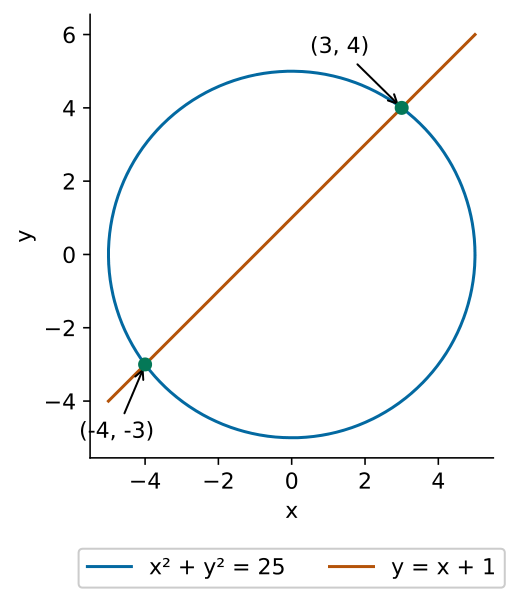
Existing worked example: √(x+6)=x implies x≥0. Squaring gives x²-x-6=0 with candidates 3 and -2; only 3 works. For x²+y²=25 and y=x+1, substitution gives x²+x-12=0, hence (3,4) and (-4,-3). (x²-4)/(x-2) simplifies to x+2 for x≠2, preserving the restriction.
Complete original context
Every transfer question states all data it needs.
Independent practice and checked reasoning
Transfer 1
Solve simultaneously $x^2+y^2=25$ and $y=x-1$. Check each ordered pair in both equations.
Reasoning: Substitute to get $x^2+(x-1)^2=25$, or $x^2-x-12=0$. Roots are $4,-3$, giving $(4,3)$ and $(-3,-4)$. Both give squared sum 25 and satisfy $y=x-1$.
Transfer 2
Solve $\sqrt{3x+4}=x$ and describe all points satisfying $y\ge x+1$ and $y<4-x$.
Reasoning: Squaring with $x\ge0$ gives $(x-4)(x+1)=0$; only $x=4$ works. The region is on/above $y=x+1$ and below $y=4-x$. It exists only when $x+1<4-x$, so $x<3/2$; their meeting point is excluded.
Transfer 3
Simplify $F(x)=(x^2-4x)/(x^2-16)$. State every original restriction and explain why $F$ is not identical to $x/(x+4)$ on that latter formula's whole domain.
Reasoning: Factor numerator $x(x-4)$ and denominator $(x-4)(x+4)$. The original domain excludes $x=4,-4$. Cancellation gives $F(x)=x/(x+4)$ for $x\ne4,-4$. The latter formula alone permits $4$, where it gives $1/2$, while $F(4)$ is undefined.
Limits and next use
Restrictions survive simplification. In a simultaneous system, check both coordinates in every original relation.
All tasks here are public original practice with authored guidance. They are not official questions or fresh diagnostics. Existing protected tests and mocks remain separate.