Dimensional analysis: one curve for every sphere
Introduzido| English | Significado |
|---|---|
| dimensional analysis/daɪˈmenʃənl əˈnæləsɪs/ | A method that groups the variables of a problem into dimensionless combinations, so fewer tests describe the physics. |
| Buckingham Pi theorem | The rule that n variables built from k base dimensions form n − k independent dimensionless groups. |
| Reynolds number/ˈrenəldz ˈnʌmbə/ | The dimensionless ratio of inertial to viscous forces, ρVD/μ, which decides whether a flow is laminar or turbulent. |
| dynamic similarity | The condition that a model and a full-size body have equal dimensionless groups, so their force coefficients match. |
| Froude number | Velocity divided by the square root of gravity times length, the ratio that governs free-surface flows such as waves and spillways. |
A test you can afford
- Drag on a new sensor pod cannot be calculated from first principles, and a full-size test is expensive. Dimensional analysis 量纲分析 shows which few groups matter, so a small, cheap test predicts the large one.
- The Buckingham Pi theorem π定理: $n$ variables with $k$ base dimensions combine into $n - k$ dimensionless groups.
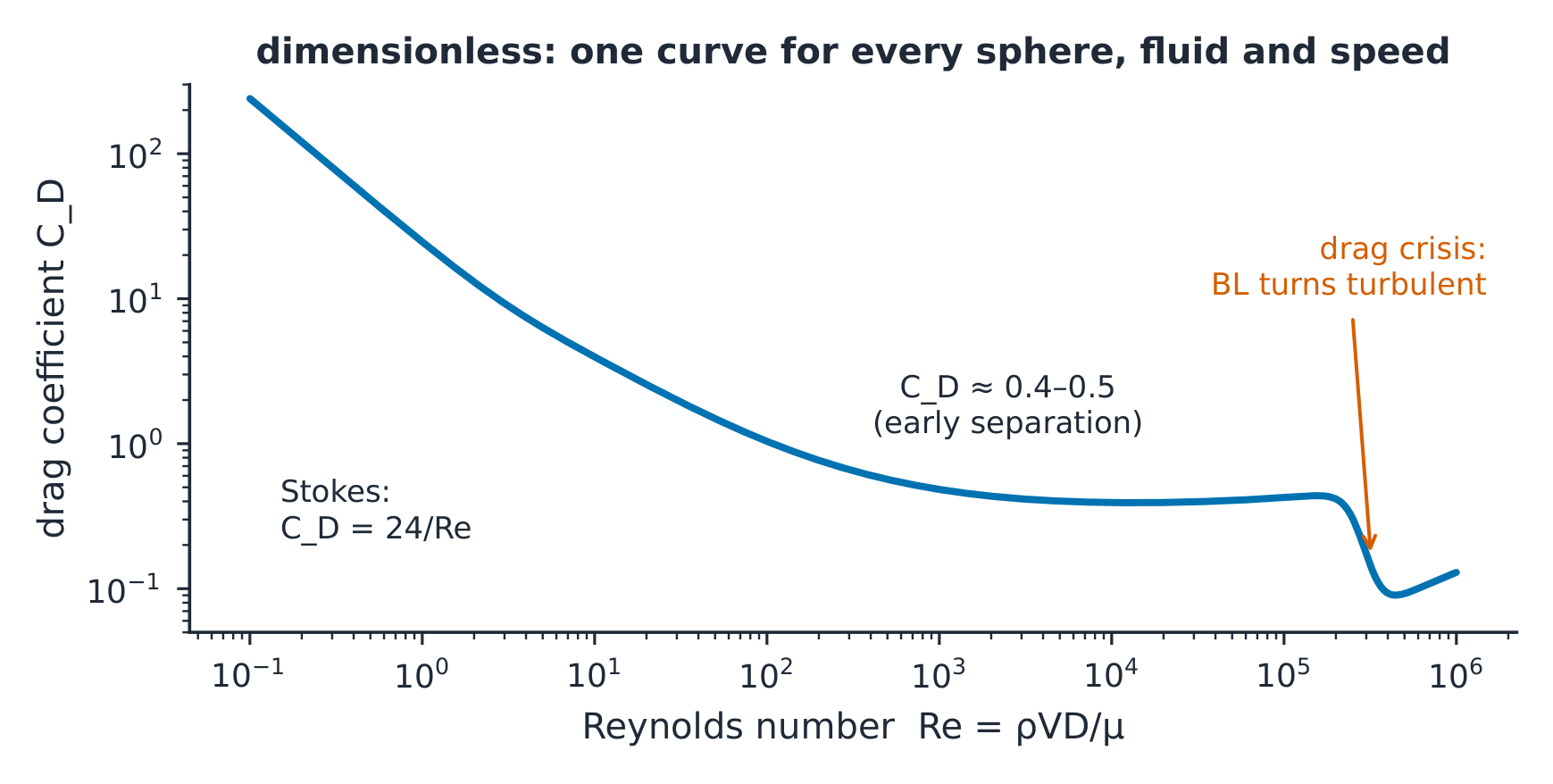
Five variables, two groups
- Sphere drag depends on $F, \rho, V, D, \mu$: five variables in M, L and T, so $5 - 3 = 2$ groups.
- They are $C_D = F/(\tfrac12\rho V^2A)$ and the Reynolds number 雷诺数 $Re = \rho VD/\mu = VD/\nu$, which compares inertia with viscous forces. Every correct law is $C_D = \phi(Re)$.
Which group, which regime?
Classify each case by its group or flow regime.
How many dimensionless groups for F, rho, V, D, mu in M, L, T?
Dificuldade 2/5 · Moedas 140 + pequeno bônus na primeira conclusão hoje
5 variables minus 3 dimensions.
The model test
- The pod, 0.5 m long at 20 m/s in air ($\nu = 1.516 \times 10^{-5}$): $Re = 6.60 \times 10^5$.
- A half-scale model in water ($\nu = 1.004 \times 10^{-6}$) needs the same $Re$ (dynamic similarity 动力相似): $V_m = 20 \times 2 \times (1.004/15.16) = \mathbf{2.65}$ m/s.
- The model measures 30 N. Equal $C_D$ scales it back: $F_p = 30 \times (1.204/998) \times (20/2.65)^2 \times 4 = \mathbf{8.25}$ N.
Re of the 0.5 m pod at 20 m/s in air, nu = 1.516e-5 (in units of 10^5, two decimals)?
Dificuldade 2/5 · Moedas 140 + pequeno bônus na primeira conclusão hoje
VL over nu = 10 / 1.516e-5.
Water speed for the half-scale model (two decimals, m/s)?
Dificuldade 2/5 · Moedas 140 + pequeno bônus na primeira conclusão hoje
V_p (L_p/L_m)(nu_m/nu_p).
Model drag 30 N: prototype drag in air (two decimals, N)?
Dificuldade 2/5 · Moedas 140 + pequeno bônus na primeira conclusão hoje
Equal C_D; scale by density ratio times speed squared times length squared.
Reading Re in a pipe
- The loop's pipe flow has $Re = 2.39 \times 0.08/1.004 \times 10^{-6} = \mathbf{1.90 \times 10^5}$.
- Pipe flow is laminar below about 2300 and turbulent above about 4000, so the loop is firmly turbulent, and that decides how its friction is found.
Water at Re = 1.9 x 10^5 in a pipe is:
Dificuldade 1/5 · Moedas 100 + pequeno bônus na primeira conclusão hoje
Far above 4000.
When gravity governs: Froude
- For free-surface flows (spillways, hulls, waves), gravity matters more than viscosity, and the group to match is the Froude number 弗劳德数 $Fr = V/\sqrt{gL}$.
- A 1:25 spillway model at equal $Fr$ runs at $V_m = V_p/\sqrt{25} = V_p/5$. Flow scales as $L^{2.5}$, so 10 L/s in the model stands for $10 \times 25^{2.5} = 31\,250$ L/s, or $\mathbf{31.3}$ m³/s.
A 1:25 Froude-scaled spillway model passes 10 L/s. Prototype flow (one decimal, m³/s)?
Dificuldade 2/5 · Moedas 140 + pequeno bônus na primeira conclusão hoje
$Q_p = Q_m \times 25^{2.5} = 10 \times 3125 = 31\,250$ L/s $= 31.3$ m³/s.
A ship model can usually match both Reynolds and Froude numbers in ordinary water.
Dificuldade 1/5 · Moedas 100 + pequeno bônus na primeira conclusão hoje
Equal $Fr$ forces $V_m = V_p/\sqrt{\text{scale}}$, while equal $Re$ in the same fluid needs $V_m$ larger than $V_p$. Towing tanks match Froude and correct for friction.
Worked example: the groups for pipe friction
- Pressure drop in a pipe depends on $\Delta p, \rho, V, D, \mu, L, \varepsilon$: seven variables in M, L, T, so $7 - 3 = 4$ groups.
- Choose them as $\Delta p/\rho V^2$, $Re$, $L/D$ and $\varepsilon/D$. Since $\Delta p$ grows in proportion to $L$, the first group is $(L/D)$ times a function of $Re$ and $\varepsilon/D$: that function is the friction factor of the next lesson.
Pipe pressure drop with $\Delta p, \rho, V, D, \mu, L, \varepsilon$ in M, L, T: how many groups?
Dificuldade 2/5 · Moedas 140 + pequeno bônus na primeira conclusão hoje
$7 - 3 = 4$: $\Delta p/\rho V^2$, $Re$, $L/D$, $\varepsilon/D$.
Three similarity slips
- Same shape, different $Re$. Geometric similarity alone is not enough.
- Matching $Re$ and Froude together with one fluid. Usually impossible; match the group that governs.
- $\mu$ where $\nu$ is meant. $Re = VD/\nu$ needs the kinematic one.
A geometrically similar model always gives the same drag coefficient.
Dificuldade 1/5 · Moedas 100 + pequeno bônus na primeira conclusão hoje
Only if the Reynolds number is matched as well.
Recap
- $n - k$ groups; sphere drag is $C_D = \phi(Re)$.
- Equal $Re$: the half-scale water model runs at 2.65 m/s; its 30 N becomes 8.25 N in air.
- Pipe $Re$ of $1.90 \times 10^5$ means turbulent flow.