Friction
Introduzido| English | Significado |
|---|---|
| friction/ˈfrɪkʃn/ | atrito |
| coefficient of static friction/ˌkəʊɪˈfɪʃənt ɒv ˈstætɪk ˈfrɪkʃn/ | coeficiente de atrito estático |
| coefficient of kinetic friction/ˌkəʊɪˈfɪʃənt ɒv kɪˈnetɪk ˈfrɪkʃn/ | coeficiente de atrito cinético |
| angle of friction | The edge of the friction cone. |
| impending slip/ɪmˈpendɪŋ slɪp/ | deslizamento iminente |
Why does the crate on the ramp stay put?
- A $50\ \text{kg}$ crate sits on a $20^{\circ}$ ramp and does not slide. Something along the ramp must be holding it.
- That force adjusts itself: it gives exactly what is needed, up to a limit. How steep could the ramp get before the limit is reached?
It takes what it needs, up to a limit
- Dry friction 摩擦 acts along the contact and opposes sliding. Before sliding, it is whatever equilibrium needs, up to $F \le \mu_s N$, where $N$ is the normal force.
- $\mu_s$ is the coefficient of static friction 静摩擦系数. Once sliding starts, $F = \mu_k N$ with the smaller coefficient of kinetic friction 动摩擦系数.
The friction force on a block at rest is always $\mu_s N$.
Dificuldade 1/5 · Moedas 100 + pequeno bônus na primeira conclusão hoje
$\mu_s N$ is the most static friction can give. A block at rest feels only the friction that equilibrium needs, which reaches $\mu_s N$ only when it is about to slip.
Worked example: needed against available
- A $50\ \text{kg}$ crate ($W = 490.5\ \text{N}$) rests on a $20^{\circ}$ ramp with $\mu_s = 0.4$. Does it slide?
- Needed: the weight's part down the ramp, $490.5\sin 20^{\circ} = 167.8\ \text{N}$.
- Available: $\mu_s N = 0.4 \times 490.5\cos 20^{\circ} = 184.4\ \text{N}$.
- $167.8 < 184.4$, so it stays. The friction acting is $167.8\ \text{N}$, not $184.4\ \text{N}$.
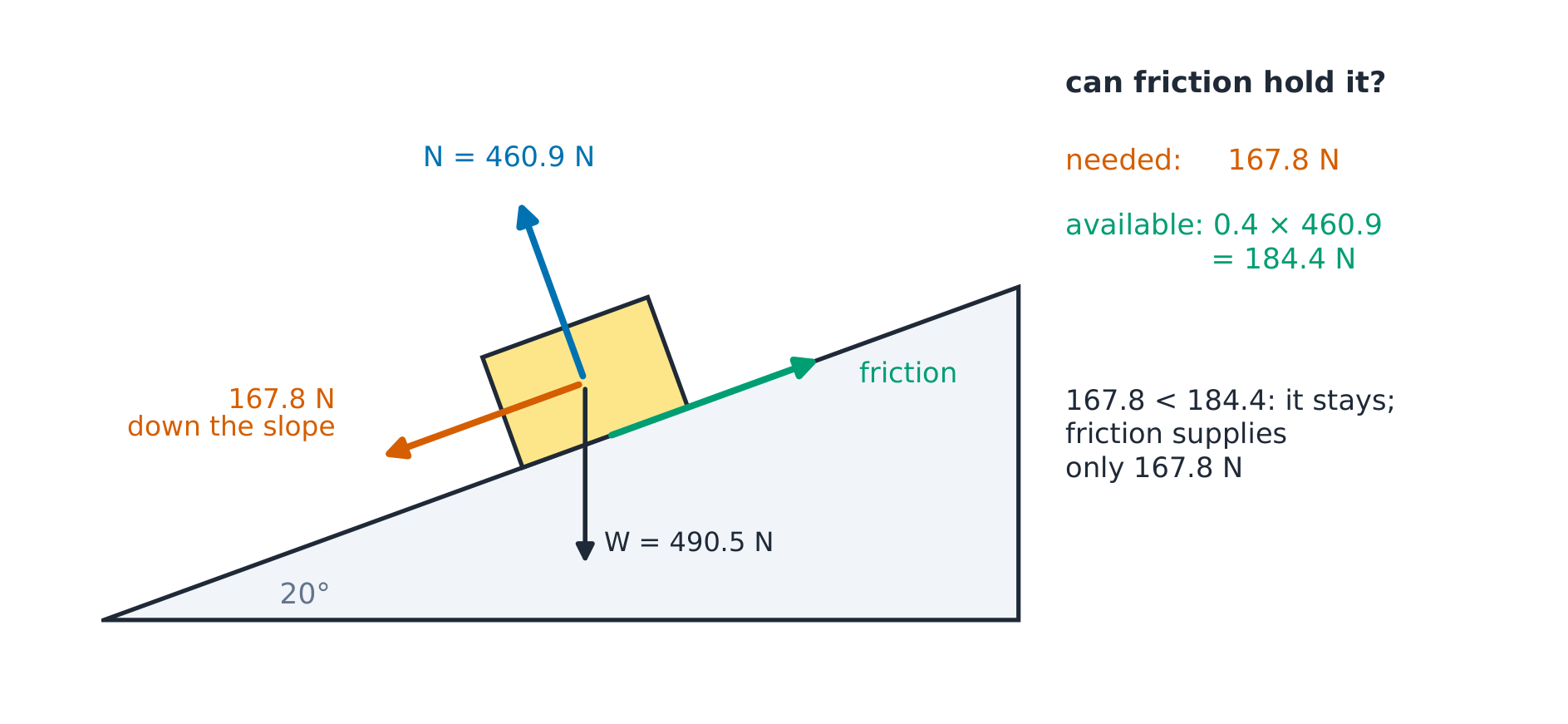
Needed against available
The block stays while the down-slope pull $mg\sin\theta$ is less than the most friction can give, $\mu mg\cos\theta$. Raise the angle past $\tan^{-1}\mu$ and it slides, whatever the mass.
A $30\ \text{kg}$ box rests on a level floor with $\mu_s = 0.5$. You push it sideways with $100\ \text{N}$ and it does not move. How large is the friction force, in N?
Dificuldade 2/5 · Moedas 140 + pequeno bônus na primeira conclusão hoje
The limit is $0.5 \times 30 \times 9.81 = 147.2\ \text{N}$, but the box only needs $100\ \text{N}$ to balance your push. Friction gives exactly $100\ \text{N}$.
The steepest safe slope
- At the limit, the total contact force leans $\phi$ from the normal, where $\tan\phi = \mu_s$. This angle of friction 摩擦角 is the edge of the friction cone.
- A block on a slope starts to slide when the slope reaches $\phi$, whatever its weight. For $\mu_s = 0.4$: $\phi = \tan^{-1} 0.4 = 21.8^{\circ}$, so the $20^{\circ}$ ramp is close to the edge.

A block sits on a plank with $\mu_s = 0.6$. You slowly tilt the plank. At what angle, in degrees, does the block start to slide?
Dificuldade 2/5 · Moedas 140 + pequeno bônus na primeira conclusão hoje
Sliding starts when $\tan\theta = \mu_s$: $\theta = \tan^{-1} 0.6 = 31.0^{\circ}$. The mass cancels, because both the pull and the friction limit scale with $mg$.
Direction first: against the would-be motion
- At impending slip 临界滑动, friction points against the motion that is about to happen. Say that motion in words first; then the sign is easy.
- To push the $50\ \text{kg}$ crate up the ramp, friction acts down it: $P = 167.8 + 184.4 = 352.1\ \text{N}$ along the ramp, more than twice the down-slope pull of the weight.
You push a block slowly up a rough slope, parallel to the slope. Which way does the friction on the block act?
Dificuldade 1/5 · Moedas 100 + pequeno bônus na primeira conclusão hoje
The block is moving up the slope, so friction opposes that motion and acts down the slope, adding to the weight's pull.
What force parallel to the slope is needed to start a $20\ \text{kg}$ box moving up a $25^{\circ}$ slope with $\mu_s = 0.3$, in N?
Dificuldade 2/5 · Moedas 140 + pequeno bônus na primeira conclusão hoje
$W = 196.2\ \text{N}$. Down-slope pull $196.2\sin 25^{\circ} = 82.9\ \text{N}$, plus friction $0.3 \times 196.2\cos 25^{\circ} = 53.3\ \text{N}$, gives $P = 136.3\ \text{N}$.
Tip or slide?
- A box pulled sideways can slide or tip over its front edge. Find the pull for each, then the smaller one happens first.
- A crate $0.5\ \text{m}$ wide and $1.0\ \text{m}$ tall, $W = 392.4\ \text{N}$, $\mu_s = 0.5$, pulled at its top. Slide: $P = 0.5 \times 392.4 = 196.2\ \text{N}$. Tip: $P \times 1.0 = 392.4 \times 0.25$, so $P = 98.1\ \text{N}$. It tips first.
A cabinet weighs $400\ \text{N}$, is $0.8\ \text{m}$ wide, and stands on a floor with $\mu_s = 0.4$. It is pulled sideways at a height of $1.2\ \text{m}$. What pull makes it move (tip or slide, whichever comes first), in N?
Dificuldade 2/5 · Moedas 140 + pequeno bônus na primeira conclusão hoje
Slide: $0.4 \times 400 = 160\ \text{N}$. Tip: $P \times 1.2 = 400 \times 0.4$, so $P = 133.3\ \text{N}$. The smaller pull wins: it tips.
The ladder: how steep is safe?
- A uniform ladder leans on a smooth wall at angle $\theta$ to the floor. Moments about the foot give the wall's push: $\dfrac{W}{2\tan\theta}$. The floor's friction must match it.
- Friction is at most $\mu_s W$, so the ladder stands when $\tan\theta \ge \dfrac{1}{2\mu_s}$. For $\mu_s = 0.4$: $\theta \ge 51.3^{\circ}$.
A uniform ladder leans on a smooth wall. The floor has $\mu_s = 0.25$. What is the smallest angle between the ladder and the floor at which it can stand, in degrees?
Dificuldade 2/5 · Moedas 140 + pequeno bônus na primeira conclusão hoje
$\tan\theta \ge \dfrac{1}{2\mu_s} = \dfrac{1}{0.5} = 2$, so $\theta \ge 63.4^{\circ}$. A slippery floor needs a steep ladder.
Marks that slip away
- Writing $F = \mu_s N$ every time. That is only the limit. If the crate does not slide, friction is what equilibrium needs.
- Wrong direction. Friction opposes the motion that would happen, not any motion you can picture.
- Checking only sliding. A tall object pulled high may tip long before it slides.
You've got it
- Static friction: $F \le \mu_s N$, and it equals the limit only at impending slip.
- Compare needed with available; the steepest safe slope is $\tan^{-1}\mu_s$.
- Work out the would-be motion first; compare tipping with sliding and take the smaller pull.