Maxwell's equations
Introduzido| English | Significado |
|---|---|
| displacement current/dɪˈspleɪsmənt ˈkʌrənt/ | The term for a changing electric field, which produces a magnetic field just as a current does. |
One term that makes radio possible
- Every radio, every photon and every wireless phone charger depends on one term that Maxwell added to Ampère's law.
- Without it the equations contradict themselves, and there are no waves. This lesson finds the contradiction, adds the term and derives the speed of light.
The four equations
- Two divergence laws: $\nabla \cdot \mathbf{E} = \dfrac{\rho}{\varepsilon_{0}}$ (charge is a source of $\mathbf{E}$) and $\nabla \cdot \mathbf{B} = 0$ (no magnetic charges).
- Two curl laws: $\nabla \times \mathbf{E} = -\dfrac{\partial \mathbf{B}}{\partial t}$ (Faraday) and $\nabla \times \mathbf{B} = \mu_{0}\mathbf{J} + \mu_{0}\varepsilon_{0}\dfrac{\partial \mathbf{E}}{\partial t}$ (Ampère–Maxwell).
Match each equation to what it says.
Dificuldade 2/5 · Moedas 140 + pequeno bônus na primeira conclusão hoje
Two laws about sources, two about circulation. The time derivatives couple $\mathbf{E}$ e $\mathbf{B}$.
Faraday's law and Lenz
- A changing magnetic field makes a circulating electric field. That is how transformers, generators and wireless chargers work.
- The minus sign is Lenz's law: the induced current flows so as to oppose the change in flux.
The minus sign in Faraday's law means the induced current
Dificuldade 1/5 · Moedas 100 + pequeno bônus na primeira conclusão hoje
Lenz's law: if the induced current reinforced the change, energy would appear from nowhere.
The flux through a 50-turn coil changes by 2 mWb in 10 ms. What is the size of the induced EMF, in volts?
Dificuldade 2/5 · Moedas 140 + pequeno bônus na primeira conclusão hoje
$|\mathcal{E}| = N\dfrac{\Delta\Phi}{\Delta t} = 50 \times \dfrac{0.002}{0.01} = 10$ V.
The missing term
- Take the divergence of the old law $\nabla \times \mathbf{B} = \mu_{0}\mathbf{J}$. The left side is always zero, but the right side is $-\mu_{0}\dfrac{\partial \rho}{\partial t}$ wherever charge builds up.
- Maxwell's displacement current 位移电流 term $\mu_{0}\varepsilon_{0}\dfrac{\partial \mathbf{E}}{\partial t}$ has divergence $+\mu_{0}\dfrac{\partial \rho}{\partial t}$ by Gauss's law. Added in, it repairs the equation.
Without the displacement-current term, Ampère's law would contradict charge conservation wherever charge builds up.
Dificuldade 1/5 · Moedas 100 + pequeno bônus na primeira conclusão hoje
The divergence of a curl is zero, but $\nabla \cdot \mu_{0}\mathbf{J} = -\mu_{0}\dfrac{\partial\rho}{\partial t}$ is not when charge accumulates, as on a capacitor plate.
Worked example: the capacitor's missing amp
- A capacitor charges at 1 A. No charge crosses the gap, yet a loop round the wire must give the same answer whichever surface it spans, including one through the gap.
- Between the plates $E = \dfrac{Q}{\varepsilon_{0}A}$, so $\varepsilon_{0}A\dfrac{\partial E}{\partial t} = \dfrac{dQ}{dt} = 1\,\text{A}$. The displacement current equals the wire current exactly.
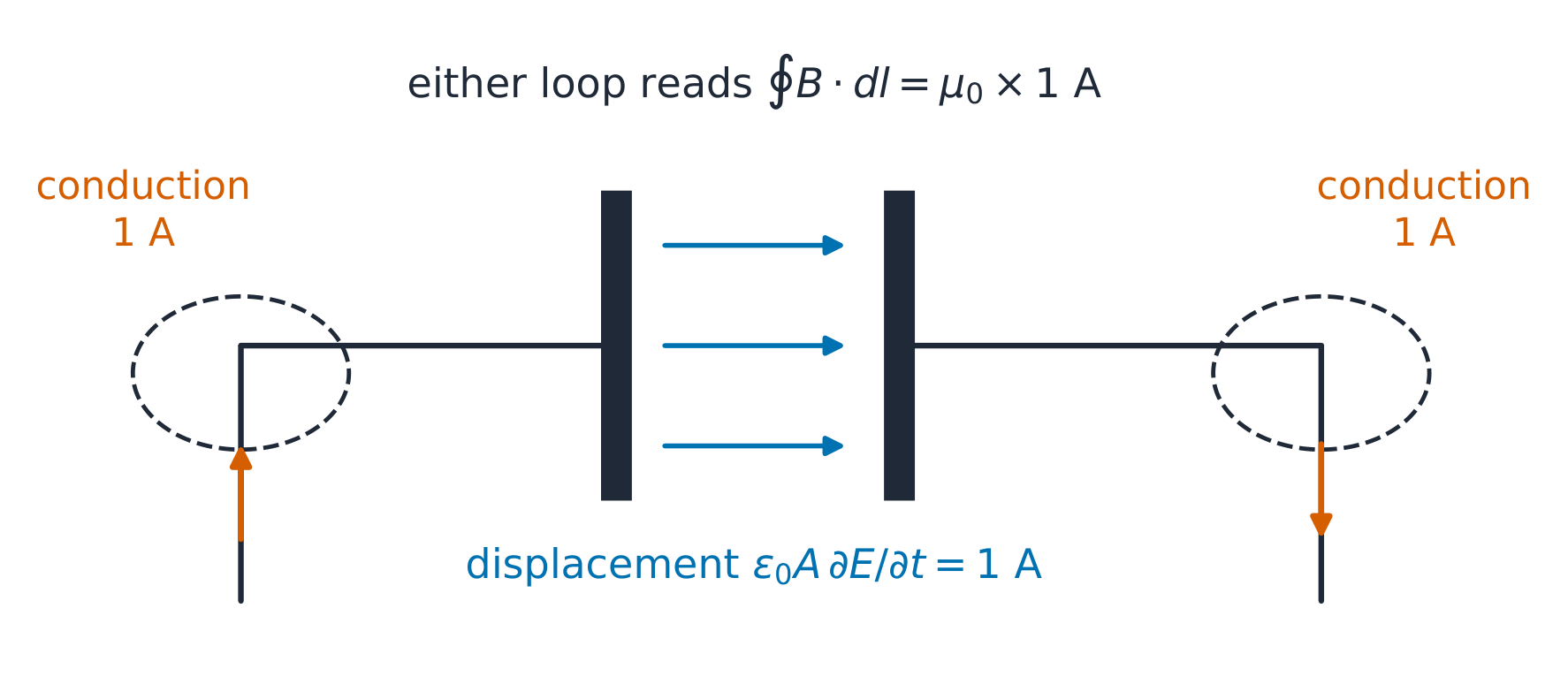
A capacitor charges at 1 A. The displacement current between its plates is
Dificuldade 1/5 · Moedas 100 + pequeno bônus na primeira conclusão hoje
$\varepsilon_{0}A\dfrac{\partial E}{\partial t} = \dfrac{dQ}{dt} = 1$ A: the displacement current continues the wire current across the gap.
Waves and the speed of light
- In empty space, combine the two curl laws: $\nabla^{2}\mathbf{E} = \mu_{0}\varepsilon_{0}\dfrac{\partial^{2}\mathbf{E}}{\partial t^{2}}$. This is a wave equation.
- Its speed is $c = \dfrac{1}{\sqrt{\mu_{0}\varepsilon_{0}}} = 3.0 \times 10^{8}\,\dfrac{\text{m}}{\text{s}}$: the speed of light, from two constants measured on a bench.
1/√(μ₀ε₀) works out to
Dificuldade 1/5 · Moedas 100 + pequeno bônus na primeira conclusão hoje
The wave equation from Maxwell's equations travels at $\dfrac{1}{\sqrt{\mu_{0}\varepsilon_{0}}}$, which matches the measured speed of light: light is an electromagnetic wave.
In a material with εr = 4 (and μr = 1), what fraction of c do waves travel at?
Dificuldade 2/5 · Moedas 140 + pequeno bônus na primeira conclusão hoje
$v = \dfrac{1}{\sqrt{\mu_{0}\varepsilon_{0}\varepsilon_{r}}} = \dfrac{c}{\sqrt{4}} = 0.5c$.
Three common slips
- Treating displacement current as optional. It keeps the equations consistent and carries every wave.
- Misplacing the minus sign. It belongs to Faraday's law: the induced field opposes the change.
- Using static fields near antennas. Radiation is the time-varying terms at work.
Recap
- Four equations: two divergences (sources), two curls (circulation from change and current).
- Displacement current $\varepsilon_{0}\dfrac{\partial E}{\partial t}$ keeps charge conservation and continues current across a gap.
- In empty space the equations give waves at $c = \dfrac{1}{\sqrt{\mu_{0}\varepsilon_{0}}}$.