Radioactive decay and the three radiations · Decaimento radioativo e as três radiações
| English | Português |
|---|---|
| radioactivity/ˌreɪdɪəʊækˈtɪvɪti/ | radioatividade |
| radioactive decay/ˌreɪdɪəʊˈæktɪv dɪˈkeɪ/ | decaimento radioativo |
| spontaneous/spɒnˈteɪnɪəs/ | espontânea |
| background radiation/ˈbækɡraʊnd ˌreɪdɪˈeɪʃn/ | radiação de fundo |
| radon/ˈreɪdɒn/ | rádio |
| cosmic rays/ˈkɒzmɪk reɪz/ | raios cósmicos |
| count rate/kaʊnt reɪt/ | taxa de contagem |
| alpha/ˈælfə/ | alpha |
| ionising/ˈaɪənaɪzɪŋ/ | ionizante |
| beta/ˈbiːtə/ | beta |
| gamma/ˈɡæmə/ | gama |
Unstable nuclei
- Some nuclei are unstable — sooner or later they break down and shoot out radiation.
- A Geiger counter clicks as it detects each burst.
- This is radioactivity 放射性, and it comes in three types.
Núcleos instáveis
- Alguns núcleos são instáveis — num momento ou outro desintegram-se e emitem radiação.
- Um contador Geiger faz um clique ao detetar cada rajada.
- Isto é radioatividade 放射性, e existe em três tipos.
Radioactive decay 放射性衰变
- An unstable nucleus breaks down and gives out radiation — radioactive decay.
- A nucleus may be unstable because it has too many neutrons or is too heavy.
- Decay is spontaneous 自发 (you cannot speed it up or slow it down) and random (you cannot say which nucleus is next, or exactly when).
A Geiger counter detects and counts radiation
Decaimento radioativo 放射性衰变
- Um núcleo instável desintegra-se e emite radiação — decaimento radioativo.
- Um núcleo pode ser instável porque tem muitos nêutrons ou é demasiado pesado.
- O decaimento é espontâneo 自发 (não se pode acelerar nem desacelerar) e aleatório (não se pode prever qual será o próximo núcleo ou exatamente quando).
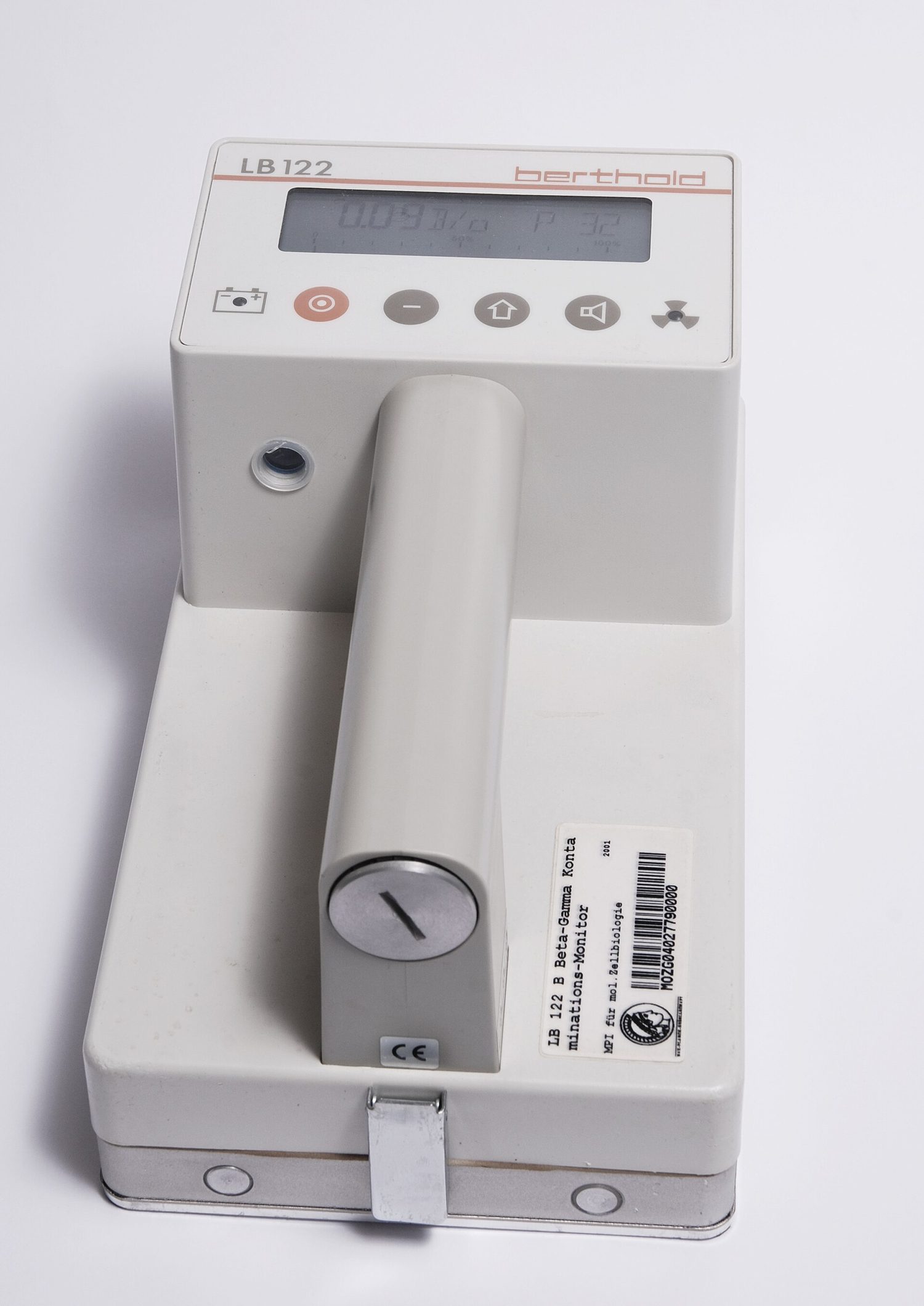
Um contador Geiger detecta e conta a radiação
Radioactive decay · Decaimento radioativo
N = N₀·bᵗ
The number of unstable nuclei decays · decai exponentially. · O número de núcleos instáveis decai exponencialmente.
Radioactive decay is spontaneous and random. This means: · O decaimento radioativo é espontâneo e aleatório. Isso significa que:
Spontaneous = not triggered and not controllable; random = you cannot say which nucleus decays next or exactly when. · Espontâneo = não acionado e não controlável; aleatório = você não pode dizer qual núcleo decairá next ou exatamente quando.
Background radiation 背景辐射 and measuring
- Some radiation is around us all the time — background radiation.
- Main sources: radon 氡 gas (usually the biggest), rocks and buildings, food and drink, cosmic rays 宇宙射线 from space.
- A detector and counter give the count rate 计数率 (counts per second or minute).
- To find a source's true rate, subtract the background:
Deflection of radiation in an electric field
Radiação de fundo 背景辐射 e medição
- Existe sempre alguma radiação à nossa volta — radiação de fundo.
- Principais fontes: gás rádio 氡 (geralmente a maior), rochas e edifícios, alimentos e bebidas, raios cósmicos 宇宙射线 do espaço.
- Um detector e contador fornecem a taxa de contagem 计数率 (contagens por segundo ou minuto).
- Para encontrar a taxa real de uma fonte, subtrai a radiação de fundo:

Deflexão da radiação num campo elétrico
A source reads $250$ counts/min. The background is $30$ counts/min. What is the corrected count rate, in counts/min? · Uma fonte apresenta $250$ contagens/min. O fundo é $30$ contagens/min. Qual é a taxa de contagem corrigida, em contagens/min?
Corrected = measured − background = $250 - 30 = 220$ counts/min. · Corrigido = medido − fundo = $250 - 30 = 220$ contagens/min.
The three types of radiation
- Alpha α粒子 (α) — a helium nucleus (charge $+2$): most ionising 电离, least penetrating — stopped by paper.
- Beta β粒子 (β) — a fast electron (charge $-1$): medium — stopped by a few mm of aluminium.
- Gamma γ射线 (γ) — a high-energy EM wave (no charge): least ionising, most penetrating — only reduced by thick lead.
Os três tipos de radiação
- Alfa α粒子 (α) — um núcleo de hélio (carga $+2$): mais ionizante 电离, menos penetrante — parado pelo papel.
- Beta β粒子 (β) — um eletrão rápido (carga $-1$): médio — parado por alguns mm de alumínio.
- Gama γ射线 (γ) — uma onda eletromagnética de alta energia (sem carga): menos ionizante, mais penetrante — apenas reduzido por chumbo espesso.

Match each radiation to what stops it. · Associe cada radiação ao que a detém.
Alpha is least penetrating (paper), beta is medium (aluminium), gamma is most penetrating (thick lead only reduces it). · Alfa é o menos penetrante (papel), beta é médio (alumínio), gama é o mais penetrante (chumbo espesso apenas o reduz).
Which radiation is the most ionising but the least penetrating? · Qual radiação é a mais ionizante, mas a menos penetrante?
Alpha is the most ionising (big +2 charge, slow and heavy) but is easily absorbed — the least penetrating. · Alfa é a mais ionizante (grande carga +2, lenta e pesada), mas é facilmente absorvida — a menos penetrante.
Deflection and decay equations
- Because α and β are charged, fields deflect them — in opposite directions (the lighter β bends more). Gamma (no charge) is not deflected.
- Alpha decay: lose 2 protons + 2 neutrons, so $A$ falls by 4 and $Z$ by 2.
- Beta decay: a neutron becomes a proton + the emitted electron, so $A$ stays the same and $Z$ rises by 1, e.g. $^{24}_{11}\text{Na} \rightarrow {}^{24}_{12}\text{Mg} + {}^{\ \ 0}_{-1}\beta$.
- Gamma: only energy leaves, so $A$ and $Z$ are unchanged.
Deflexão e equações de decaimento
- Como α e β são carregados, campos defletem-nos — em direções opostas (o β mais leve curva mais). O gama (sem carga) não é defletido.
- Decaimento Alfa: perde 2 prótons + 2 nêutrons, logo $A$ cai em 4 e $Z$ em 2.
- Decaimento Beta: um nêutron torna-se um próton + o eletrão emitido, logo $A$ permanece igual e $Z$ aumenta em 1, ex. $^{24}_{11}\text{Na} \rightarrow {}^{24}_{12}\text{Mg} + {}^{\ \ 0}_{-1}\beta$.
- Gama: apenas energia sai, logo $A$ e $Z$ permanecem inalterados.
When a nucleus emits an alpha particle, the nucleon number A and proton number Z change by: · Quando um núcleo emite uma partícula alfa, o número nucleônico A e o número de prótons Z mudam em:
An alpha particle is 2 protons + 2 neutrons, so A drops by 4 and Z drops by 2. · Uma partícula alfa tem 2 prótons + 2 nêutrons, então A cai em 4 e Z cai em 2.
Gamma radiation is deflected by a magnetic field. · A radiação gama é desviada por um campo magnético.
Gamma rays have no charge, so they are not deflected. Only the charged alpha and beta particles bend in fields. · Raios gama não têm carga, então não são desviados. Apenas as partículas carregadas alfa e beta curvam em campos.
You've got it
- decay is spontaneous and random; corrected rate = measured − background
- α (He nucleus, +2): most ionising, stopped by paper
- β (electron, −1): medium, stopped by aluminium; γ (EM wave): most penetrating, lead
- α decay: $A{-}4$, $Z{-}2$ · β decay: $A$ same, $Z{+}1$ · γ: no change; only α and β are deflected
Entendeu?
- decaimento é espontâneo e aleatório; taxa corrigida = medida − fundo
- α (núcleo He, +2): mais ionizante, parado por papel
- β (eletrão, −1): médio, parado por alumínio; γ (onda EM): mais penetrante, chumbo
- decaimento α: $A{-}4$, $Z{-}2$ · decaimento β: $A$ igual, $Z{+}1$ · γ: sem alteração; apenas α e β são defletidos