Your learning plan · Continue · Review →
了 — saying an action has happened
IntroduzidoSua posição salva fica neste navegador. Retomar não conclui a lição nem responde às suas perguntas.
Have you eaten yet?
- A friend asks if you have eaten. You had noodles an hour ago.
- I我eat吃(completed / change)了。 Wǒ chī le. — "I've eaten." I我eat吃(completed / change)了一碗noodles面条。 — "I ate a bowl of noodles."
Verb + (completed / change)了: the action is done
- (completed / change)了 (le) after a verb says the action has happened: I我eat吃(completed / change)了, I ate; 他来(completed / change)了, he has come.
- With an amount, (completed / change)了 comes right after the verb: buy买(completed / change)了two两(measure word)个apples苹果, bought two apples.
I我buy买了two两(measure word)个apples苹果。
Complete: “I bought two apples.” 我买____两个苹果。
Difficulty 1/5 · 100 coins + a small bonus on first completion today
了 comes right after the verb when an amount follows.
Asking: ……(completed / change)了(yes/no ?)吗?
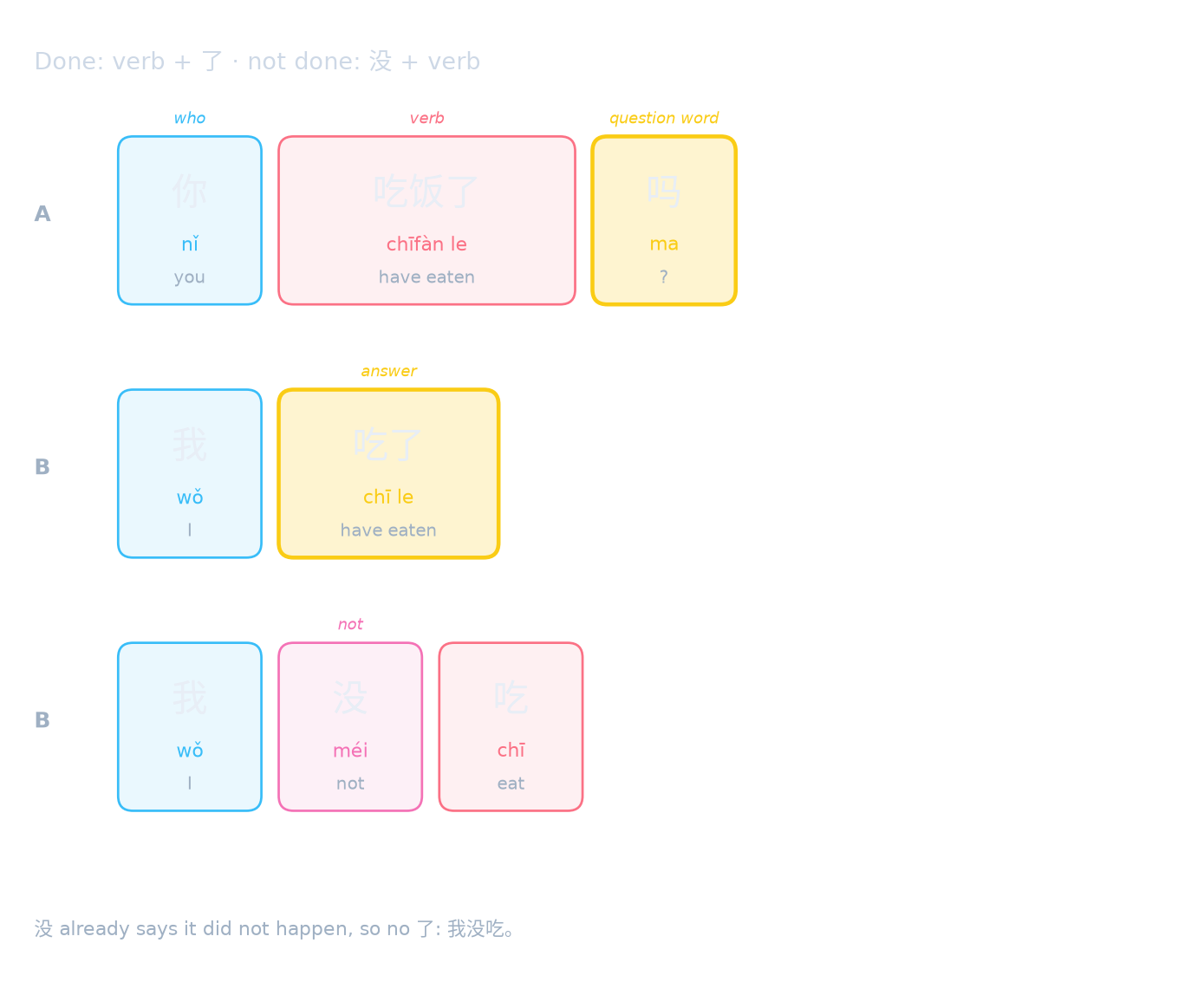
- you你eat吃饭(completed / change)了(yes/no ?)吗? Nǐ chī fàn le ma? — "Have you eaten?" Answer eat吃(completed / change)了 for yes.
- People often ask this as a friendly greeting, not only about food.
you你eat吃饭了吗?
Build: “Have you eaten?”
Difficulty 3/5 · 200 coins + a small bonus on first completion today
Verb + 了 + 吗 asks whether an action has happened.
Saying it did not happen: not没(to have / there is有)
- The negative uses not没 and drops (completed / change)了: I我not没eat吃。 — "I haven't eaten." Not I我not没eat吃(completed / change)了.
I我not没eat吃。
You have not eaten yet. Which reply fits?
Difficulty 1/5 · 100 coins + a small bonus on first completion today
The negative uses 没 and drops 了.
Watch out
- (completed / change)了 is not a simple past tense. Habits do not take it: I我every day每天eat吃(cooked) rice米饭, I eat rice every day.
- In the negative, use not没 and remove (completed / change)了: I我not没to go去, not I我not没to go去(completed / change)了.
我每天吃了米饭 is the normal way to describe a daily habit.
Difficulty 1/5 · 100 coins + a small bonus on first completion today
False. Habits do not take 了 — 我每天吃米饭.
Recap
- Verb + (completed / change)了 = the action has happened: I我eat吃(completed / change)了, buy买(completed / change)了two两(measure word)个apples苹果.
- Ask ……(completed / change)了(yes/no ?)吗?; answer no with not没 + verb (no (completed / change)了). Habits do not take (completed / change)了.
A friend asks what you did this morning. Say two things you did and one thing you did not do. Close the examples. Say it, then write it in Chinese.
Compare meaning and word order with the model; your sentences need not copy it. A partner or teacher must hear the spoken version to comment on pronunciation.