Pular para o conteúdo
Gramática Inglesa · Nível B2

Tempos narrativos

  • 1 Tempos narrativos
    1.1

    Pretérito simples e pretérito contínuo

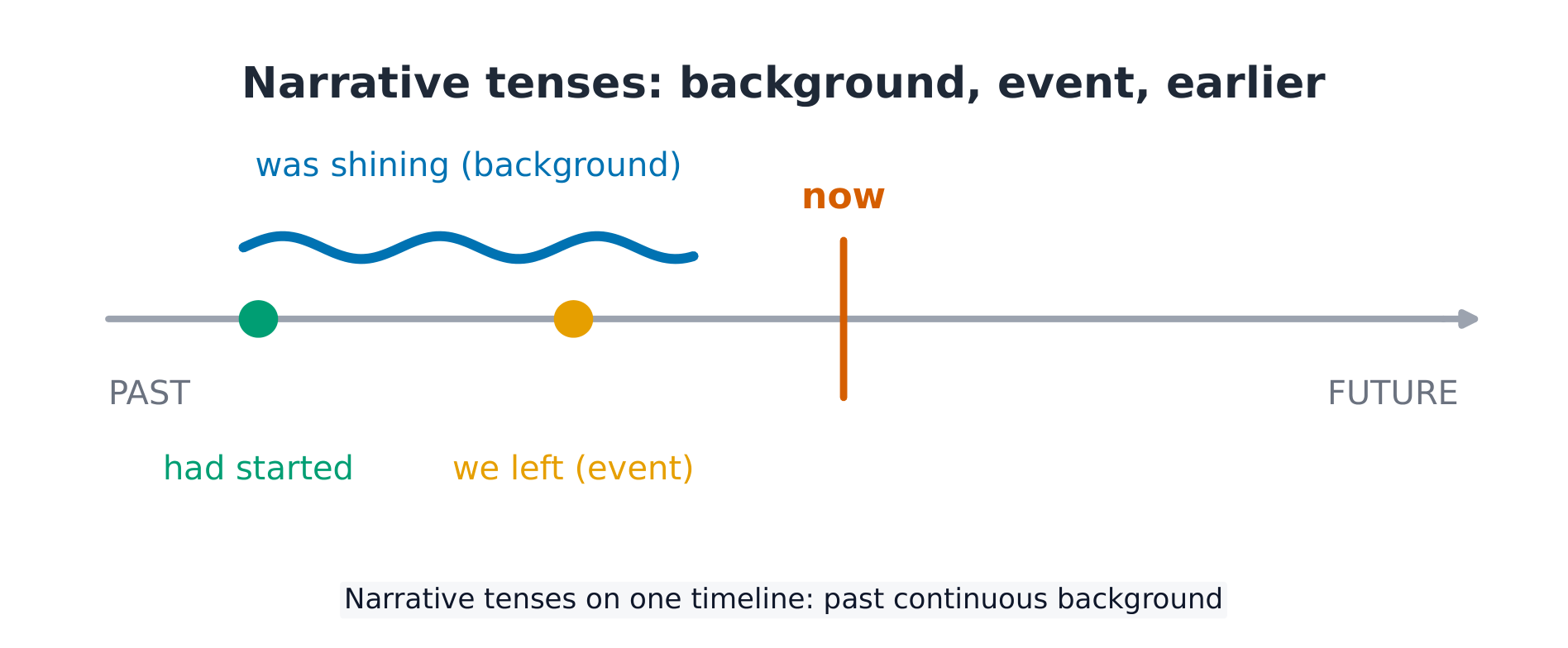
    Tempos narrativos: fundo, evento, anterior
    Tempos narrativos: fundo, evento, mais antigo

    讲故事时,英语用一组叙事时态 (narrative tenses) 配合使用。最基础的两个是:

    • Pretérito simples: avança a trama com as ações principais (uma após a outra).
    • Pretérito contínuo: estabelece o fundo, descrevendo o que estava em curso naquele momento.

    (冠词)The 太阳sun (过去进行)was 照耀shining 当...时when 我们we 出发left.

    Nós partimos enquanto o sol brilhava intensamente. (Fundo + ação principal)

    她She (过去进行)was 做饭cooking 当...时when (冠词)the 电话phone 响了rang.

    O telefone tocou enquanto ela cozinhava.

    注意 长的背景动作用过去进行时(was cooking);打断它的短动作用一般过去时(rang)。

    1.2

    Pretérito perfeito anterior para o passado mais remoto

    当需要表示一个动作发生在另一个过去动作之前,用过去完成时 (had + 过去分词)。

    当...时When 我们we 到达arrived (冠词), the 电影film (过去完成)had 已经already 开始started.

    Chegamos e o filme já tinha começado. (Começou antes de chegarmos)

    Concordância na narrativa:

    • 最早 → 过去完成时(had started)。
    • 之后 → 一般过去时(arrived)。
    • 背景 → 过去进行时(was raining)。

    Atenção ao usar esses três tempos juntos para clarificar as camadas temporais da história.

    1.3

    Pretérito mais-que-perfeito contínuo

    过去完成进行时 (had been + V-ing) 强调在某个过去时间点之前一直持续的动作。

    她She (过去)was 累tired 因为because 她she (过去完成)had (进行)been 工作working 一整天all day.

    Ela estava cansada porque trabalhava o dia todo.

    Diferença em relação ao pretérito perfeito anterior:

    • 过去完成进行时:强调持续的过程 / 时长(had been working — 一直在干)。
    • 过去完成时:强调完成 / 结果(had finished — 干完了)。

    注意 状态动词(know、be)不用进行时:用 had known,不用 ~~had been knowing~~。

    Erros Comuns

    • ❌ ~~When the phone rang, she cooked dinner.~~(想说"正在做饭")→ ✓ …she was cooking dinner. — 用一般过去时,意思会变成"电话响了之后她才开始做饭"。
    • ❌ ~~While I walked home, I was meeting a friend.~~ → ✓ While I was walking home, I met a friend. — 长的背景动作用进行时,短动作用过去时,别颠倒。
    • ❌ ~~She had finished the report, then she had sent it.~~ → ✓ She finished the report, then sent it. — 按发生顺序叙述时,一般过去时就够了;过去完成时只在"倒回去补充更早的事"时用。
    • ❌ ~~It was the first time I saw snow.~~ → ✓ It was the first time I had seen snow. — 过去叙事里的"第一次"用过去完成时。

Todos os tópicos · Gramática Inglesa · Nível B2

Entrar ou criar conta

IGCSE, A-Level & AP