Globalisation and trade restrictions
Introduced| English | Meaning |
|---|---|
| globalisation/ˌɡləʊbəlaɪˈzeɪʃn/ | The increasing connections and interdependence between countries through trade, investment, communication and other flows. |
| multinational companies/ˌmʌltɪˈnæʃənl ˈkʌmpəniz/ | Businesses with operations in more than one country. |
| tariff/ˈtærɪf/ | A tax imposed on imported goods. |
| protectionism/prəˈtekʃənɪzəm/ | Government policies that restrict imports or otherwise protect domestic producers from foreign competition. |
| quota/ˈkwəʊtə/ | A fixed limit on the quantity of a good that may be produced, sold or imported. |
| subsidy/ˈsʌbsɪdi/ | Financial assistance, usually from government, that reduces costs or supports a particular activity. |
| dumping/ˈdʌmpɪŋ/ | Selling exports at a price below the comparable home-market price or an appropriate cost benchmark. |
| retaliation/rɪˌtælɪˈeɪʃn/ | A response against another party's action, such as imposing trade restrictions after a partner introduces tariffs. |
A more connected world
- A phone designed in California, made in China from parts across Asia, sold worldwide — that's globalisation 全球化.
- But governments sometimes try to block trade. Why, and how?
The growing integration of the world's economies is called ______.
Difficulty 1/5 · 100 coins + a small bonus on first completion today
Driven by trade, investment and technology.
Globalisation
- Globalisation = the growing integration of the world's economies through trade, investment and technology.
- It is driven by cheaper transport, the internet, and multinational companies 跨国公司.

A tariff 关税 raises the price from the world price to 'world price + tariff': domestic supply rises, demand falls, imports shrink, and the shaded box is the government's tariff revenue
Trade restrictions in the market
A tariff raises the price of imports, shifting effective supply and protecting home producers at consumers' expense.
A tariff is:
Difficulty 1/5 · 100 coins + a small bonus on first completion today
A tariff is an import tax; a quota is a quantity limit.
A quota restricts trade by:
Difficulty 1/5 · 100 coins + a small bonus on first completion today
A quota caps the quantity of imports allowed.
Trade restrictions (protectionism 贸易保护主义)
- Tariff: a tax on imports, raising their price.
- Quota 配额: a limit on the quantity that can be imported.
- Subsidy 补贴 to domestic firms, and regulations, also restrict trade.
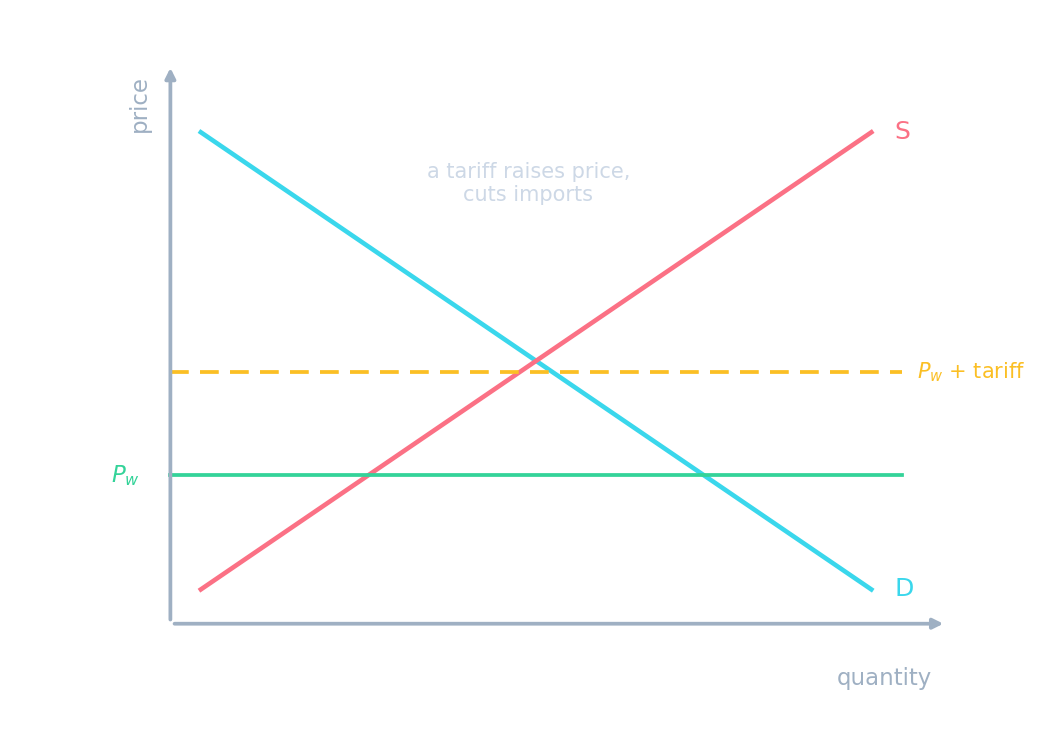
A tariff lifts the price of imports, so consumers buy fewer of them and more is made at home.
Which are reasons governments restrict trade? (Select all that apply.)
Difficulty 2/5 · 140 coins + a small bonus on first completion today
Protection tends to raise, not lower, domestic prices.
Imposing tariffs can lead other countries to retaliate with their own.
Difficulty 1/5 · 100 coins + a small bonus on first completion today
Retaliation is a major risk of protectionism.
Why restrict trade?
- To protect new ("infant") or declining industries and the jobs in them.
- To raise revenue and guard against dumping 倾销 (foreign goods sold below cost).
- But protection raises prices and can trigger retaliation 报复.
Protection has a cost. A tariff may save some home jobs, but consumers pay higher prices and other countries may retaliate with tariffs of their own. The gains are rarely free.

Exports are sold abroad; imports are bought from abroad
You've got it
- globalisation = world economies integrating through trade, investment, technology
- tariffs (import taxes) and quotas (import limits) restrict trade
- protection saves some jobs but raises prices and risks retaliation