Firms' costs, revenue and objectives
Introduced| English | Meaning |
|---|---|
| profit/ˈprɒfɪt/ | Total revenue minus total cost. |
| variable costs/ˈveərɪəbl kɒsts/ | Costs that change as the level of output changes. |
| fixed costs/fɪkst kɒsts/ | Costs that do not change with output over the relevant period and production range. |
| total cost/ˈtəʊtl kɒst/ | The sum of all costs of producing a given level of output, including fixed and variable costs. |
| average cost/ˈævrɪdʒ kɒst/ | Total production cost divided by the quantity produced. |
| total revenue/ˈtəʊtl ˈrevənjuː/ | The total income from sales, equal to price multiplied by quantity for a single product at one price. |
| economies of scale/ɪˈkɒnəmiz ɒv skeɪl/ | Falls in average production cost as the scale of output increases. |
| diseconomies/ˌdɪsɪˈkɒnəmiz/ | Increases in average production cost associated with a larger scale of operation. |
What it really costs to make something
- Before a firm can price a product or judge its profit 利润, it must know its costs.
- Costs come in two kinds — and they behave very differently as output changes.
Which is a fixed cost?
Difficulty 1/5 · 100 coins + a small bonus on first completion today
Rent does not change with the level of output — a fixed cost.
Average cost equals total cost divided by ______.
Difficulty 1/5 · 100 coins + a small bonus on first completion today
AC = TC / quantity of output.
Fixed and variable costs 可变成本
- Fixed costs 固定成本 don't change with output: rent, insurance, loan interest.
- Variable costs rise with output: raw materials, wages, power.
- Total cost 总成本 = fixed + variable; average cost 平均成本 = total cost ÷ output.
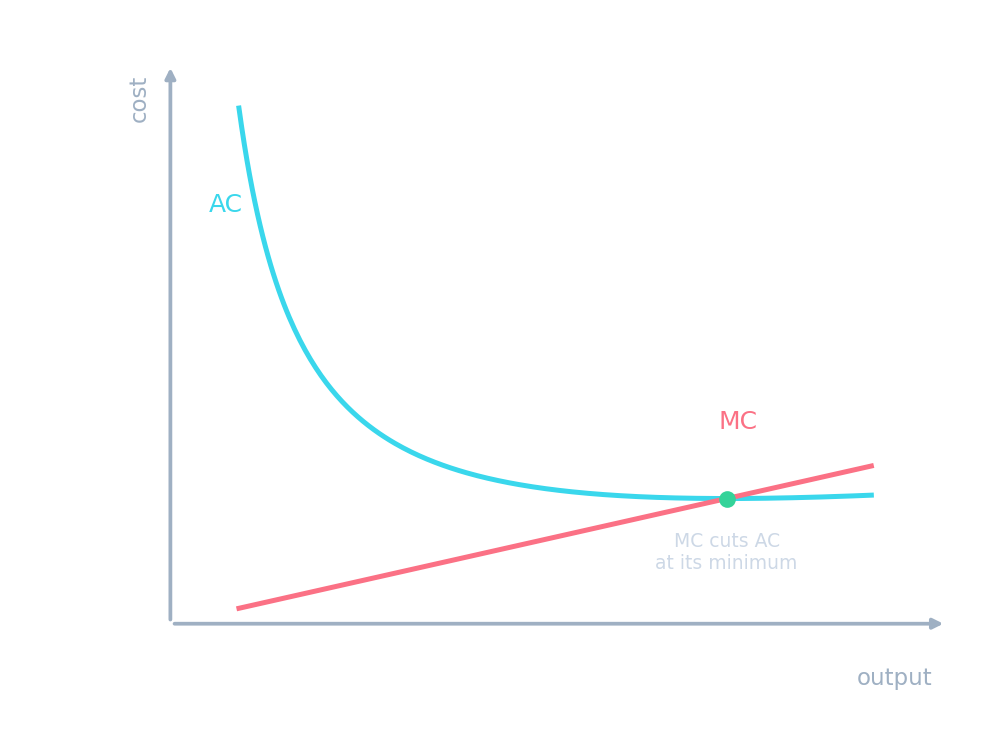
Average cost is U-shaped: it falls as fixed costs spread, then rises as the firm overstretches.
Costs, revenue and the firm
Average cost falls then rises (a U shape); marginal cost crosses it at its lowest point. Firms watch these to decide output.
A firm sells 300 units at 4 each. What is total revenue?
Difficulty 2/5 · 140 coins + a small bonus on first completion today
Revenue = price × quantity = 4 × 300 = 1200.
Total revenue is 5000 and total cost is 3200. What is profit?
Difficulty 2/5 · 140 coins + a small bonus on first completion today
Profit = revenue − total cost = 5000 − 3200 = 1800.
Revenue and profit
- Total revenue 总收益 = price × quantity sold.
- Profit = total revenue − total cost. It is the entrepreneur's reward and main objective.
Worked example. A firm sells 200 units at 10 each → revenue = 2000. If total cost is 1500, profit = 500.
Economies of scale mean that, as a firm grows, its:
Difficulty 1/5 · 100 coins + a small bonus on first completion today
Bulk buying and spreading fixed costs lower average cost.
Economies of scale 规模经济
- As a firm grows, average cost falls — bulk buying, specialist machines, spreading fixed costs.
- Grow too big and average cost can rise again (diseconomies 规模不经济 — poor communication, low morale).
Fixed costs aren't "costs that never change ever." They're fixed with respect to output — you pay the same rent whether you make 1 unit or 1000. They still change over time (a rent review).
You've got it
- total cost = fixed + variable; average cost = TC ÷ output (U-shaped)
- revenue = price × quantity; profit = revenue − total cost
- growth brings economies of scale (lower average cost), then diseconomies