Diffusion
Introduced| English | Meaning |
|---|---|
| diffusion/dɪˈfjuːʒn/ | The net movement of particles from higher to lower concentration due to their random motion. |
| concentration gradient/ˌkɒnsənˈtreɪʃn ˈɡreɪdɪənt/ | A change in a substance's concentration across a distance or between regions. |
| surface area/ˈsɜːfɪs ˈeərɪə/ | The total area of the outer surfaces of a three-dimensional object. |
Why does oxygen enter a working cell?
- A respiring cell uses oxygen, keeping its oxygen concentration lower than outside. Oxygen enters by diffusion 扩散; the cell does not spend energy pumping it in.
- Cells also use other transport processes. Diffusion explains this oxygen movement, but it does not explain every substance entering a cell.
Random movement gives a net direction
- Diffusion is the net movement of particles from higher to lower concentration, down a concentration gradient 浓度梯度, as a result of random movement.
- Particles move both ways. If 12 cross to the right and 5 cross to the left in the same time, the net movement is 7 particles to the right.
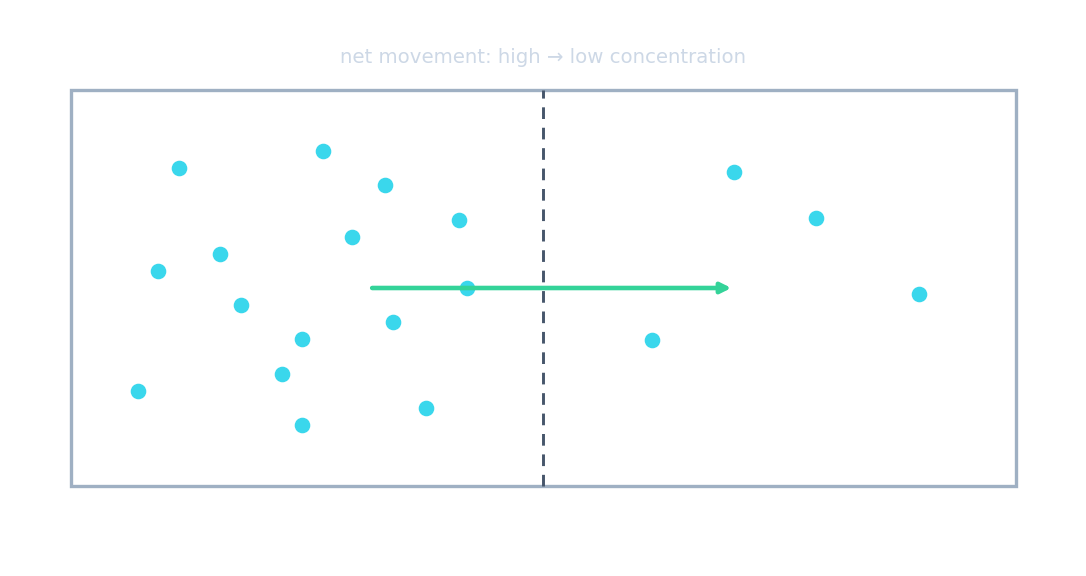
The arrow shows the net direction, not the direction of every particle.
The particles keep moving after the concentrations become equal.
Diffusion
net movement: high → low
Particles spread down the gradient, from where they're crowded to where they're sparse.
Diffusion is the net movement of particles from a region of:
Difficulty 1/5 · 100 coins + a small bonus on first completion today
Particles move down the concentration gradient.
Diffusion requires energy from the cell.
Difficulty 1/5 · 100 coins + a small bonus on first completion today
Particles have kinetic energy from random movement. The cell does not supply energy from respiration for diffusion.
Diffusion is the ______ movement of particles down a concentration gradient.
Difficulty 1/5 · 100 coins + a small bonus on first completion today
Particles move both ways, but the net flow is high to low.
In one interval, 12 particles cross right and 5 cross left. How many particles is the net movement to the right?
Difficulty 2/5 · 140 coins + a small bonus on first completion today
12 − 5 = 7 to the right; particles have still crossed both ways.
Follow each substance's own gradient
- Oxygen enters a respiring cell because its concentration is higher outside. Carbon dioxide produced by respiration can diffuse out because its concentration is higher inside.
- Different substances can therefore have opposite net directions across the same membrane. Diffusion also happens without cells, as when a smell spreads through air.
Oxygen concentration is higher outside a respiring cell than inside. What is its net diffusion direction?
Difficulty 1/5 · 100 coins + a small bonus on first completion today
Oxygen crosses both ways, but more enters than leaves because its concentration is higher outside. Respiration uses oxygen inside.
Explain a faster rate
- A steeper gradient increases net movement. Higher temperature makes particles move faster, increasing the rate of diffusion.
- A larger surface area 表面积 allows more particles to cross at once; a shorter diffusion distance lets them cross more quickly. Thin gas-exchange surfaces use both features.
Two gas-exchange surfaces have the same area, temperature and oxygen gradient. Surface A is thinner than B. Oxygen diffuses faster across A because the diffusion distance is shorter. State the changed factor and its effect, rather than just saying A is “better”.
Which increase the rate of diffusion? (Select all that apply.)
Difficulty 2/5 · 140 coins + a small bonus on first completion today
A thicker barrier slows diffusion; the others speed it up.
A gas-exchange surface is thinner but has the same area, temperature and oxygen gradient. Predict and explain the effect on oxygen diffusion.
Diffusion is faster because the diffusion distance is shorter; oxygen still moves net down its concentration gradient.
Equal concentrations do not stop particles
- At equal concentrations, particles still cross in both directions. Over time the opposing movements balance, so there is no net movement.
- Diffusion needs no energy supplied by the cell. The particles already have kinetic energy; “passive” does not mean that particles have no energy or stop moving.

These counts illustrate the subtraction; random crossings fluctuate from one interval to another.
Do not say that particles choose where to go. Random motion produces a net movement down a gradient. “No net movement” at equilibrium is different from “no movement”.
At equal concentrations, which description is correct?
Difficulty 1/5 · 100 coins + a small bonus on first completion today
Equilibrium is dynamic: opposing movements balance over time.
Explain a new gas-exchange surface
- A small organism has a thin outer surface and uses oxygen in respiration. Compare oxygen movement if that surface becomes thicker while all other conditions stay the same.
- Build the answer from the oxygen gradient, the transport process and the changed diffusion distance.
A small organism uses oxygen in respiration. Its outer surface becomes thicker, while area, temperature and oxygen concentrations stay the same. Explain how oxygen enters and predict the effect on its diffusion rate.
Respiration keeps oxygen concentration lower inside. Oxygen diffuses into the organism down its gradient without energy supplied by the cells. The thicker surface increases diffusion distance, so the rate decreases.
Investigate temperature fairly
- Place equal-sized indicator agar cubes in equal volumes of the same acid concentration at different measured temperatures. Wear eye protection and follow the teacher's handling instructions.
- Time how long each cube takes to change colour completely. Keep cube size, acid concentration and volume constant; repeat at each temperature and compare mean times. A shorter time indicates faster penetration. This models diffusion in agar, not movement through a living membrane.
Two equal volumes have equal oxygen concentrations. Which statement describes the oxygen particles?
Difficulty 1/5 · 100 coins + a small bonus on first completion today
Random motion continues at equal concentrations. Equal overall flows cancel; individual particles do not stop.
In one second, 31 particles cross left to right and 12 cross right to left. How many particles move left to right NET in that second?
Difficulty 2/5 · 140 coins + a small bonus on first completion today
Net transfer = 31 − 12 = 19 particles to the right.
A learner tests diffusion in agar using a small cube in warm acid and a large cube in cold acid. The small cube changes colour first. Can this show the effect of temperature alone? Propose an improved comparison.
Check your reasoning against each criterion; other wording is valid if it explains the same evidence.
Check the mechanism
- Diffusion is net movement down a concentration gradient because particles move randomly.
- Steeper gradient, higher temperature, greater surface area and shorter distance increase its rate.
- Equal concentrations mean no net movement; particles still move. No cellular energy supply is required.