Narrative tenses
IntroducedTelling a story
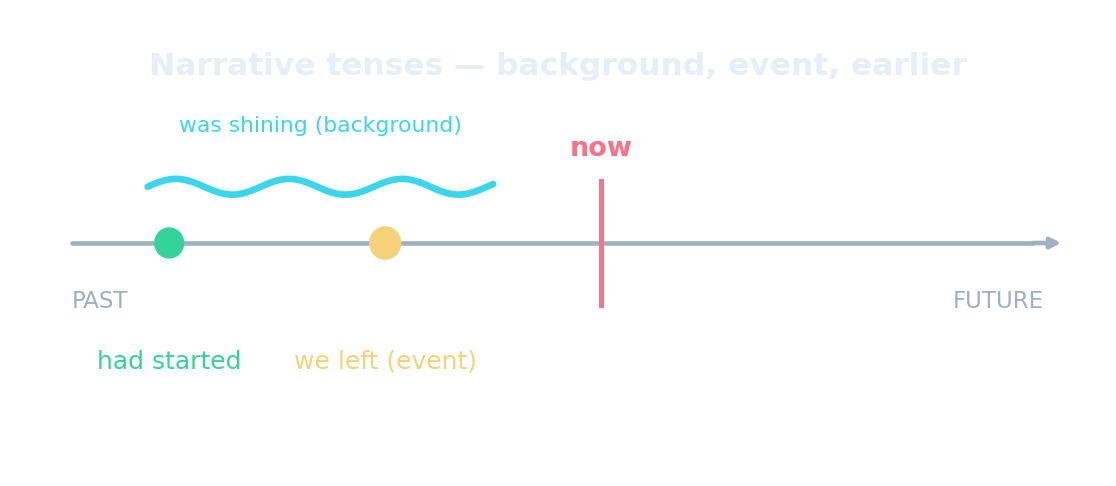
- Good storytelling uses several past tenses together.
- Past simple (events), past continuous (background), past perfect (the earlier past).
- Each tense plays a different role in the timeline.
While I was looking for my notes, I realised the dog had been studying them.
Events and background
- Past simple = the main events, one after another.
- Past continuous = what was already happening (the scene).
- The sun was shining when we left. She was cooking when the phone rang.
What is each tense doing in the story?
Past simple = events; past continuous = background; past perfect = earlier.
Choose the background action: The sun ___ when we left.
Background scene → past continuous: “was shining”.
The earlier past
- Past perfect (had + past participle) = something that happened before.
- When we arrived, the film had already started.
- It shows which event came first.
Complete: When we arrived, the film had already ___ (start).
Earlier action → past perfect: had + started.
Putting them together
- Background → past continuous; events → past simple; earlier → past perfect.
- Together they make the order of a story clear.
Do we use the past continuous for the background scene of a story?
Yes — past continuous sets the scene; past simple gives the events.
Translate into English: 我们到时,电影已经开始了。
Earlier action → past perfect: “… the film had already started.”
Common mistakes
- ❌ When the phone rang, she cooked dinner. (she was mid-task) → ✓ she was cooking dinner.
- ❌ She had finished the report, then she had sent it. → in-order events → past simple.
- ❌ It was the first time I saw snow. → ✓ …the first time I had seen snow.
Match the storytelling job to its tense.
was doing sets the scene, did drives the plot, had done jumps back, had been doing stresses duration.
Complete: The sun ___ shining when we left. (be)
Background weather → past continuous: was shining.
- Past simple = events; past continuous = background scene.
- Past perfect = the earlier of two past actions.
- Mix them to tell a clear, layered story.
Begin a short story. Write one sentence that uses two past tenses (for example, past continuous + past simple).
Example: “I was walking home when I saw an old friend.”