Your learning plan · Continue · Review →
Gerunds and infinitives
IntroducedYour saved position stays in this browser. Resuming does not complete the lesson or answer its questions.
-ing or to …?
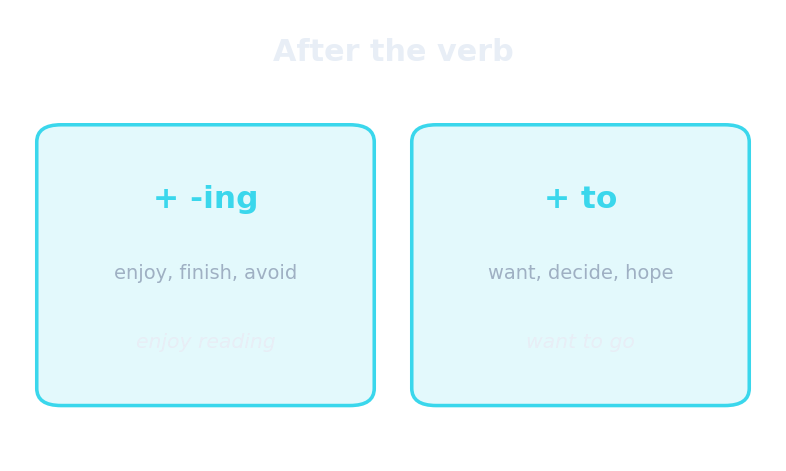
- After some verbs, use the -ing form (gerund).
- After others, use to + base verb (infinitive).
- Learn a verb together with its pattern and meaning. The same verb may allow another pattern with a different meaning.
I enjoy reading, but I keep forgetting to return the books.
verb + -ing
- enjoy, finish, stop, mind, suggest, avoid + -ing.
- I enjoy reading. She finished doing her homework.
- In I enjoy reading, the -ing clause names the activity enjoyed. Enjoy can also take a noun phrase: I enjoyed the concert.
Choose: I enjoy ___ to music.
Difficulty 1/5 · 100 coins + a small bonus on first completion today
For the action after enjoy in this frame, use listening: I enjoy listening to music. Enjoy can also take a noun phrase, such as the concert.
verb + to-infinitive
- want, need, decide, hope, promise, learn, would like + to + base verb.
- I want to learn English. They decided to stay.
- Some verbs allow both forms, with differences depending on meaning and context: I like reading / I like to read before bed. Compare I stopped talking (I ended the talking) with I stopped to talk (I paused another activity in order to talk).
After this verb — -ing or to?
Sort these verbs by the direct action pattern exemplified here, not by every complement each verb can take.
Complete: They decided ___ stay. (one word before the verb)
Difficulty 1/5 · 100 coins + a small bonus on first completion today
“decide” is followed by a to-infinitive: “decided to stay”.
Translate into English: 我想学英语。
Difficulty 3/5 · 200 coins + a small bonus on first completion today
I want to learn English is one answer. I’d like to learn English also expresses the wish with a grammatical pattern; translation does not require one exact sentence.
After a preposition: noun, pronoun or action
- A preposition can have a noun or pronoun after it: about the plan, for her. When an action directly follows the ordinary prepositions in the patterns here, use -ing: good at drawing, thank you for helping.
- She's good at drawing. Thank you for helping.
- Distinguish the to in look forward to seeing you from infinitive to in hope to see you. Before I leave is a full clause; it does not need changing to before I leaving.
Is this correct? “She is good at draw.”
Difficulty 1/5 · 100 coins + a small bonus on first completion today
With the action directly after at in this frame, use drawing: good at drawing. A preposition can also be followed by a noun or pronoun in other examples.
Common mistakes
- ❌ I enjoy to read. → ✓ I enjoy reading. — in this direct action pattern, enjoy takes reading; it can also take a noun, such as the book.
- ❌ I want reading. → ✓ I want to read. — to express this wish with a following action, use want to read. Want can also take a noun or another person: I want a book. I want you to read it.
- ❌ I look forward to see you. → ✓ …look forward to seeing you. — this to is a preposition.
Match the verb to a correct ending.
Difficulty 2/5 · 140 coins + a small bonus on first completion today
In these direct action examples, enjoy/avoid take -ing and hope/promise take to + base verb. The same verbs can occur in other frames, so learn each full example.
The teacher came in, and the class went quiet: “Everyone stopped ___.”
Difficulty 1/5 · 100 coins + a small bonus on first completion today
stop + -ing = quit doing it; stop + to = pause in order to do it.
- Some verbs take -ing (enjoy, finish, avoid).
- Some take to + base verb (want, decide, hope).
- Check the full frame: at drawing, to seeing after look forward, but to see after hope. Nouns and pronouns are also possible after prepositions.
- Tomorrow, write a new example with enjoy, hope and look forward to; explain how stop doing differs from stop to do. Next: connected stories and opinions.
- Usage references checked 20 October 2026: British Council: -ing forms, Cambridge: patterns after verbs. Independent language and learner review remain pending.
Write one sentence about something you enjoy doing, using a verb + -ing (a gerund).
Difficulty 3/5 · 200 coins + a small bonus on first completion today
Example: “I enjoy playing basketball with my friends.”