Forces and Free-Body Diagrams
Introduced| English |
|---|
| force/fɔːs/ |
| free-body diagram/friː ˈbɒdi ˈdaɪəɡræm/ |
| newton/ˈnjuːtn/ |
| weight/weɪt/ |
| normal force/ˈnɔːml fɔːs/ |
| tension/ˈtenʃn/ |
| friction/ˈfrɪkʃn/ |
| net force/net fɔːs/ |
Every push and pull, on one clean diagram
- A book on a table is doing nothing — yet several forces act on it at once.
- Gravity pulls down; the table pushes up; a hand might shove it sideways.
- To reason clearly, physicists strip away everything but the forces 力 on that one object.
- The result is a free-body diagram 受力图 — the single most useful sketch in mechanics.
What a force is
- A force is a push or a pull — a vector, measured in newtons 牛顿 ($\text{N}$).
- It has a size and a direction, so forces add like vectors, not plain numbers.
- A force always comes from an interaction between two objects.
- $1\ \text{N}$ is roughly the weight of a small apple.
What is the SI unit of force?
Force is measured in newtons ($\text{N}$). Joules measure energy, watts power, pascals pressure.
The usual suspects
- Weight 重量 $mg$ — gravity's pull, always straight down.
- Normal force 法向力 $N$ — a surface pushing perpendicular to itself.
- Tension 张力 $T$ — a pull along a rope or string.
- Friction 摩擦力 $f$ — a surface resisting sliding, parallel to the surface.
Which force is always perpendicular to the surface an object rests on?
The normal force is defined as the surface's push perpendicular to itself. Friction runs parallel to the surface.
Drawing a free-body diagram
- Shrink the object to a dot and draw every force as an arrow from that dot.
- Include only forces acting on the object — never forces it exerts on others.
- Point each arrow the right way; longer arrow = larger force.
- Then the net force 合力 is the vector sum of them all.
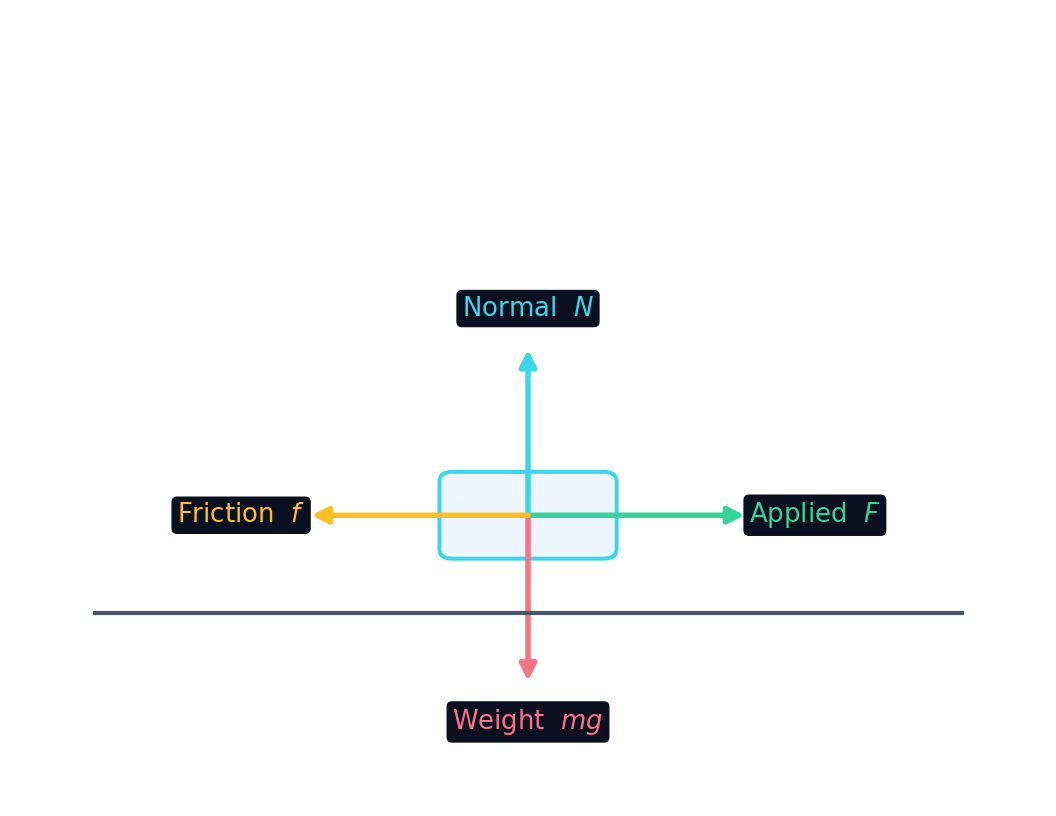
Build a free-body diagram
Change the applied force, friction and mass, and watch the force arrows and the net force respond.
A free-body diagram should include the forces the object exerts on other objects.
A free-body diagram shows only the forces acting on the chosen object, never the forces it exerts on others.
A block is pushed along a rough table. Select all forces that belong on its free-body diagram.
All four forces act on the block. The force the block exerts on the table acts on the table, so it is left out.
Adding the forces up
- Add forces component by component, just like any vectors.
- If they balance, the net force is zero and the object keeps constant velocity.
- If they don't, the leftover net force sets the acceleration (next lessons).
- Always ask: what is the net force, and which way does it point?
A crate feels $10\ \text{N}$ right and $4\ \text{N}$ left. What is the net horizontal force, in $\text{N}$?
Take right as positive: $10 - 4 = 6\ \text{N}$ to the right.
The net force on an object is the ____ sum of all the forces acting on it.
Forces have direction, so they combine as a vector sum, not a plain arithmetic sum.
The normal force is not always equal to the weight. On a slope, or when something presses down or lifts up on the object, $N$ changes. Never assume $N = mg$ — work it out from the forces perpendicular to the surface.
A crate feels $F = 10\ \text{N}$ to the right and friction $f = 4\ \text{N}$ to the left.
- Horizontal net force $= 10 - 4 = 6\ \text{N}$, to the right.
- Vertically, $N$ and $mg$ balance, so the crate stays on the floor.
A force (in newtons) is a push or pull from an interaction. A free-body diagram shows every force acting on one object as arrows from a dot. The net force is their vector sum — and the normal force is not always $mg$.