Challenges of Contemporary Agriculture
Introduced 8:32
Agriculture and Rural Land-Use Patterns and Processes
Two farmers. The same job: grow food. Completely different worlds. One drives a machine across a field so wide you cannot see the end of it, and every grain…
English narration · English and 中文 subtitles you can switch
In this lesson
| English | Meaning |
|---|---|
| food security/fuːd sɪˈkjʊərɪti/ | Reliable access to enough safe, nutritious food for an active and healthy life. |
| food deserts/fuːd ˈdezəts/ | An area where people face limited access to affordable nutritious food; definitions vary with distance, transport and household resources. |
| GMOs/ˌdʒiː em ˈəʊz/ | Organisms whose genetic material has been altered using genetic-engineering techniques. |
| organic farming/ɔːˈɡænɪk ˈfɑːmɪŋ/ | Farming under standards that emphasise ecological processes and restrict specified inputs; it does not mean that every pesticide is prohibited. |
Enough food, still hungry
- The world grows enough food to give every person over 2,900 kilocalories a day, more than they need. Yet in 2023 more than 700 million people were hungry, mostly in sub-Saharan Africa and South Asia, and many places with plenty of food have neighbourhoods where fresh food is hard to buy.
- Hunger today is mostly a problem of access (money, roads, conflict), not of total supply. Contemporary agriculture faces debates about how to grow food and who gets it.
What is the main cause of hunger in the world today?
Difficulty 1/5 · 100 coins + a small bonus on first completion today
Total supply is enough; access is the problem.
Food security and food deserts
- Food security 粮食安全 means everyone has reliable access to enough safe, nutritious food. It fails through poverty, war (Yemen, Sudan), drought or high prices, even where food exists nearby.
- Food deserts 食物荒漠 are areas, often low-income city neighbourhoods or remote rural places, with little access to fresh, affordable food: no supermarket within easy reach, only shops selling packaged snacks.
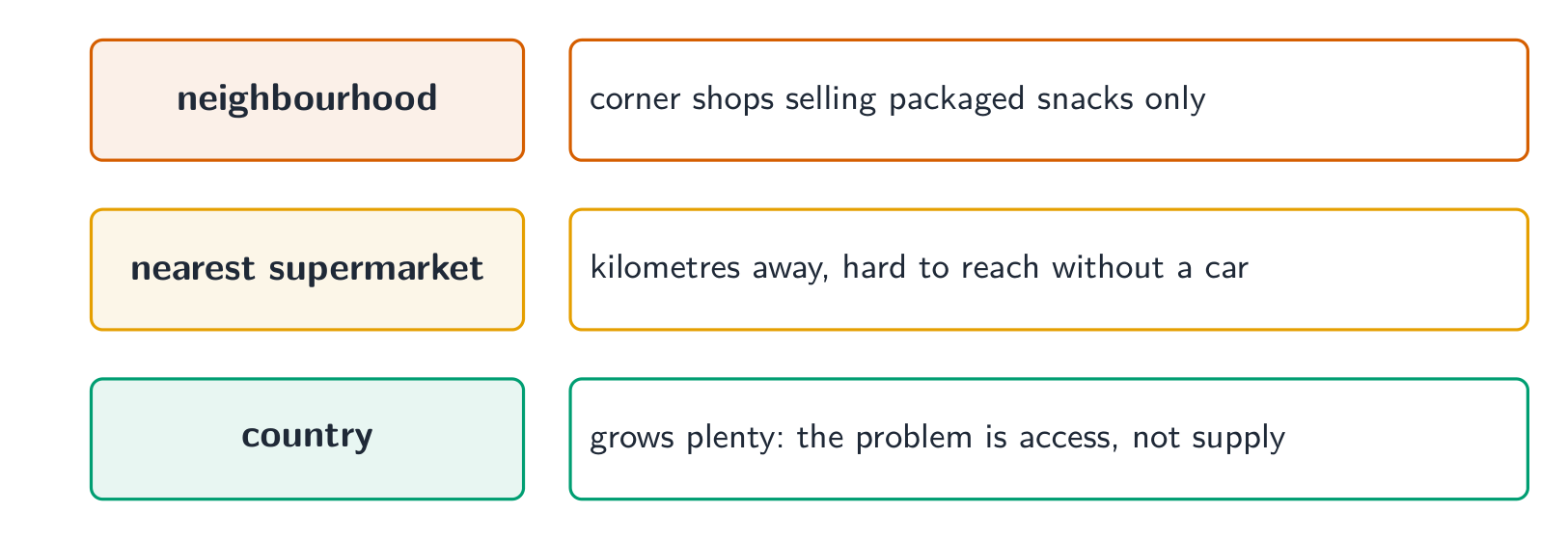
Which agricultural challenge?
Match each example to the challenge it shows.
A food desert can exist in a rich country with plenty of food.
Difficulty 1/5 · 100 coins + a small bonus on first completion today
It is about local access to fresh, affordable food.
The debates
| Issue | For | Against |
|---|---|---|
| GMOs 转基因生物 (genetically modified crops) | higher yields, pest resistance, less pesticide (Bt cotton in India); vitamin-rich "Golden Rice" | farmers depend on large seed firms; fears about health and gene flow to wild plants |
| Organic farming 有机农业 | no synthetic chemicals; healthier soil and water | lower yields need more land; higher prices |
| Local food ("food miles") | fresher food; supports local farmers; less transport | not always lower in emissions (greenhouses use energy); less choice |
| Fair trade | fairer, more stable prices for producers | small share of world trade; higher prices for consumers |
Match each argument to the issue.
Difficulty 2/5 · 140 coins + a small bonus on first completion today
Each debate has benefits and costs.
New patterns of production and eating
- Value-added specialty crops: farmers earn more by producing organic, fair-trade or local-label products, or by processing (making cheese, not selling milk).
- Dietary shifts: as incomes rise (China, India), people eat more meat and dairy, which needs much more land and grain per calorie. Urban farming and community-supported agriculture bring food production into cities.
As incomes rise in China and India, how does diet usually change?
Difficulty 1/5 · 100 coins + a small bonus on first completion today
Meat needs several kilograms of grain per kilogram produced.
Worked FRQ answer
(A) Define a food desert. An area, often a low-income urban neighbourhood, where residents have little access to fresh, affordable, healthy food.
(B) Explain ONE reason food insecurity exists even though the world produces enough food. Poor households cannot afford to buy food, and conflict or bad roads prevent food from reaching some regions, so hunger is caused by lack of access rather than by low production.
(C) Explain ONE argument for and ONE against genetically modified crops. For: insect-resistant crops such as Bt cotton raise yields and reduce pesticide spraying. Against: farmers must buy patented seed each year from a few large companies, which increases costs and their dependence on those firms.
- Why it scores: (B) separates supply from access; (C) gives each side a mechanism and an example.
Do not say hunger is caused simply by "not enough food". Explain access: income, prices, conflict and transport.
Food security is reliable access to enough nutritious food; hunger is mostly about access, not supply. Food deserts lack fresh, affordable food. Debates: GMOs, organic farming, local food and fair trade each have benefits and costs. New patterns include value-added specialty crops, rising meat demand and urban farming.
FRQ practice. (A) Identify ONE strategy a city could use to reduce food deserts. (B) Explain how it would improve access. (C) Explain ONE limitation of the strategy.
Access means distance, price and transport.
What went wrong? Only the site team sees this.