Production and use of X-rays
Introduced| English | Meaning |
|---|---|
| tungsten/ˈtʌŋstn/ | A metal element with the symbol W and a very high melting point. |
| target/ˈtɑːɡɪt/ | The material or object struck by an incident beam of particles or radiation. |
| anode/ˈænəʊd/ | An electrode at which oxidation occurs. |
| cathode/ˈkæθəʊd/ | An electrode at which reduction occurs. |
| thermionic emission/ˌθɜːmɪˈɒnɪk ɪˈmɪʃn/ | The release of electrons from a heated material. |
| kinetic energy/kɪˈnetɪk ˈenədʒi/ | The energy an object has because of its motion. |
| photons/ˈfəʊtɒnz/ | Quanta of electromagnetic radiation, each carrying energy proportional to its frequency. |
| Bremsstrahlung/ˈbremʃtrɑːlʊŋ/ | Radiation emitted when a charged particle is accelerated or decelerated, such as when an electron is deflected near a nucleus. |
| hardness/ˈhɑːdnəs/ | A material's resistance to scratching, indentation or other local permanent deformation. |
| characteristic/ˌkærɪktəˈrɪstɪk/ | Features or qualities that describe or distinguish an organism, object or group. |
| sharpness/ˈʃɑːpnəs/ | sharpness |
| contrast/ˈkɒntræst/ | The difference in degree of blackening between neighbouring regions, produced by a difference in attenuation. |
| attenuation/əˌtenjuːˈeɪʃn/ | A reduction in a wave or beam's intensity as it travels through a medium. |
| contrast medium/ˈkɒntræst ˈmiːdɪəm/ | A substance used in medical imaging to make particular tissues, organs or spaces easier to distinguish. |
| half-value thickness/hɑːf ˈvæljuː ˈθɪknəs/ | The thickness of an absorber that reduces a beam's intensity to half its incident value under the stated conditions. |
| computed tomography/kəmˈpjuːtɪd təˈmɒɡrəfi/ | An imaging method that uses X-ray measurements from multiple angles and computer processing to reconstruct cross-sectional images. |
A machine that wastes ninety-nine per cent of its power
- An X-ray tube run at $75\ \text{kV}$ and $30\ \text{mA}$ takes in $2250\ \text{W}$. About $99\%$ of that becomes heat in a lump of tungsten the size of a coin.
- Left alone, the target's temperature would climb at over $1000\ \text{K}$ per second and melt in a few seconds.
- That is why exposures are brief and the anode spins. The remaining one per cent is the picture.
- This lesson is how X-rays are produced, what sets their penetrating power, and how they make an image.
Production
- The four-mark answer runs in four moves, and each is a mark.
- One. Electrons are emitted from a heated filament (the cathode 阴极) by thermionic emission 热电子发射.
- Two. They are accelerated through a high p.d., tens of kV, across an evacuated tube towards a metal target 靶, the anode 阳极, usually tungsten 钨.
- Three. They decelerate rapidly when they strike the target.
- Four. The kinetic energy 动能 lost is emitted as X-ray photons 光子, this is Bremsstrahlung 轫致辐射 or braking radiation, with most of it becoming heat.

Heat one end, brake at the other
X-rays are produced when fast electrons:
Difficulty 1/5 · 100 coins + a small bonus on first completion today
The sudden deceleration on the target gives out X-ray photons (Bremsstrahlung).
Most of the electrons' kinetic energy in an X-ray tube becomes heat, not X-rays.
Difficulty 1/5 · 100 coins + a small bonus on first completion today
Only a small fraction becomes X-rays — which is why the target must be cooled.
Two controls, two different jobs
- Intensity, the energy per unit area per second, is set by the number of electrons hitting the target per second, so it is controlled by the filament current. A hotter filament emits more electrons.
- Hardness 硬度, the penetrating power, is set by the photon energies, so it is controlled by the accelerating p.d. A larger p.d. gives higher-energy, shorter-wavelength, more penetrating X-rays.
- Keep them apart. A question asking how to make the beam more penetrating is not answered by turning up the current.
- A metal filter removes the softest X-rays, which would be absorbed in the patient's skin without ever reaching the detector.
Match each control to what it changes.
Difficulty 2/5 · 140 coins + a small bonus on first completion today
A question asking how to make the beam more penetrating is not answered by turning up the current.
The minimum wavelength
- The most energy one photon can carry is the whole kinetic energy of one electron, lost in a single event:
- This is the short-wavelength cut-off, and it depends only on the accelerating p.d., never on the target metal or the current.
- Doubling the p.d. halves the minimum wavelength.
The minimum X-ray wavelength from a tube at accelerating voltage $V$ is:
Difficulty 1/5 · 100 coins + a small bonus on first completion today
From $hf_{\max} = eV$ and $c = f\lambda$: $\lambda_{\min} = \dfrac{hc}{eV}$.
A higher accelerating voltage gives a ____ minimum wavelength.
Difficulty 1/5 · 100 coins + a small bonus on first completion today
$\lambda_{\min} = \dfrac{hc}{eV}$, so a larger $V$ gives a smaller $\lambda_{\min}$ (more energetic X-rays).
Worked example: the cut-off at 75 kV
- Electrons are accelerated through $75\ \text{kV}$. Find the maximum photon energy and the minimum wavelength.
- Maximum energy $= eV = 75\ \text{keV} = 75000 \times 1.60\times10^{-19} = 1.2\times10^{-14}\ \text{J}$.
- $\lambda_{\text{min}} = \dfrac{hc}{eV} = \dfrac{(6.63\times10^{-34})(3.00\times10^{8})}{1.2\times10^{-14}} = 1.7\times10^{-11}\ \text{m}$.
- The maximum photon momentum is $p = E/c = 4.0\times10^{-23}\ \text{N s}$.
- Note that $eV$ in joules needs the p.d. in volts, not kilovolts. That factor of a thousand is the usual casualty.
Electrons are accelerated through 75 kV. What is the minimum X-ray wavelength, in units of 1e-11 m?
Difficulty 2/5 · 140 coins + a small bonus on first completion today
lambda_min = hc/(eV) = 1.7e-11 m. Use volts, not kilovolts. Doubling the p.d. halves the minimum wavelength, and the target metal makes no difference to it.
Reading the spectrum
- The spectrum is continuous because each electron may lose any fraction of its energy, in one deceleration or several, so photons of every energy up to the maximum appear.
- It has a sharp cut-off at $\lambda_{\text{min}}$ because no photon can carry more than one electron's energy, $eV$.
- The sharp peaks are characteristic 特征 of the target metal: an incoming electron knocks out an inner electron, an outer one falls into the vacancy, and the photon carries the difference between those two levels.
- So the curve's shape has three separate causes, and a question about it wants all three named.
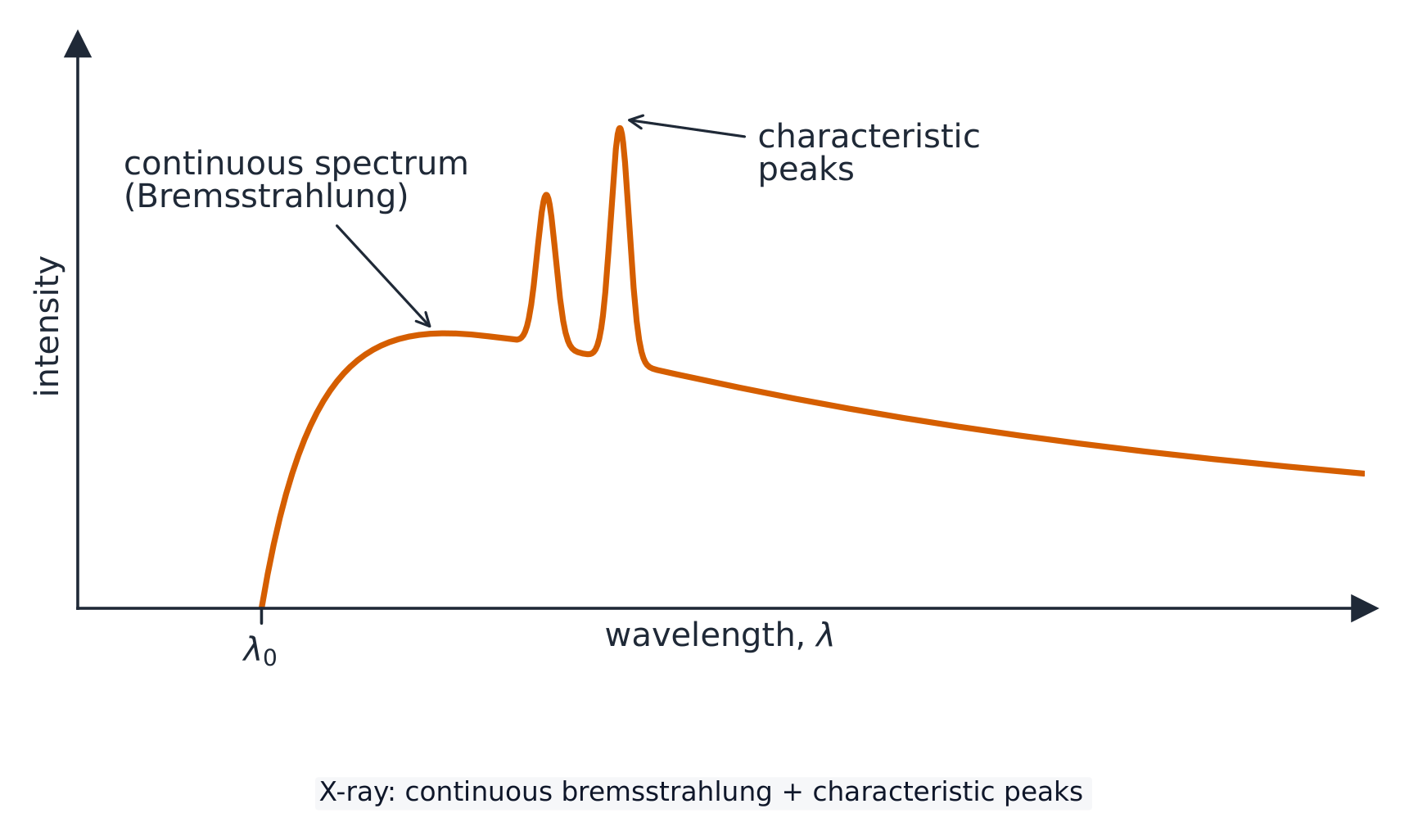
A cliff, a hump, and two spikes
X-ray production route
Follow electrons from cathode to X-ray photons.
Why does an X-ray spectrum have the shape it does? Select all that apply.
Difficulty 2/5 · 140 coins + a small bonus on first completion today
The peaks belong to the target's energy levels, so only changing the target moves them. The p.d. moves the cut-off.
Sharpness and contrast are different things
- Sharpness 清晰度 is how well defined the edges are. It improves with a small source spot, a still patient, and the detector close to the patient.
- Contrast 对比度 is the difference in degree of blackening between neighbouring regions, produced by a difference in attenuation 衰减.
- The two are independent: an image can be sharp with poor contrast, or blurred with strong contrast.
- Where two soft tissues attenuate similarly, a contrast medium 造影剂 such as barium is swallowed or injected to outline one of them.
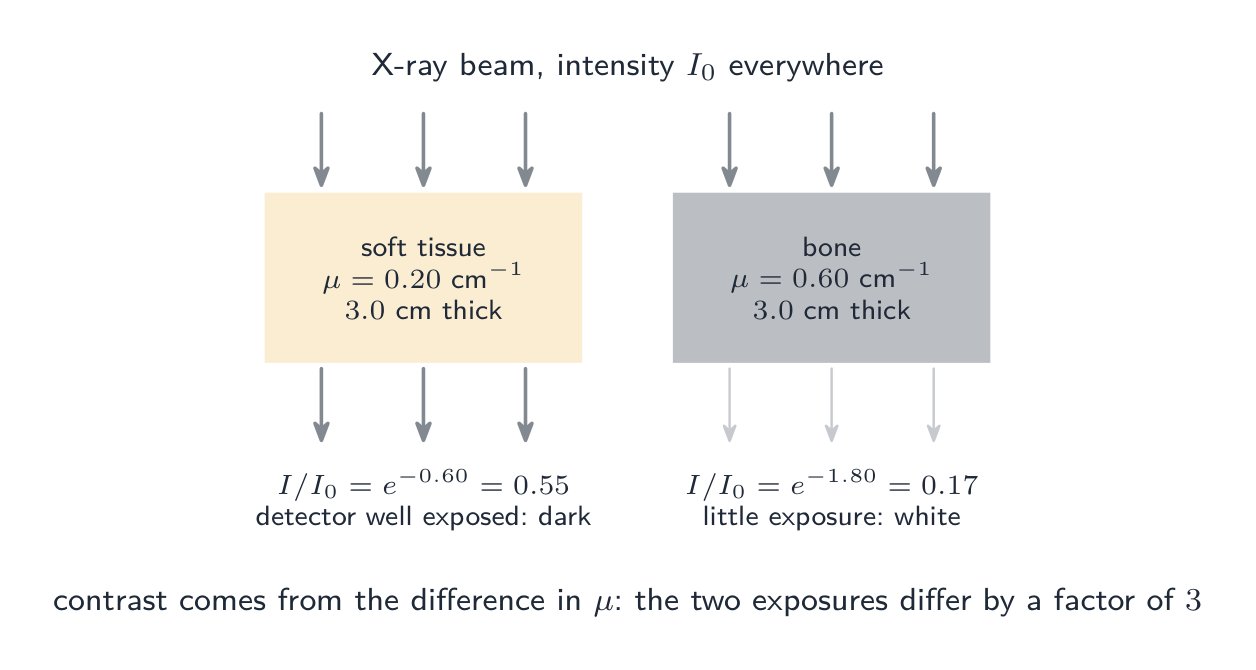
Same beam, very different shadows
An X-ray image with excellent sharpness must also have good contrast.
Difficulty 1/5 · 100 coins + a small bonus on first completion today
They are independent. Sharpness is edge definition, set by the source size and geometry; contrast is a difference in attenuation between tissues.
Worked example: why bone shows white
- X-rays cross $3.0\ \text{cm}$ of soft tissue ($\mu = 0.20\ \text{cm}^{-1}$) in one region and $3.0\ \text{cm}$ of bone ($\mu = 0.60\ \text{cm}^{-1}$) in another. Compare the transmitted intensities.
- Soft tissue: $I/I_0 = e^{-0.20\times3.0} = e^{-0.60} = 0.55$.
- Bone: $I/I_0 = e^{-0.60\times3.0} = e^{-1.80} = 0.17$.
- The tissue region receives more than three times the exposure, so bone appears white and tissue dark.
- The exposure ratio is $e^{(\mu_{\text{bone}} - \mu_{\text{tissue}})x}$, which grows with thickness: contrast improves for thicker structures, though the total attenuation grows too.
The attenuation law
- Higher-energy X-rays penetrate further, meaning a smaller $\mu$; bone has a much larger $\mu$ than soft tissue.
- For a thickness, take logs: $x = \dfrac{1}{\mu}\ln\dfrac{I_0}{I}$. The half-value thickness 半值厚度 is $x_{1/2} = \ln 2/\mu$, exactly like a half-life.
- Through two layers the exponentials multiply, so add the exponents: $I = I_0 e^{-(\mu_1 x_1 + \mu_2 x_2)}$. Never add the thicknesses or the coefficients, and note the order of the layers makes no difference.
- Read the question: "what fraction is absorbed" is $1 - e^{-\mu x}$, not $e^{-\mu x}$.
Bone looks white on an X-ray image because it:
Difficulty 1/5 · 100 coins + a small bonus on first completion today
Dense, high-$Z$ bone absorbs more ($I = I_0 e^{-\mu x}$ with large $\mu$), casting a stronger shadow.
A beam crosses 2.0 cm of P (mu = 0.35 /cm) then 1.5 cm of Q (mu = 0.90 /cm). What fraction of the intensity is transmitted?
Difficulty 2/5 · 140 coins + a small bonus on first completion today
The exponentials multiply, so add the exponents: e^-(0.70 + 1.35) = e^-2.05 = 0.13. Never add the thicknesses or the coefficients, and the order of the layers makes no difference.
Computed tomography
- A computed tomography 计算机断层扫描 (CT) scan builds a three-dimensional image, and the syllabus wants the construction described in order.
- One. Many X-ray images of the same section are taken from different angles around the patient.
- Two. A computer combines them into one two-dimensional image of that section.
- Three. The process is repeated for many sections along an axis.
- Four. The two-dimensional sections are combined into a three-dimensional image, which can be rotated or sliced on screen. The dose is far higher than a single radiograph, which is the trade-off.
A CT scan takes X-ray images from many angles to build a 3-D image.
Difficulty 1/5 · 100 coins + a small bonus on first completion today
Rotating the tube and detectors and reconstructing the slices separates overlapping tissues into a 3-D picture.
Put the construction of a CT image in order.
Difficulty 3/5 · 200 coins + a small bonus on first completion today
Angles first, then sections. The dose is far higher than a single radiograph, which is the trade-off for the 3-D view.
Marks that slip away
- Filament current sets intensity, accelerating p.d. sets penetrating power. Do not swap them.
- $\lambda_{\text{min}}$ depends only on the p.d., not on the target or the current.
- Sharpness and contrast are independent. A question about blurred edges is not answered by talking about attenuation.
- Two layers: add the exponents $\mu_1 x_1 + \mu_2 x_2$.
- Match the units of $\mu$ and $x$, and check whether the question wants what gets through or what is absorbed.
You've got it
- X-rays are produced when electrons from a heated cathode, accelerated through a high p.d., decelerate rapidly in a metal target, mostly as heat
- $\lambda_{\text{min}} = hc/(eV)$ is the cut-off set by the accelerating p.d. alone, with characteristic peaks from the target metal on a continuous curve
- sharpness is edge definition, contrast is the difference in attenuation, and they are independent
- $I = I_0 e^{-\mu x}$, with half-value thickness $\ln 2/\mu$ and exponents that add through successive layers; CT combines many angles into a section and many sections into a 3-D image