Non-parametric tests
Introduced| English | Meaning |
|---|---|
| non-parametric/nɒn ˌpærəˈmetrɪk/ | non-parametric |
| rank/ræŋk/ | rank |
| sign test/saɪn test/ | A test using counts above and below a proposed median, or positive and negative paired differences; zero differences are omitted from the usual binomial sign test. |
| median/ˈmiːdiːən/ | The middle value when data are arranged in order, or the mean of the two middle values for an even number of observations. |
| binomial/baɪˈnəʊmɪəl/ | A probability model for the number of successes in a fixed number of independent trials with the same success probability. |
| outlier/ˈaʊtlaɪə/ | An observation unusually far from the rest of the data or from the pattern expected under a model. |
| Wilcoxon signed-rank test/ˈwɪlkɒksn saɪnd ræŋk test/ | A nonparametric test using signs and ranks of absolute deviations or paired differences to assess a specified centre under a symmetry assumption. |
| rank-sum test/ræŋk sʌm test/ | rank-sum test |
When the data isn't normal
- Most tests assume the data follows a normal distribution. But reaction times, rankings, and skewed data often don't.
- Non-parametric 非参数 tests make no assumption about the underlying distribution — they work from order and rank 秩 instead of exact values.
Non-parametric test chooser
Choose the rank-based test that matches the data situation.
The key advantage of a non-parametric test is that it makes no assumption that the data is:
Difficulty 1/5 · 100 coins + a small bonus on first completion today
Non-parametric tests work without assuming an underlying normal distribution.
The sign test 符号检验
- To test a proposed median 中位数, count how many values fall above versus below it.
- Under the null hypothesis the counts follow a binomial 二项 model with $p = \tfrac12$ — so a lopsided split is evidence against the median.
Why it's robust. The sign test uses only direction (above/below), so a single wild outlier 离群值 can't distort it — unlike the mean.
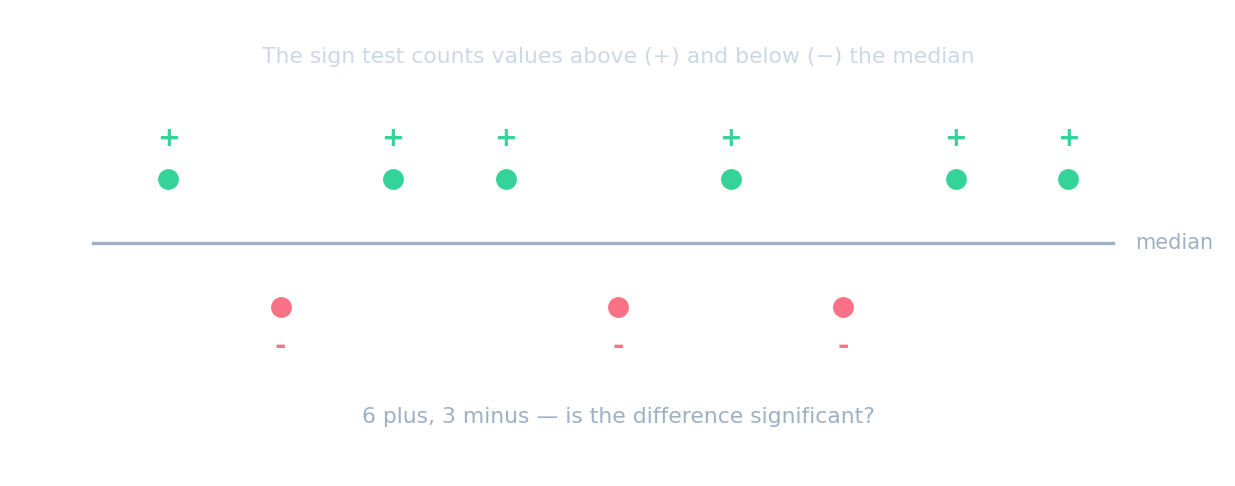
The sign test counts how many values lie above (+) or below (−) the median
Under the null hypothesis, the sign test uses which distribution for the counts above/below the median?
Difficulty 1/5 · 100 coins + a small bonus on first completion today
Each value is equally likely above or below the median, so the count is binomial with p = ½.
Because it uses only direction, the sign test is barely affected by an ______ (an extreme value).
Difficulty 1/5 · 100 coins + a small bonus on first completion today
Using only above/below makes the sign test robust to outliers.
The Wilcoxon signed-rank test 威尔科克森符号秩检验
- The sign test throws away how far each value is from the median. The Wilcoxon signed-rank test keeps that information.
- Rank the differences by size, attach their signs, and sum the positive (or negative) ranks as the test statistic.
The Wilcoxon signed-rank test uses the sizes of the differences, not just their signs.
Difficulty 1/5 · 100 coins + a small bonus on first completion today
It ranks the magnitudes of the differences, keeping information the sign test discards.
The Wilcoxon rank-sum test 秩和检验
- To compare two independent samples, pool and rank all the values together, then sum the ranks of one sample.
- If the two groups really differ, one will collect noticeably higher ranks.
Match the test to the design. Sign and signed-rank tests are for one sample (or paired data); the rank-sum test is for two independent samples. Using the wrong one invalidates the result.
- Non-parametric tests include the Wilcoxon matched-pairs signed-rank test for paired data.
Match each test to its design.
Difficulty 2/5 · 140 coins + a small bonus on first completion today
Sign and signed-rank are one-sample (or paired); rank-sum compares two independent samples.
You've got it
- non-parametric tests need no normality assumption — they use order and rank
- sign test: counts above/below a median (binomial, very robust)
- Wilcoxon signed-rank (one sample, uses the sizes of differences) and rank-sum (two independent samples)