Velocity and acceleration: polygons and Coriolis
Diperkenalkan| English | Makna |
|---|---|
| velocity polygon | A vector diagram that finds the velocities of points in a mechanism at one position. |
| instant centre | the point of a body's plane motion that has zero velocity at this instant |
| acceleration polygon | A vector diagram that finds the accelerations of points in a mechanism at one position. |
| Coriolis component | The extra acceleration, 2ωv, of a point sliding along a rotating link. |
The force starts with the acceleration
- The piston's acceleration sets the inertia force that loads the rod, the bearings and the frame. Velocity comes first, because the acceleration terms use it.
- For two points on one rigid link, $\mathbf v_C = \mathbf v_B + \boldsymbol\omega \times \mathbf r_{CB}$: the relative velocity is perpendicular to the link.
The velocity of C relative to B on one rigid link is:
Kesulitan 1/5 · 100 koin + bonus kecil pada penyelesaian pertama hari ini
A rigid link cannot stretch.
Velocities at 60°
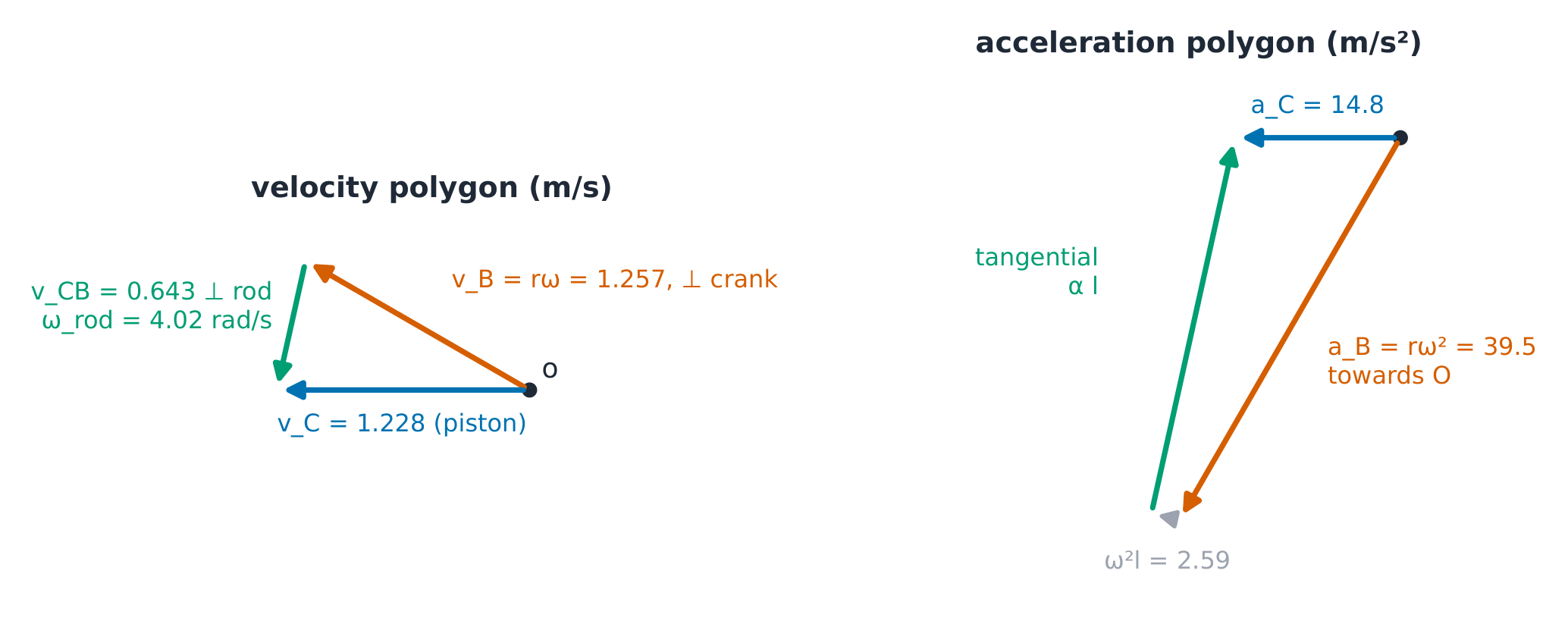
- At 300 rpm, $\omega = \mathbf{31.42}$ rad/s, so the crank pin moves at $v_B = r\omega = \mathbf{1.257}$ m/s.
- The velocity polygon closes with $v_C$ horizontal and $v_{CB}$ across the rod: $v_C = \mathbf{1.228}$ m/s, and the rod turns at $\omega_3 = 0.643/0.16 = \mathbf{4.02}$ rad/s.
- Check with the rod's instant centre: $1.257/0.312 = 1.228/0.305 = 4.02$ rad/s.
Crank speed at 300 rpm (two decimals, rad/s)?
Kesulitan 2/5 · 140 koin + bonus kecil pada penyelesaian pertama hari ini
300 x 2 pi / 60.
Crank-pin speed with r = 40 mm (three decimals, m/s)?
Kesulitan 2/5 · 140 koin + bonus kecil pada penyelesaian pertama hari ini
r omega.
Rod angular velocity with v_CB = 0.643 m/s and l = 160 mm (two decimals, rad/s)?
Kesulitan 2/5 · 140 koin + bonus kecil pada penyelesaian pertama hari ini
v_CB over l.
Accelerations
- Each link adds a centripetal part $\omega^2r$ along it and a tangential part $\alpha r$ across it: the acceleration polygon.
- The crank pin has $a_B = r\omega^2 = \mathbf{39.5}$ m/s² towards O; closing the polygon gives the piston $a_C = \mathbf{14.8}$ m/s², matching $r\omega^2(\cos\theta + \cos2\theta/n)$ with $n = 4$.
Which acceleration term?
Name each acceleration component.
Crank-pin acceleration (one decimal, m/s2)?
Kesulitan 2/5 · 140 koin + bonus kecil pada penyelesaian pertama hari ini
r omega squared.
The Coriolis component
- A point sliding along a rotating link gains an extra $2\omega v_{rel}$, perpendicular to the link: the Coriolis component. The rotation turns the sliding velocity, and the radius changes while the link turns.
- A block sliding at 0.6 m/s on an arm turning at 5 rad/s gets $2 \times 5 \times 0.6 = \mathbf{6.0}$ m/s². It appears only on a rotating guide, never a fixed one.
Coriolis term, 0.6 m/s sliding on an arm at 5 rad/s (one decimal, m/s2)?
Kesulitan 2/5 · 140 koin + bonus kecil pada penyelesaian pertama hari ini
2 omega v.
A slider on a fixed straight guide has a Coriolis component.
Kesulitan 1/5 · 100 koin + bonus kecil pada penyelesaian pertama hari ini
Coriolis needs the guide itself to rotate.
The fastest point is not at 90°
- The piston is fastest where the rod is perpendicular to the crank, because the crank pin's velocity then points straight along the rod.
- That happens at $\tan\theta = l/r = 4$, $\theta = \mathbf{76.0°}$, with $v_C = r\omega\sqrt{1 + (r/l)^2} = \mathbf{1.296}$ m/s, a little above $r\omega$.
Slider-crank with $l/r = 4$: crank angle of maximum piston speed (one decimal, degrees)?
Kesulitan 2/5 · 140 koin + bonus kecil pada penyelesaian pertama hari ini
$\tan\theta = l/r = 4$ gives $\theta = 75.96°$.
Same crank, $r\omega = 1.257$ m/s: maximum piston speed (three decimals, m/s)?
Kesulitan 2/5 · 140 koin + bonus kecil pada penyelesaian pertama hari ini
$1.257\sqrt{1 + 1/16} = 1.296$ m/s.
Worked example: the inertia force on the rod
- The 0.8 kg piston at 60° accelerates at 14.8 m/s²: the rod must push $0.8 \times 14.8 = 11.8$ N to drive it.
- At top dead centre $a_C = r\omega^2(1 + 1/n) = 39.5 \times 1.25 = 49.3$ m/s², and the rod carries $\mathbf{39.5}$ N. The peak, not the 60° value, sizes the rod and its bearing.
0.8 kg piston, $r\omega^2 = 39.5$ m/s², $n = 4$: inertia force at top dead centre (one decimal, N)?
Kesulitan 2/5 · 140 koin + bonus kecil pada penyelesaian pertama hari ini
$0.8 \times 39.5 \times 1.25 = 39.5$ N.
Three polygon slips
- Relative velocity along the link. It is across it.
- The centripetal term dropped. Every rotating link has $\omega^2r$.
- Coriolis forgotten, or added on a fixed slide. Only a rotating guide has it.
Recap
- $v_B = 1.257$, $v_C = 1.228$ m/s, $\omega_3 = 4.02$ rad/s at 60°.
- $a_B = 39.5$, $a_C = 14.8$ m/s².
- Coriolis $2\omega v_{rel} = 6.0$ m/s² on the slotted arm.