Convection: h comes from the flow
Diperkenalkan| English | Makna |
|---|---|
| thermal boundary layer | The thin layer next to a surface where the fluid temperature changes from the wall value to the free-stream value. |
| Nusselt number | The dimensionless convection coefficient hL/k, comparing convection with conduction across the fluid. |
| Prandtl number | The ratio of momentum diffusivity to thermal diffusivity of a fluid, ν/α. |
| Rayleigh number | The ratio of buoyancy to viscous and thermal diffusion that decides whether free convection is laminar or turbulent. |
A factor of a thousand
- Earlier units simply quoted $h$. In practice it must come from the flow, and it changes by a factor of a thousand between still air and fast water.
- At the wall the fluid is still, so heat crosses the first thin layer by conduction. The thermal boundary layer sets how thin that layer is: thinner layer, larger $h$.
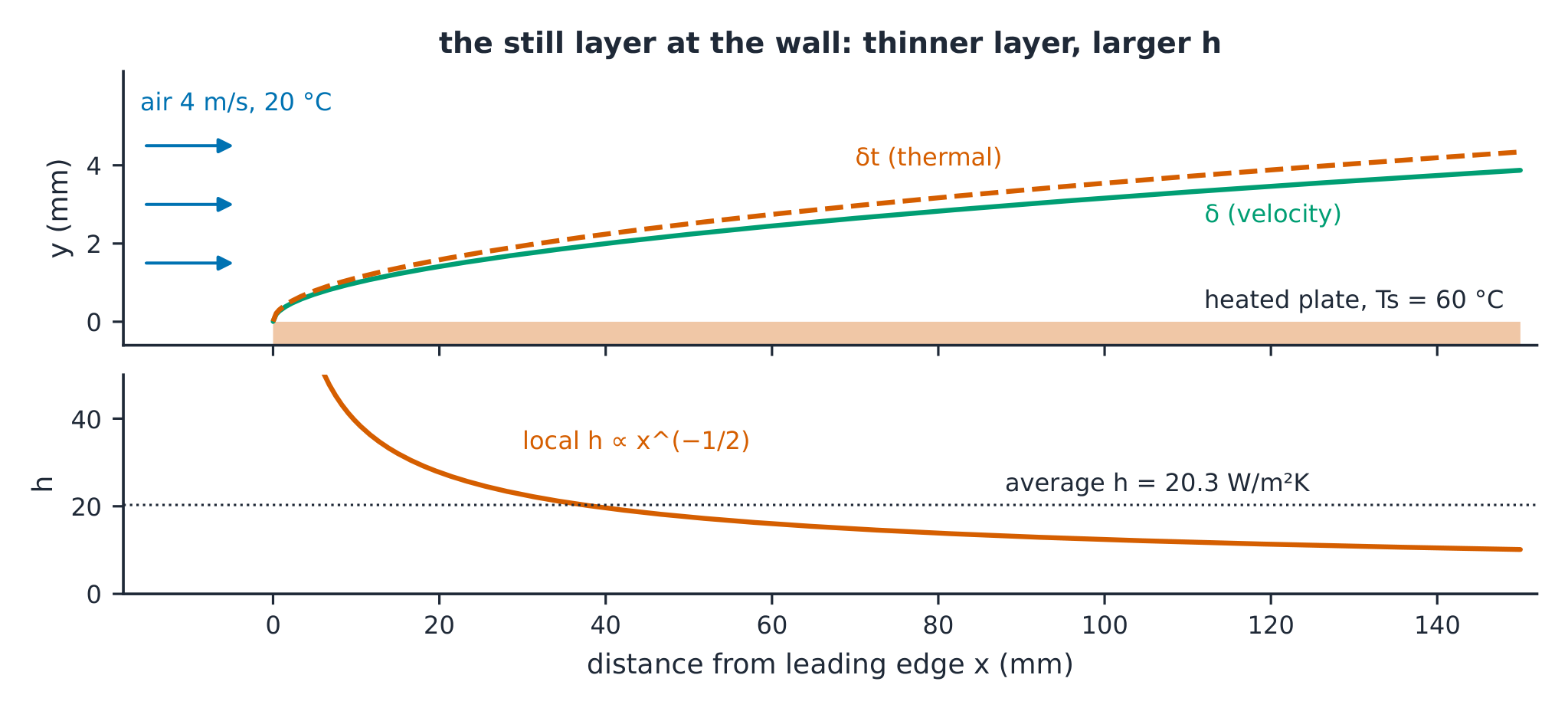
A thinner thermal boundary layer gives:
Kesulitan 1/5 · 100 koin + bonus kecil pada penyelesaian pertama hari ini
Heat crosses the still layer by conduction.
Correlations in Nu, Re and Pr
- Experiments are packed into the Nusselt number $Nu = hL/k_f$, the dimensionless wall gradient, written in terms of the Reynolds number and the Prandtl number $Pr = \nu/\alpha$.
- Every correlation is valid only in its stated range, so check the range first.
Which correlation?
Choose the correlation and regime for each flow.
Air over a plate
- Air at 4 m/s along a 150 mm plate: $Re_L = \mathbf{37\,500}$, laminar.
- $Nu = 0.664Re_L^{1/2}Pr^{1/3} = \mathbf{114.7}$, so $h = 114.7 \times 0.0265/0.15 = \mathbf{20.3}$ W/(m²·K).
- The layers are thin: $\delta = 3.9$ mm and $\delta_t = 4.3$ mm at the trailing edge.
Re for air at 4 m/s along a 150 mm plate, nu = 1.6e-5?
Kesulitan 2/5 · 140 koin + bonus kecil pada penyelesaian pertama hari ini
U L over nu.
h with Nu = 114.7, k = 0.0265, L = 0.15 m (one decimal, W/m2K)?
Kesulitan 2/5 · 140 koin + bonus kecil pada penyelesaian pertama hari ini
Nu k over L.
Water inside the pipe
- 16.8 L/s in the 80 mm pipe at 40 °C: $V = 3.34$ m/s and $Re = \mathbf{4.06 \times 10^5}$, turbulent.
- Dittus–Boelter, $Nu = 0.023Re^{0.8}Pr^{0.4} = \mathbf{1268}$, gives $h \approx \mathbf{10\,000}$ W/(m²·K): five hundred times the air value.
Mean speed of 16.8 L/s in an 80 mm pipe (two decimals, m/s)?
Kesulitan 2/5 · 140 koin + bonus kecil pada penyelesaian pertama hari ini
Q over the area 5.027e-3 m2.
h for Nu = 1268, k = 0.631, D = 0.08 m (W/m2K, nearest hundred)?
Kesulitan 2/5 · 140 koin + bonus kecil pada penyelesaian pertama hari ini
Nu k over D = 10 001.
Dittus-Boelter can be used in laminar pipe flow.
Kesulitan 1/5 · 100 koin + bonus kecil pada penyelesaian pertama hari ini
It needs Re above about 10^4.
When nothing blows: free convection
- Still air still moves: warm air near a hot surface rises. The driver is buoyancy, measured by the Rayleigh number 瑞利数 $Ra = g\beta\Delta T L^3/(\nu\alpha)$.
- A 0.3 m vertical plate at 60 °C in 20 °C air: $Ra = 8.3 \times 10^7$, laminar, $Nu = 0.59Ra^{1/4} = 56$ and $h = \mathbf{5.1}$ W/(m²·K). That is why still-air values sit near 5 to 10.
Vertical plate, $Ra = 8.3 \times 10^7$, $Nu = 0.59Ra^{1/4}$, $k = 0.0271$, $L = 0.3$ m: $h$ (one decimal, W/(m²·K))?
Kesulitan 2/5 · 140 koin + bonus kecil pada penyelesaian pertama hari ini
$Ra^{1/4} = 95.4$; $Nu = 56.3$; $h = 56.3 \times 0.0271/0.3 = 5.1$.
With no fan or pump, convection stops and only conduction and radiation remain.
Kesulitan 1/5 · 100 koin + bonus kecil pada penyelesaian pertama hari ini
Buoyancy drives free convection: a 60 °C plate in still air still has $h$ about 5 W/(m²·K).
Worked example: what doubling the flow costs
- In turbulent pipe flow $h \propto V^{0.8}$: doubling the speed raises $h$ by $2^{0.8} = \mathbf{1.74}$.
- The pressure drop rises about as $V^{1.8}$ (3.5 times) and pump power as $V^{2.8}$, about 7 times. Heat transfer is bought with pumping power, and the exchange rate worsens as you push.
Turbulent pipe flow, $Nu \propto Re^{0.8}$: factor on $h$ when the velocity doubles (two decimals)?
Kesulitan 2/5 · 140 koin + bonus kecil pada penyelesaian pertama hari ini
$2^{0.8} = 1.74$.
Three convection slips
- A correlation outside its range. A laminar plate formula at $Re = 10^6$ is wrong.
- Properties at the wrong temperature. Use the film or bulk mean.
- The wrong length in Re. A plate uses its length; a pipe uses its diameter.
Recap
- $Nu = hL/k_f$ from a correlation in $Re$ and $Pr$.
- Laminar plate: $Nu = 0.664Re^{1/2}Pr^{1/3}$, $h = 20.3$ for the air.
- Turbulent pipe: $Nu = 0.023Re^{0.8}Pr^{0.4}$, $h \approx 10\,000$ for the water.