Bolts and gear teeth: the small features that carry most
Diperkenalkan| English | Makna |
|---|---|
| bolted joint | A connection in which a tightened bolt clamps parts together. |
| preload | The tension put into a bolt when it is tightened, which clamps the joint before any external load. |
| spur gear | A gear with straight teeth parallel to its axis, used between parallel shafts. |
| line of action/laɪn ɒv ˈækʃn/ | The line along which the force between meshing gear teeth acts. |
| pressure angle | The angle between the line of action and the common tangent to the pitch circles, often 20 degrees. |
| module/ˈmɒdjuːl/ | The pitch diameter of a gear divided by its number of teeth, in millimetres. |
| Lewis form factor | A factor that depends on tooth shape and number of teeth, used to find the bending stress in a gear tooth. |
Two small features, big loads
- The housing flange bolts and the gear teeth are the most heavily loaded small features in the drive. Both have simple, reliable checks.
- A bolted joint is tightened to a preload $F_i$, typically $0.75A_tS_p$. The bolt then carries only its stiffness share $CP$ of an external load, with $C = k_b/(k_b + k_m)$.
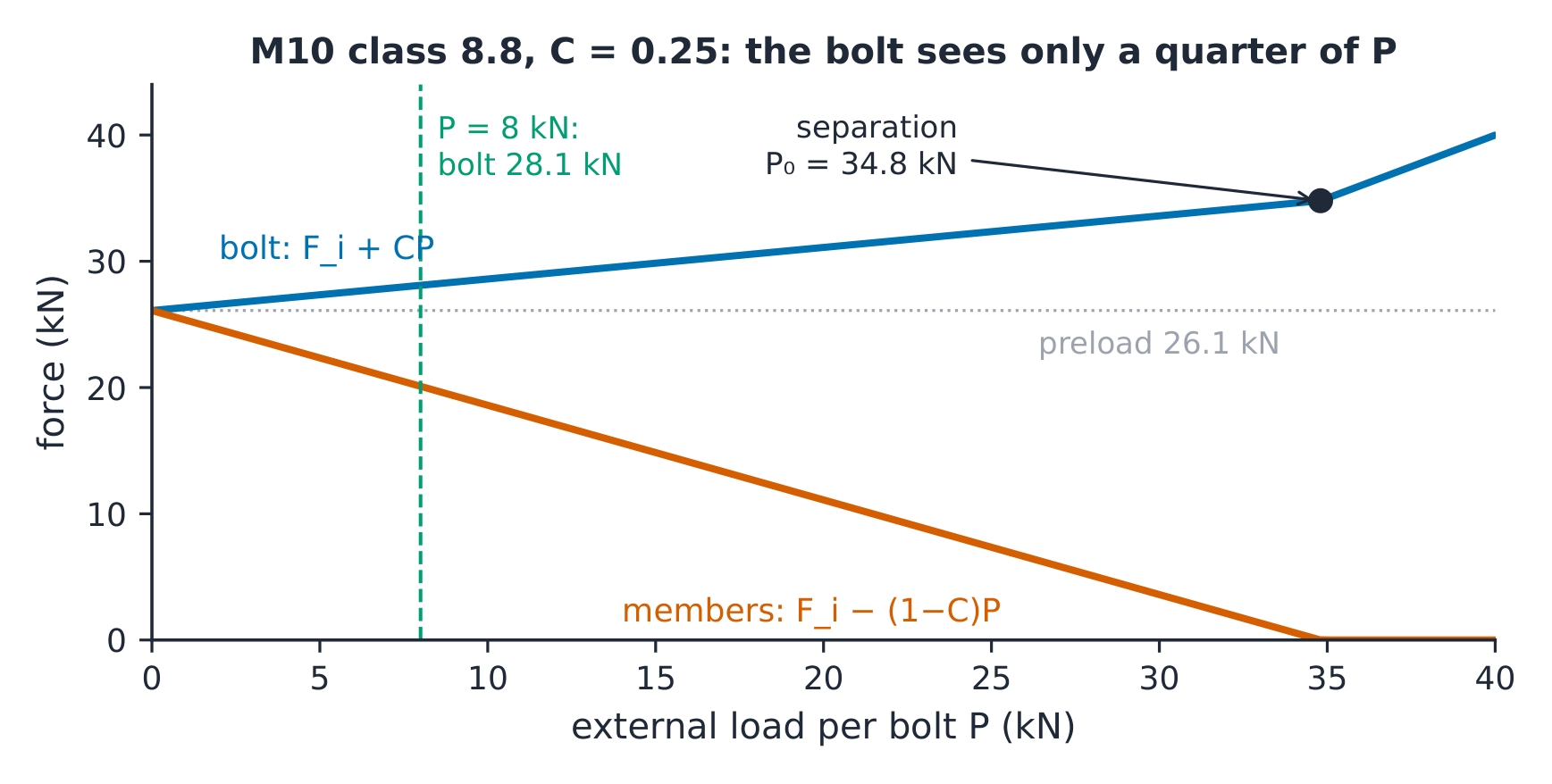
A preloaded bolt carries the whole external load.
Kesulitan 1/5 · 100 koin + bonus kecil pada penyelesaian pertama hari ini
It carries only its stiffness share C P until the joint separates.
The flange bolts
- M10 class 8.8: $A_t = 58.0\ \mathrm{mm^2}$, $S_p = 600$ MPa, so $F_i = \mathbf{26.1}$ kN.
- With $C = 0.25$ and $P = 8$ kN: bolt force $26.1 + 2 = \mathbf{28.1}$ kN, stress 484 MPa, below proof.
- Load factor $n = (S_pA_t - F_i)/CP = \mathbf{4.35}$; the joint separates at $F_i/(1 - C) = \mathbf{34.8}$ kN.
Bolt or gear rule?
Match each quantity to the rule that gives it.
Preload of an M10 8.8 bolt, A_t = 58.0 mm2, S_p = 600 MPa (one decimal, kN)?
Kesulitan 2/5 · 140 koin + bonus kecil pada penyelesaian pertama hari ini
0.75 A_t S_p.
Bolt force with C = 0.25 and P = 8 kN (one decimal, kN)?
Kesulitan 2/5 · 140 koin + bonus kecil pada penyelesaian pertama hari ini
F_i + C P.
Separation load (one decimal, kN)?
Kesulitan 2/5 · 140 koin + bonus kecil pada penyelesaian pertama hari ini
F_i over (1 - C).
Gear geometry
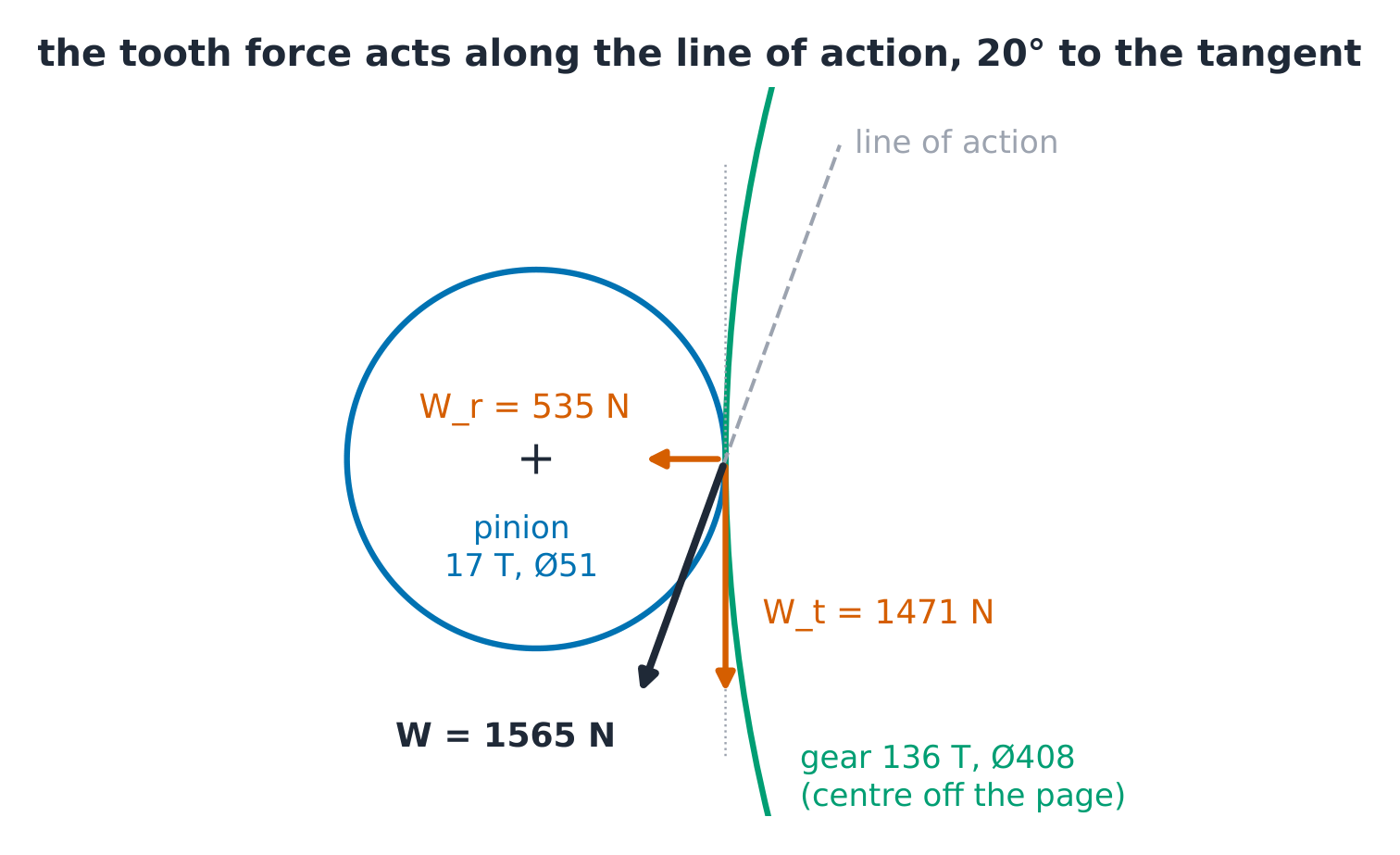
- In a spur gear pair, the force acts along the line of action at the pressure angle $\phi = 20°$. The module $m = d/N$ sets the tooth size.
- Module 3 with 17 teeth gives $d = 51$ mm; mating with 136 teeth gives 408 mm and a ratio of 8:1.
Pitch diameter for module 3 and 17 teeth (mm)?
Kesulitan 2/5 · 140 koin + bonus kecil pada penyelesaian pertama hari ini
m times N.
Bending and contact
- Lewis treats a tooth as a cantilever: $\sigma = K_vW_t/(FmY)$, with Lewis form factor $Y = 0.303$ for 17 teeth. At 3.85 m/s, $K_v = 1.63$, so $\sigma = \mathbf{87.9}$ MPa.
- The surface contact stress comes out at $\mathbf{633}$ MPa: contact, not bending, sets the gear's material and hardness.
Dynamic factor K_v = (6.1 + V)/6.1 at V = 3.85 m/s (two decimals)?
Kesulitan 2/5 · 140 koin + bonus kecil pada penyelesaian pertama hari ini
9.95 over 6.1.
For these hardened gears the governing check is usually:
Kesulitan 1/5 · 100 koin + bonus kecil pada penyelesaian pertama hari ini
633 MPa contact against 87.9 MPa bending.
The wrench sets the preload, roughly
- Preload is applied by torque: $T = KF_id$, with a nut factor $K \approx 0.2$ for dry steel. The M10's 26.1 kN needs $0.2 \times 26\,100 \times 0.010 = \mathbf{52.2}$ N·m.
- Friction varies, so a torque wrench sets preload only to about ±25%. Critical joints use angle-of-turn or direct tension measurement instead.
Tightening torque for $F_i = 26.1$ kN on an M10 with $K = 0.2$ (one decimal, N·m)?
Kesulitan 2/5 · 140 koin + bonus kecil pada penyelesaian pertama hari ini
$0.2 \times 26\,100 \times 0.010 = 52.2$ N·m.
A torque wrench sets bolt preload to within a few per cent.
Kesulitan 1/5 · 100 koin + bonus kecil pada penyelesaian pertama hari ini
Thread and face friction vary, so the same torque gives about ±25% preload.
Worked example: preload 25% low
- At the bottom of the scatter, $F_i = 0.75 \times 26.1 = 19.6$ kN. The joint now separates at $19.6/(1 - 0.25) = \mathbf{26.1}$ kN instead of 34.8.
- Still above the 8 kN load, but the margin has shrunk by a quarter. Once a joint separates, the bolt carries the whole load change on every cycle, and bolts fail in fatigue that way.
Preload 25% low with $C = 0.25$: separation load (one decimal, kN)?
Kesulitan 2/5 · 140 koin + bonus kecil pada penyelesaian pertama hari ini
$F_i = 19.6$ kN; $19.6/0.75 = 26.1$ kN.
Three joint slips
- Adding the whole load to the bolt. It carries only $CP$ until separation.
- Module confused with diametral pitch. Module is millimetres per tooth.
- Bending checked, contact forgotten. Contact usually governs.
Recap
- $F_i = 0.75A_tS_p = 26.1$ kN; bolt $F_i + CP = 28.1$ kN; separation at 34.8 kN.
- $W_t = 2T/d$, $W_r = W_t\tan\phi$; Lewis $\sigma = K_vW_t/(FmY) = 87.9$ MPa.
- Contact stress 633 MPa governs.