Your learning plan · Continue · Review →
Academic Task 1 maps — compare place, change and proposal
DiperkenalkanPosisi tersimpan Anda tetap berada di browser ini. Melanjutkan tidak menyelesaikan pelajaran atau menjawab pertanyaannya.
A familiar place can change without everything changing
- Outcome: write and revise a connected Academic Task 1 map report that preserves dates, proposal status, locations, changed uses and retained features. Start with the writing criteria and selection and overviews. A new cafe does not erase the pond merely by being more exciting to describe.
- Compare matching locations across the plans, then look for the main pattern. Read the compass, labels and dates first. These original fictional maps show schematic zone uses, not measured building footprints. They are not to scale; the common path and southern gate help locate features, not calculate distances.
Worked comparison: report change and retention together
- In Meadow park, a weak overview says “Every feature changed and all green space disappeared.” The plans retain the library, pond and hall in their positions. A better excerpt is “Several zone uses changed, while the library, pond and hall stayed in place.” Then select details: the south-western orchard zone became a cafe, and the south-eastern parking zone became a garden. This is an excerpt, not a complete 150-word report.
- Group details meaningfully: by the northern/southern sides of the path, by the major changes and stable anchors, or another arrangement the evidence supports. Describing all of the first plan and then all of the second can hide the comparison. A fixed paragraph count is not a substitute for selecting relationships.
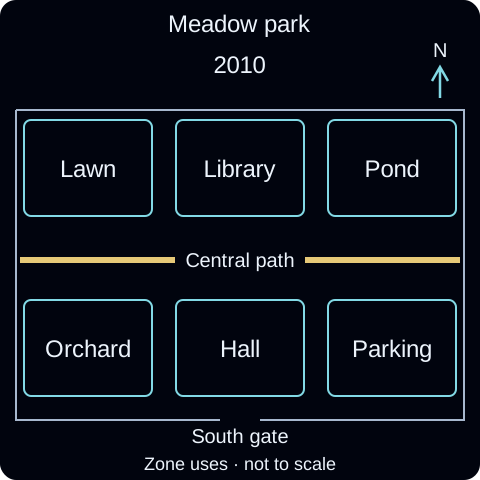
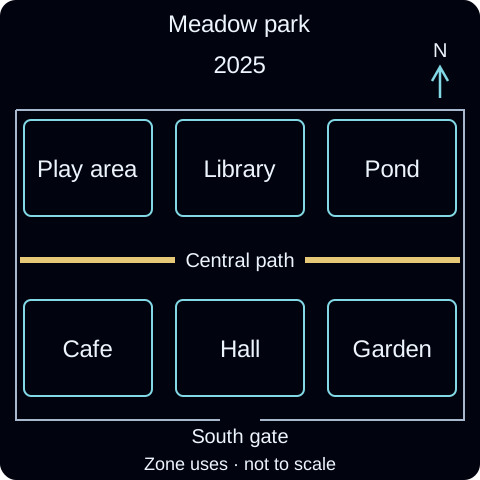
Map note: These are schematic zone uses, with north up and no scale or building-footprint detail. Both plans show the same site boundary, central east–west path and southern gate.
Worked proposal: the later plan is not completed work
- The Harbour centre source contrasts an existing 2025 layout with a proposed 2030 layout. “The library has already replaced the store” wrongly treats the proposal as built. A more accurate excerpt is “Under the proposal, the south-western store zone would be used for a library.” The plan shows and is proposed can also preserve that status.
- A proposed year is not a guarantee that work will finish. Similarly, dated observed plans show states at those dates without necessarily identifying an exact opening or construction day. Preserve the difference between a later observation, a future proposal and a precise change date.
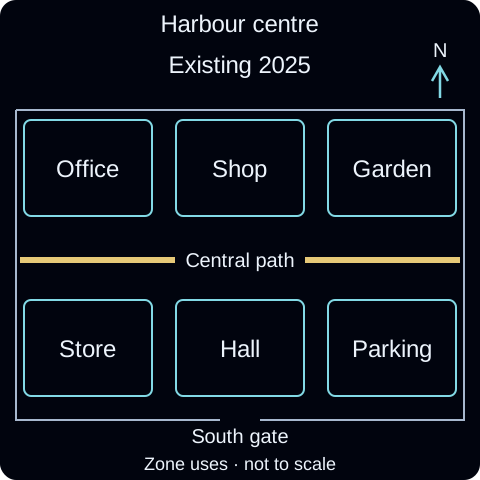
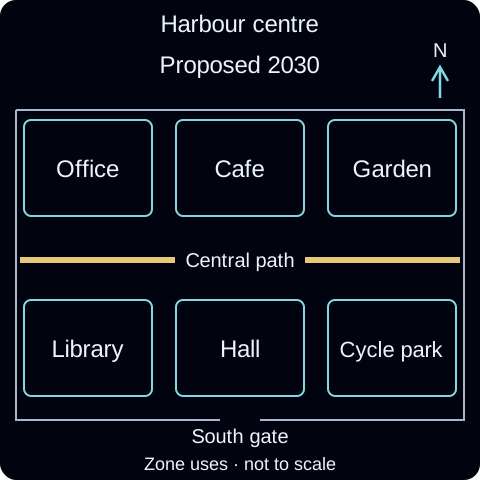
Map note: These are schematic zone uses, with north up and no scale or building-footprint detail. Both plans show the same site boundary, central east–west path and southern gate.
Worked limit: a changed use is not a construction record
- At River site, Shop changes to Cafe in the same north-western zone. A weak excerpt says “The same shop building was converted inside and doubled in size.” The labels support neither claim. A safer description is “The north-western zone, previously used for a shop, is shown as a cafe in 2025.” Building retention, demolition, floor area and added storeys need evidence beyond these use labels.
- Be equally careful with causes and effects. A cafe does not prove visitor demand, increased attendance or a successful traffic policy. These are plausible stories about a place; they are not map observations. Report the source’s features and relationships without adding a better urban-planning biography.
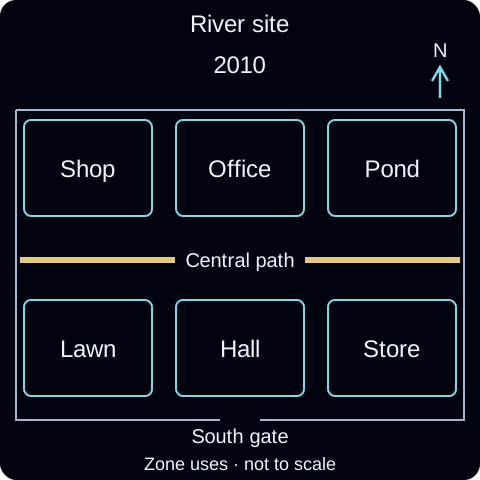
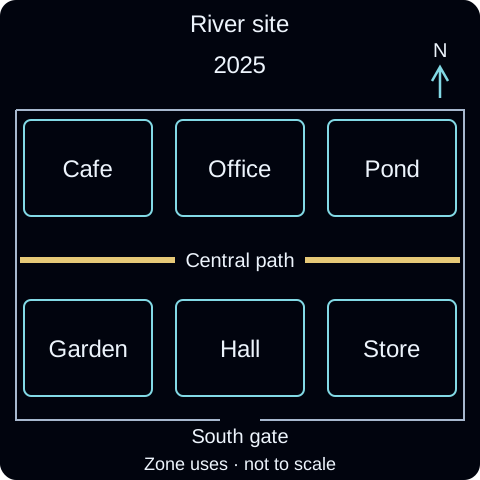
Map note: These are schematic zone uses, with north up and no scale or building-footprint detail. Both plans show the same site boundary, central east–west path and southern gate.
Separate a site zone from a direction relative to another feature
- A cafe in the site’s south-western zone can be directly west of a hall in the south-central zone. South-west names its position within this site; south-west of another feature is a different comparison. Across the path, a north-central library is north of a south-central hall. Follow the shown north arrow rather than assuming directions from memory.
- Read both presence and position. The same cafe label in another zone does not mean an unchanged location. Keep your tense consistent with the source: past comparisons can report dated observed layouts, while would, is proposed or the proposal shows can distinguish planned uses. No single tense or sentence pattern fits every map task.
Guided decisions from ten new map pairs
- Each pair gives two real plans, equivalent text descriptions, full-size links and a planning cue. Compare old and new labels at the same zone, then check the surrounding stable anchors. Read the map note: equal schematic boxes do not supply measured size, and use labels do not identify physical building continuity.
- These are decisions about writing, not ten complete reports or official multiple-choice Writing tasks. After each attempt, identify the particular error in the alternatives: wrong snapshot, reversed direction, missed retention, invented measurements, unsupported building work or a proposal presented as fact.
Original schematic teaching maps:
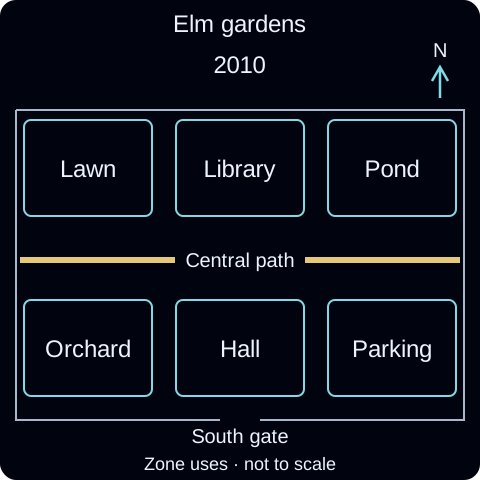
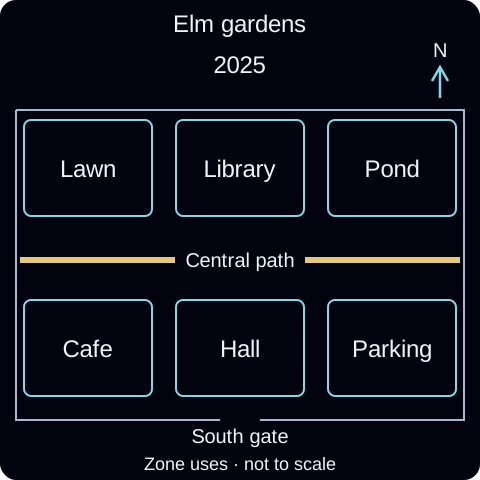
Map note: These are schematic zone uses, with north up and no scale or building-footprint detail. Both plans show the same site boundary, central east–west path and southern gate.
Reporting decision: Which sentence locates the changed use correctly?
Choose ONE answer.
Planning cue: Compare the same zone across the two plans.
Difficulty 1/5 · 100 coins + a small bonus on first completion today
Orchard changes to Cafe in the south-west. Pond and Library retain their northern positions, while Hall and Parking remain in the south. Preserve the old use, new use and location.
Original schematic teaching maps:
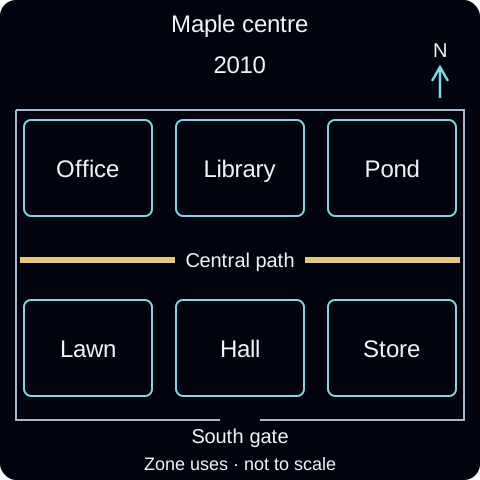
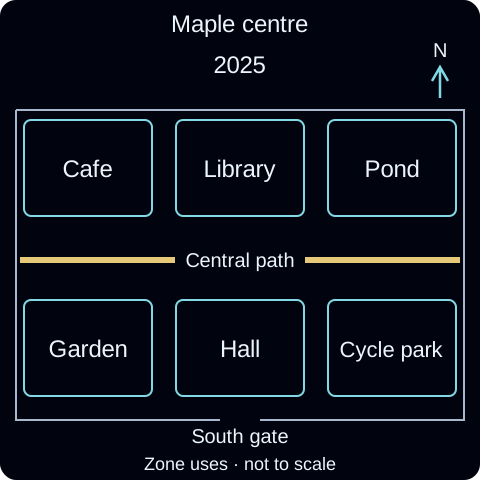
Map note: These are schematic zone uses, with north up and no scale or building-footprint detail. Both plans show the same site boundary, central east–west path and southern gate.
Reporting decision: Which retained feature is shown in the same location?
Choose ONE answer.
Planning cue: A retained label in the same zone is a source-supported stable feature.
Difficulty 1/5 · 100 coins + a small bonus on first completion today
Library stays in the north-central zone. Office becomes Cafe, Store becomes Cycle park and Lawn becomes Garden. Include significant stability alongside change rather than calling every label new.
Original schematic teaching maps:
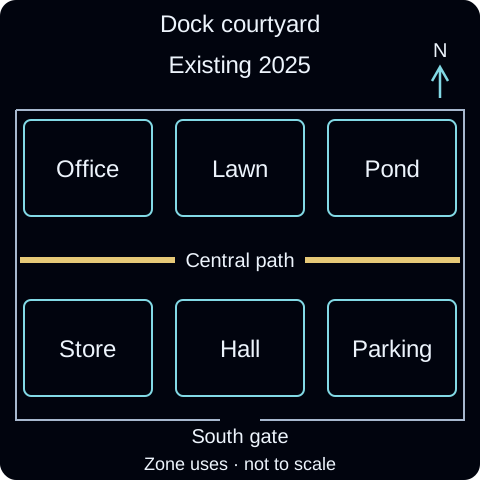
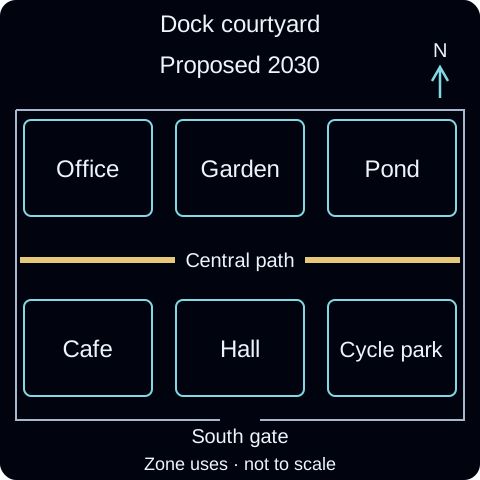
Map note: These are schematic zone uses, with north up and no scale or building-footprint detail. Both plans show the same site boundary, central east–west path and southern gate.
Reporting decision: Which sentence preserves proposal status?
Choose ONE answer.
Planning cue: Read existing/proposed before choosing tense.
Difficulty 1/5 · 100 coins + a small bonus on first completion today
The second plan is proposed for 2030. Would occupy, qualified by the proposal, preserves that status. The 2025 zone is a store, and the drawing does not prove implementation.
Original schematic teaching maps:
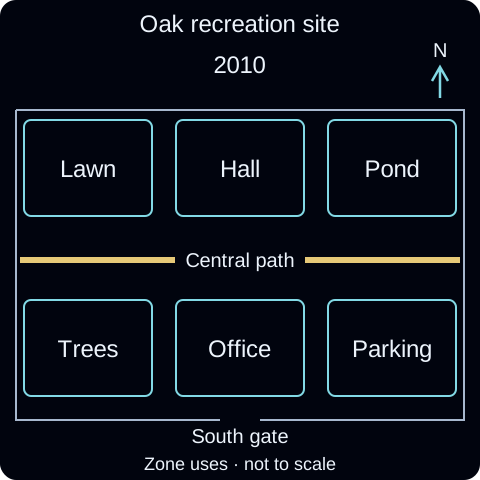
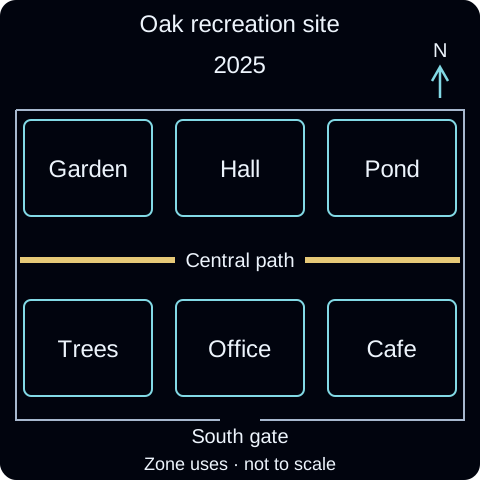
Map note: These are schematic zone uses, with north up and no scale or building-footprint detail. Both plans show the same site boundary, central east–west path and southern gate.
Reporting decision: Which claim goes beyond the map?
Choose ONE answer.
Planning cue: Use the not-to-scale legend rather than estimating dimensions.
Difficulty 1/5 · 100 coins + a small bonus on first completion today
No scale, dimensions or measured footprint is supplied. The cafe’s zone and the two retained northern features are shown. Equal schematic boxes do not supply real area.
Original schematic teaching maps:
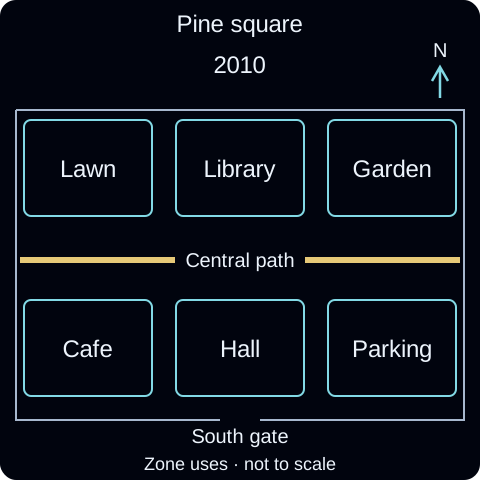
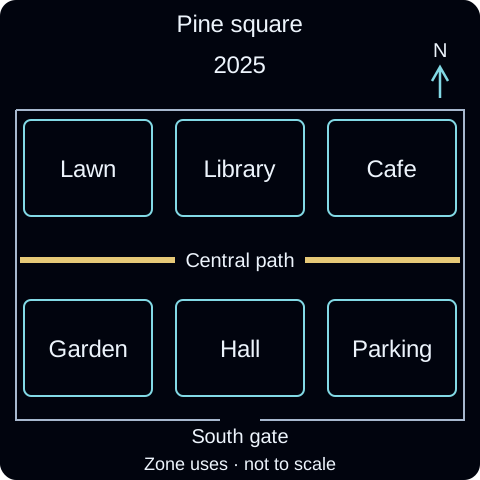
Map note: These are schematic zone uses, with north up and no scale or building-footprint detail. Both plans show the same site boundary, central east–west path and southern gate.
Reporting decision: Which description preserves the cafe’s changed location?
Choose ONE answer.
Planning cue: Compare location as well as the presence of a name.
Difficulty 1/5 · 100 coins + a small bonus on first completion today
Cafe changes from the south-west to the north-east, while Library stays north-central. A repeated facility label does not mean its position stayed unchanged. The plans do not establish the identity of a physical building.
Original schematic teaching maps:
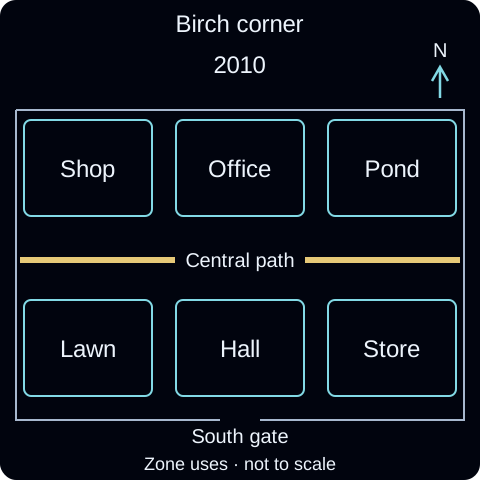
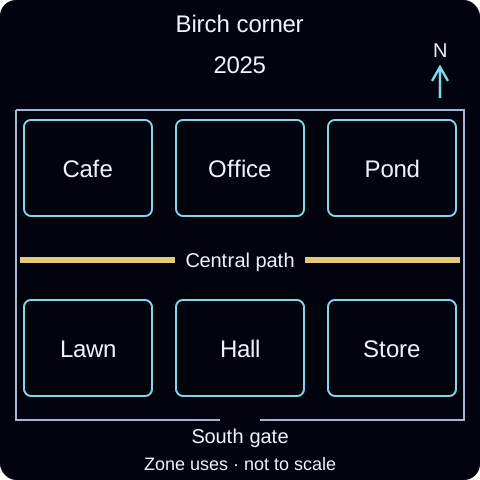
Map note: These are schematic zone uses, with north up and no scale or building-footprint detail. Both plans show the same site boundary, central east–west path and southern gate.
Reporting decision: What is established about the north-western zone?
Choose ONE answer.
Planning cue: A use label is not a record of building work.
Difficulty 1/5 · 100 coins + a small bonus on first completion today
The labels establish changed use at the same zone. They do not supply building identity, demolition or floor area. Report the change without making an unsupported construction claim.
Original schematic teaching maps:
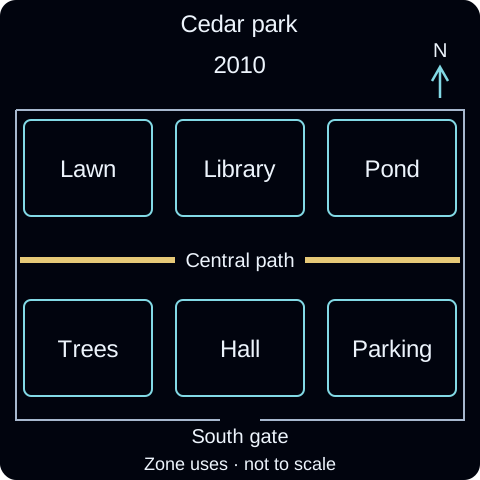
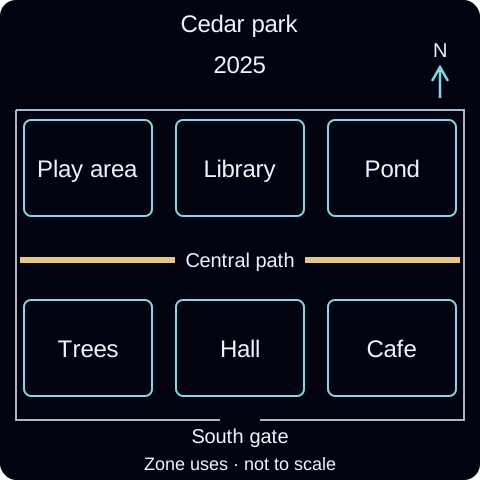
Map note: These are schematic zone uses, with north up and no scale or building-footprint detail. Both plans show the same site boundary, central east–west path and southern gate.
Reporting decision: Which overview preserves both change and stability?
Choose ONE answer.
Planning cue: Check stable zones before making an all-or-nothing claim.
Difficulty 1/5 · 100 coins + a small bonus on first completion today
Lawn becomes Play area and Parking becomes Cafe, while four zone labels stay in place. Pond and Trees remain, so total removal of green features is unsupported. A useful overview can include retention, not just additions.
Original schematic teaching maps:
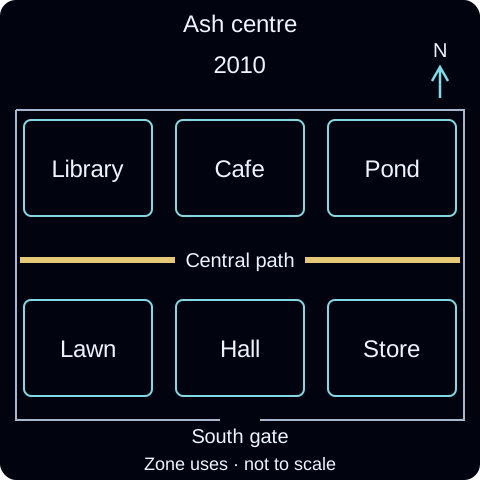
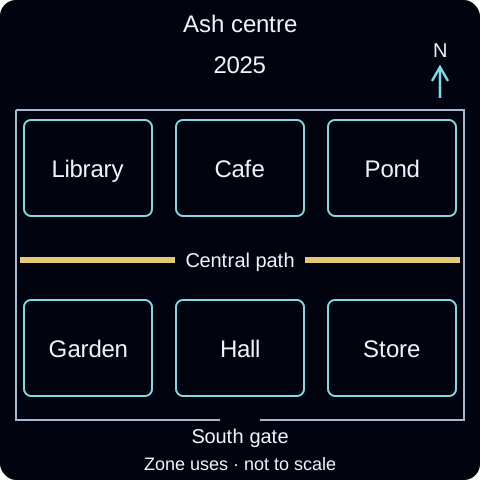
Map note: These are schematic zone uses, with north up and no scale or building-footprint detail. Both plans show the same site boundary, central east–west path and southern gate.
Reporting decision: Which positional statement is accurate?
Choose ONE answer.
Planning cue: Identify the north/south side of the path first.
Difficulty 1/5 · 100 coins + a small bonus on first completion today
Cafe occupies north-central and Hall south-central, separated by the east–west path. Library is west of Pond; Store is south-east. Use the north arrow rather than a remembered room arrangement.
Original schematic teaching maps:
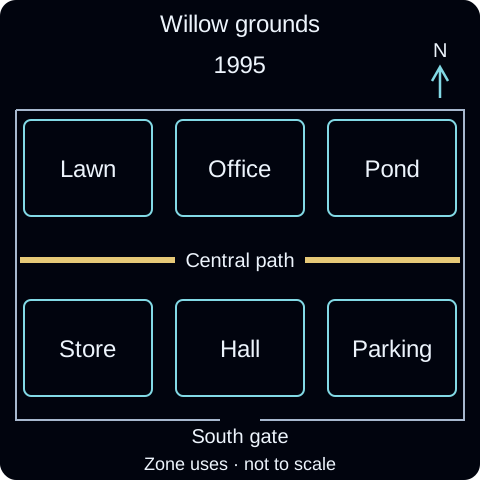
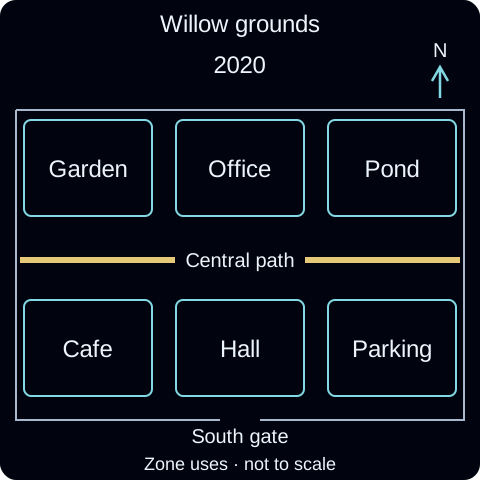
Map note: These are schematic zone uses, with north up and no scale or building-footprint detail. Both plans show the same site boundary, central east–west path and southern gate.
Reporting decision: Which description fits these dated observations?
Choose ONE answer.
Planning cue: Keep an observed later layout separate from an exact construction date.
Difficulty 1/5 · 100 coins + a small bonus on first completion today
Both maps are dated layouts, not proposals. The 2020 plan shows Cafe where Store appeared in 1995, but the precise change date is absent. By 2020 preserves that limit.
Original schematic teaching maps:
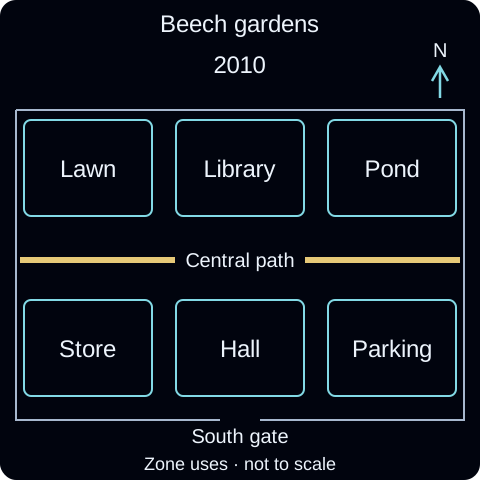
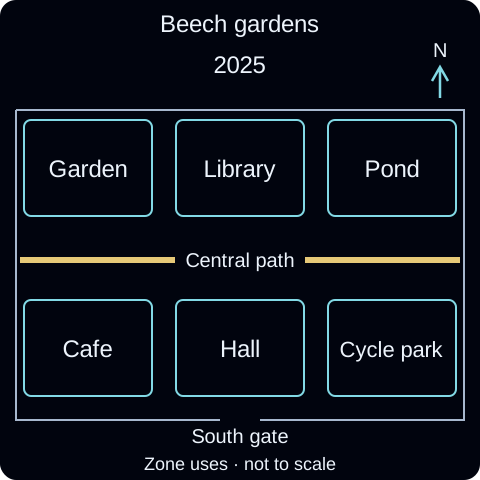
Map note: These are schematic zone uses, with north up and no scale or building-footprint detail. Both plans show the same site boundary, central east–west path and southern gate.
Reporting decision: Which explanation should be removed for lack of evidence?
Choose ONE answer.
Planning cue: A map shows what and where; a reason needs its own evidence.
Difficulty 1/5 · 100 coins + a small bonus on first completion today
Visitor demand is not supplied. The other statements follow mapped labels and positions. A plausible reason is still an added claim unless the source gives it.
Independent decisions from twenty fresh sources
- These twenty distinct pairs remove the planning cue. Read the complete source before choosing the sentence or plan that answers the current question. Some questions require the supported comparison; others ask which addition lacks evidence. Keep the decision attached to the actual wording.
- Each plan can also be read through its equivalent description and full-size link. A correct local decision is not evidence of a complete independent report or an IELTS band. Spread the work across sessions if useful, and record which direction, date, status or evidence limit you need to repair.
Original schematic teaching maps:
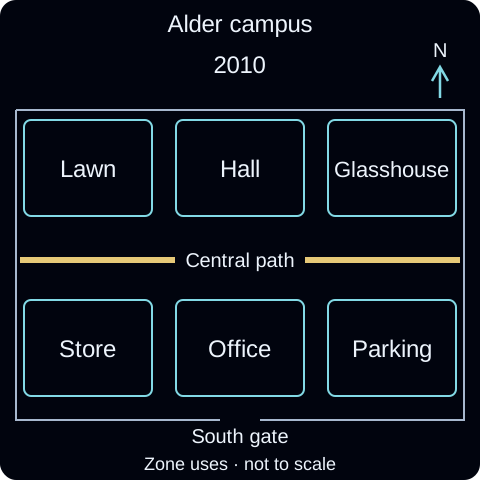
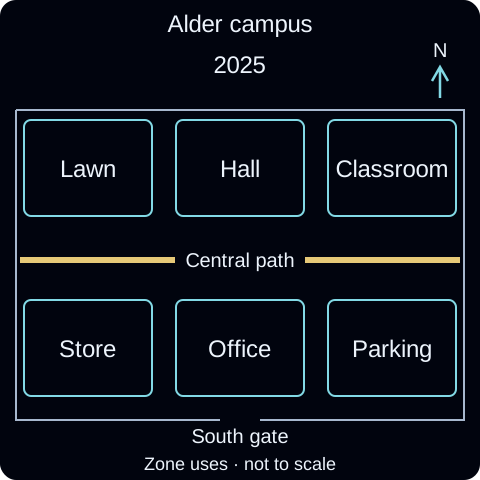
Map note: These are schematic zone uses, with north up and no scale or building-footprint detail. Both plans show the same site boundary, central east–west path and southern gate.
Reporting decision: Which sentence accurately reports the changed zone?
Choose ONE answer.
Difficulty 1/5 · 100 coins + a small bonus on first completion today
Only the north-east changes from Glasshouse to Classroom. The other five zone labels remain in place. Locate the change precisely without turning one changed zone into an all-site transformation.
Original schematic teaching maps:
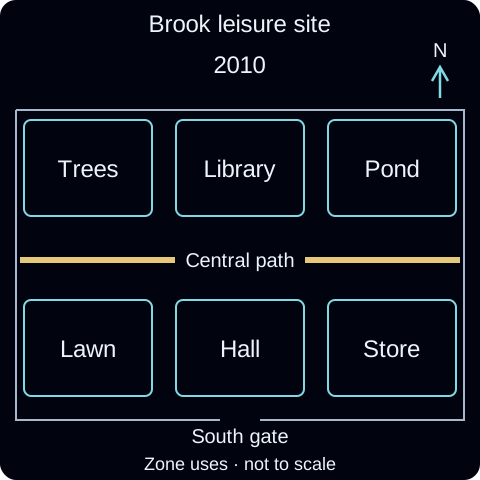
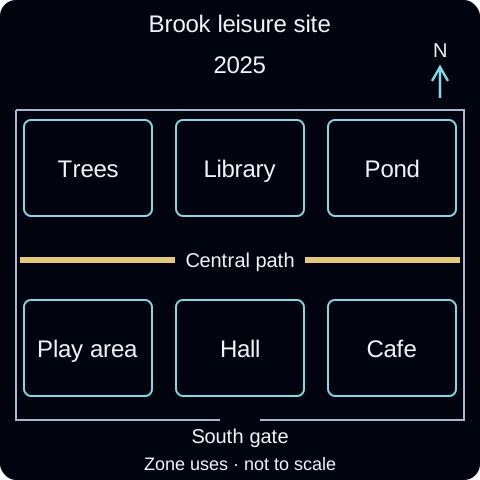
Map note: These are schematic zone uses, with north up and no scale or building-footprint detail. Both plans show the same site boundary, central east–west path and southern gate.
Reporting decision: Which overview includes the main contrast?
Choose ONE answer.
Difficulty 1/5 · 100 coins + a small bonus on first completion today
Lawn becomes Play area in the south-west and Store becomes Cafe in the south-east. All three northern labels and the southern Hall remain. Grouping by the path retains both the changes and stable features.
Original schematic teaching maps:
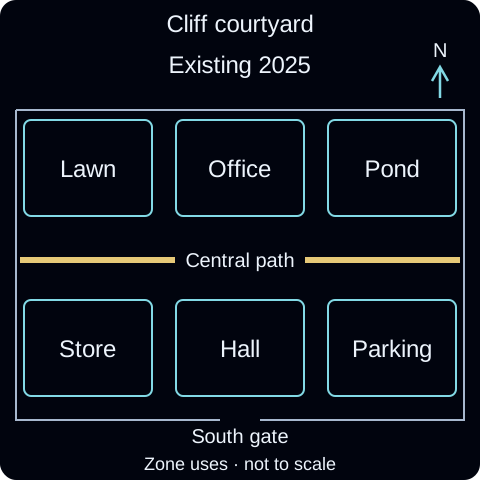
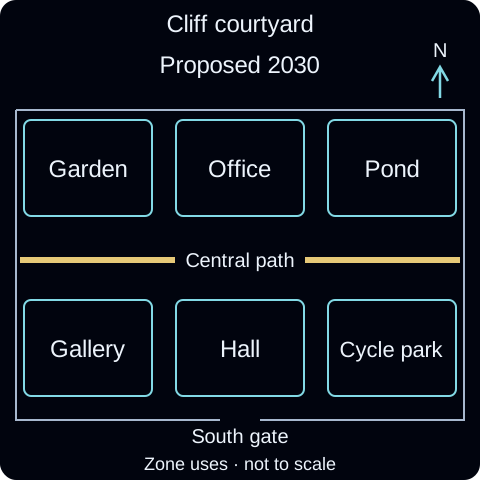
Map note: These are schematic zone uses, with north up and no scale or building-footprint detail. Both plans show the same site boundary, central east–west path and southern gate.
Reporting decision: Which sentence preserves the source status?
Choose ONE answer.
Difficulty 1/5 · 100 coins + a small bonus on first completion today
Gallery is on the proposed plan, not the existing one. The north-central office is retained. A planned use does not prove implementation or guarantee an opening date.
Original schematic teaching maps:
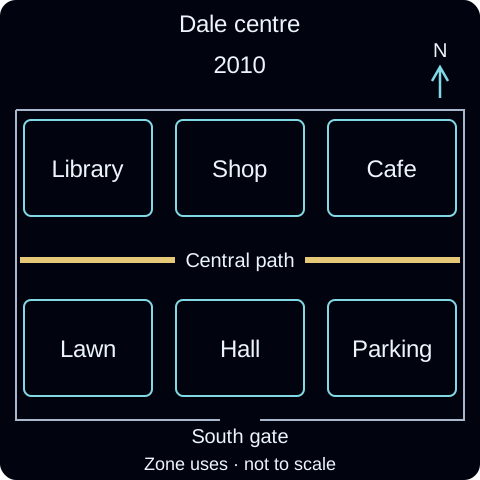
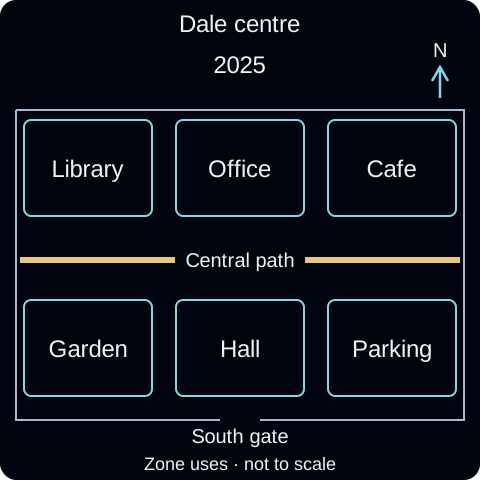
Map note: These are schematic zone uses, with north up and no scale or building-footprint detail. Both plans show the same site boundary, central east–west path and southern gate.
Reporting decision: Which location statement is supported?
Choose ONE answer.
Difficulty 1/5 · 100 coins + a small bonus on first completion today
Library is north-west and Cafe north-east. Hall remains south-central, and Shop becomes Office in the north-central zone. Preserve compass direction and use the correct snapshot.
Original schematic teaching maps:
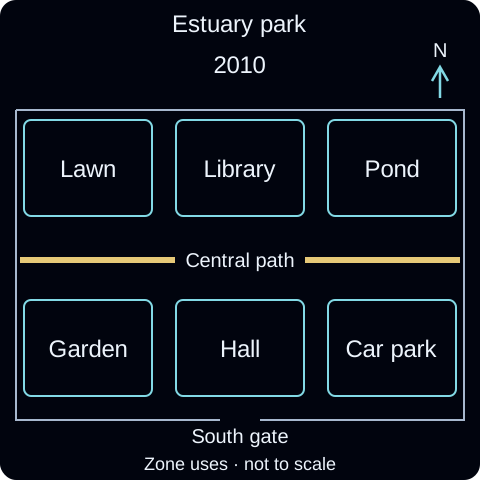
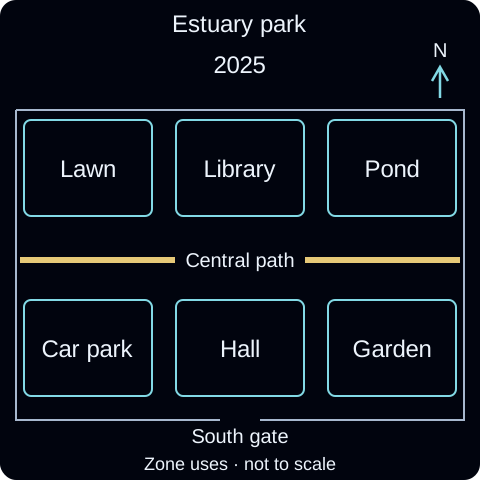
Map note: These are schematic zone uses, with north up and no scale or building-footprint detail. Both plans show the same site boundary, central east–west path and southern gate.
Reporting decision: Which description preserves the changed parking location?
Choose ONE answer.
Difficulty 1/5 · 100 coins + a small bonus on first completion today
Car park changes from south-east to south-west, while Garden changes the other way. Hall and the three northern labels are stable. A facility can remain present while its shown location changes.
Original schematic teaching maps:
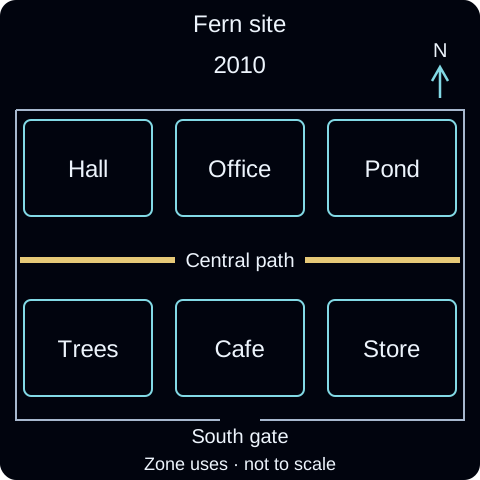
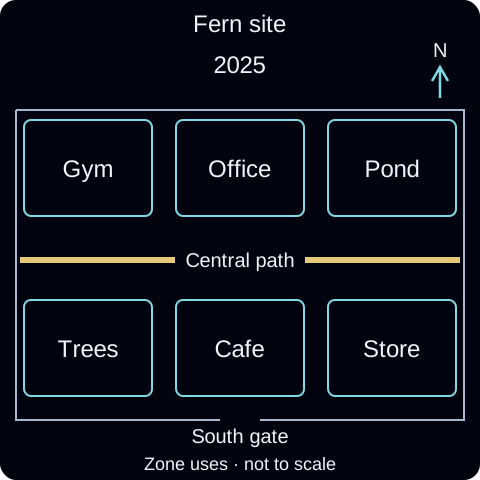
Map note: These are schematic zone uses, with north up and no scale or building-footprint detail. Both plans show the same site boundary, central east–west path and southern gate.
Reporting decision: Which conclusion stays within the drawing?
Choose ONE answer.
Difficulty 1/5 · 100 coins + a small bonus on first completion today
The source supplies uses, not construction records or measured footprints. Hall-to-Gym at one zone supports a use change; it does not establish retention, size or added floors.
Original schematic teaching maps:
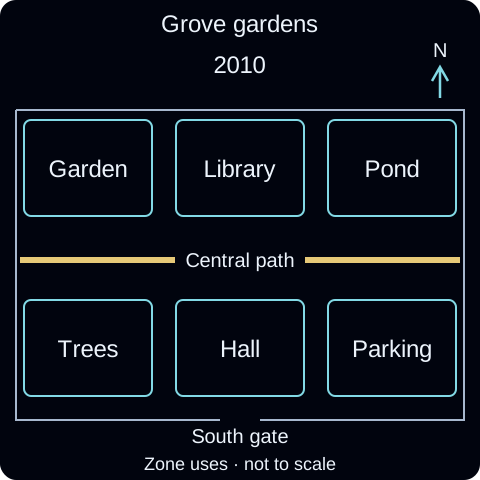
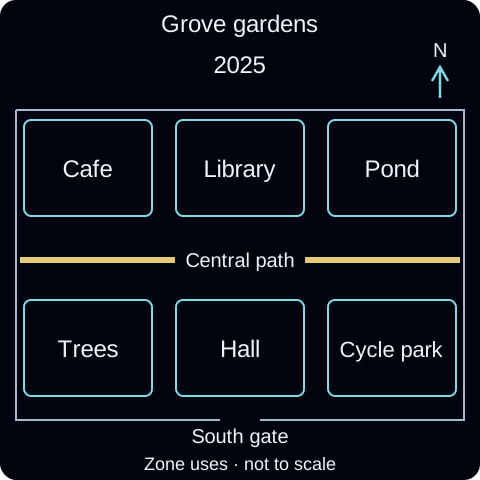
Map note: These are schematic zone uses, with north up and no scale or building-footprint detail. Both plans show the same site boundary, central east–west path and southern gate.
Reporting decision: Which overview avoids an overstatement?
Choose ONE answer.
Difficulty 1/5 · 100 coins + a small bonus on first completion today
Garden becomes Cafe and Parking becomes Cycle park. Pond and Trees remain, as do Library and Hall. Do not extend two changes to all land uses or assume that every labelled zone is a building.
Original schematic teaching maps:
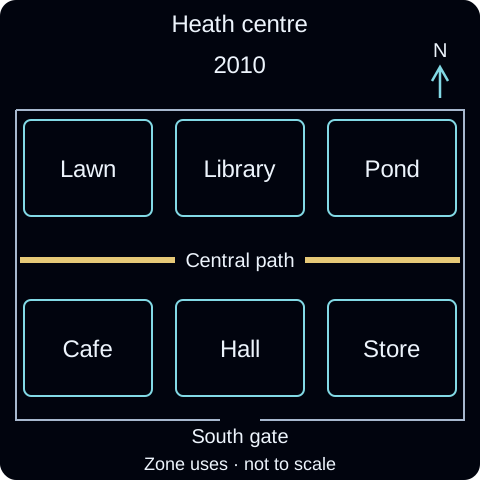
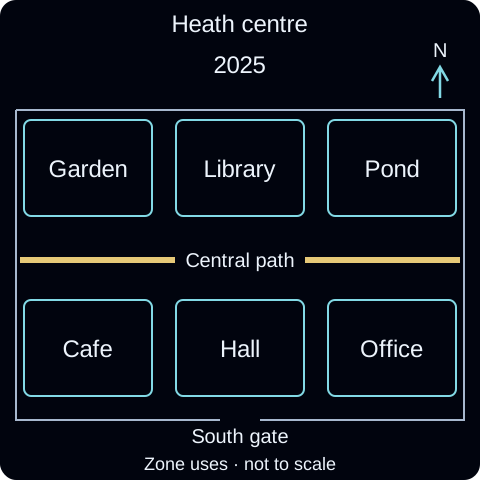
Map note: These are schematic zone uses, with north up and no scale or building-footprint detail. Both plans show the same site boundary, central east–west path and southern gate.
Reporting decision: Which relationship is shown in the later plan?
Choose ONE answer.
Difficulty 1/5 · 100 coins + a small bonus on first completion today
Library is north-central and Hall south-central. Cafe is south-west, west of Office in the south-east. Pond is north-east. Read the north arrow and the relevant zones, not a route imagined between them.
Original schematic teaching maps:
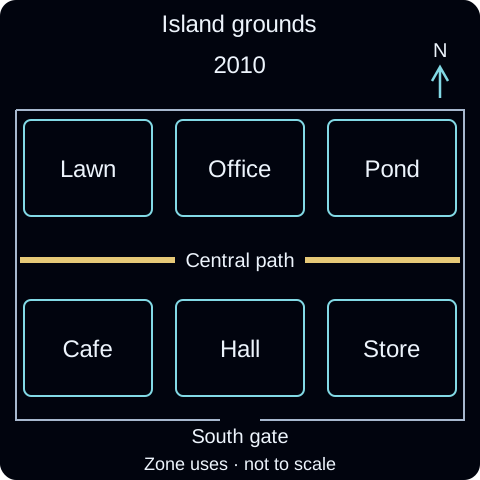
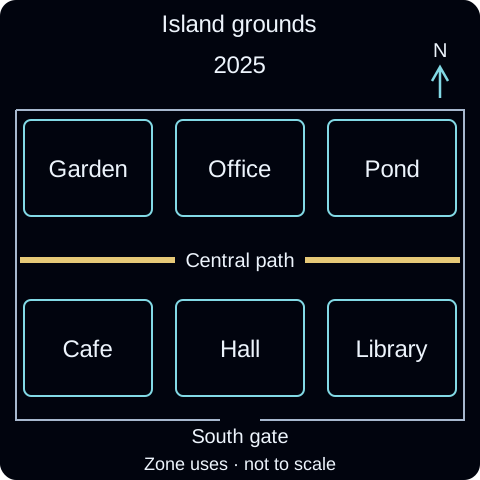
Map note: These are schematic zone uses, with north up and no scale or building-footprint detail. Both plans show the same site boundary, central east–west path and southern gate.
Reporting decision: Which claim lacks the required measurement evidence?
Choose ONE answer.
Difficulty 1/5 · 100 coins + a small bonus on first completion today
The plans are not to scale and give no distance measurement. They do establish the later library zone, the common southern side and the retained pond. Schematic spacing cannot supply metres.
Original schematic teaching maps:
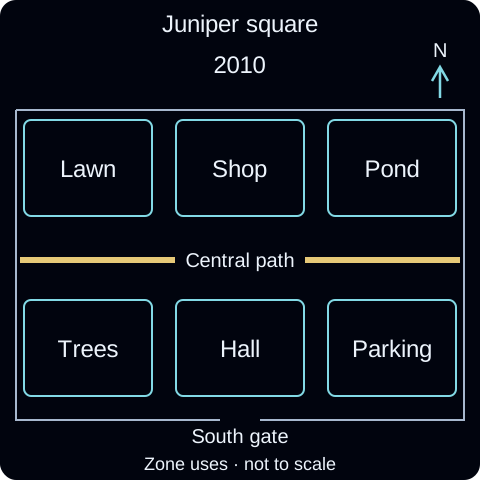
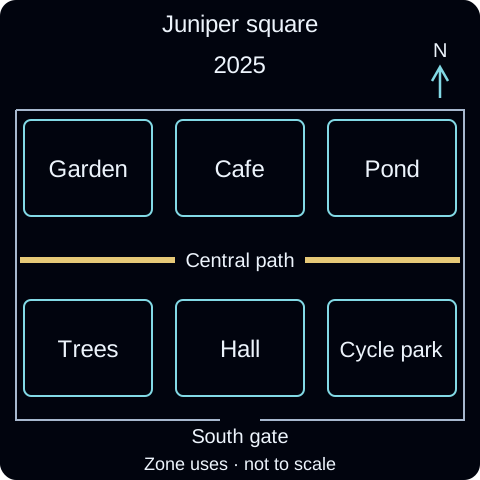
Map note: These are schematic zone uses, with north up and no scale or building-footprint detail. Both plans show the same site boundary, central east–west path and southern gate.
Reporting decision: Which explanation should be omitted?
Choose ONE answer.
Difficulty 1/5 · 100 coins + a small bonus on first completion today
Residents’ opinions and the reason for the change are absent. The remaining statements describe shown uses and positions. A map change is not evidence of the attitudes that may have motivated it.
Original schematic teaching maps:
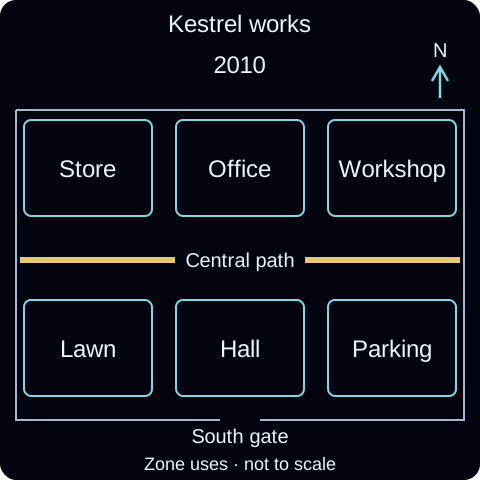
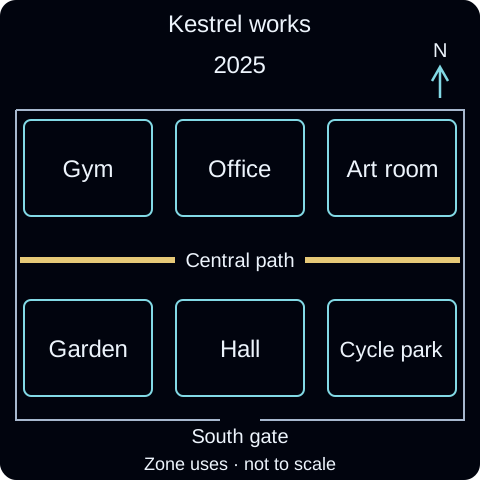
Map note: These are schematic zone uses, with north up and no scale or building-footprint detail. Both plans show the same site boundary, central east–west path and southern gate.
Reporting decision: Which overview selects a broad pattern without inventing effects?
Choose ONE answer.
Difficulty 1/5 · 100 coins + a small bonus on first completion today
Store and Workshop change to Gym and Art room; Lawn and Parking also change. Office and Hall remain. Visitor counts are not shown. Select the broad changes and stable anchors without adding measured outcomes.
Original schematic teaching maps:
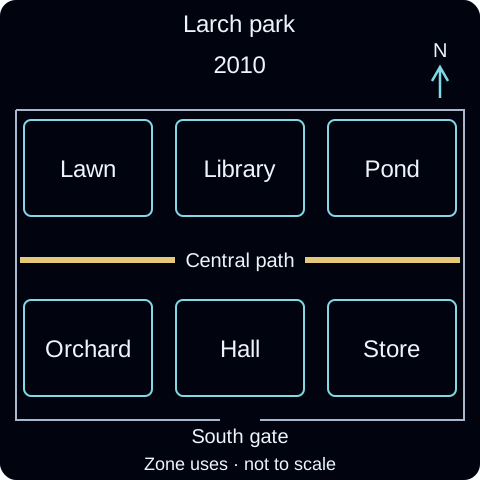
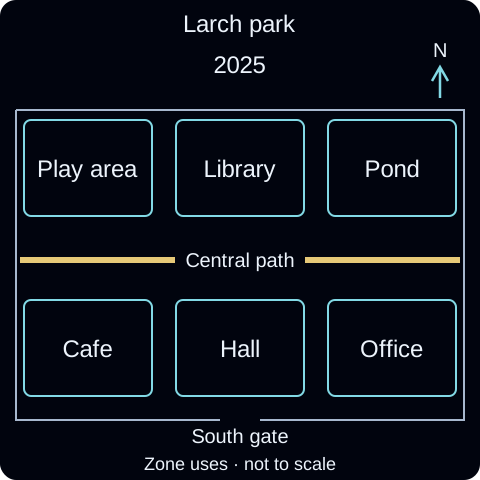
Map note: These are schematic zone uses, with north up and no scale or building-footprint detail. Both plans show the same site boundary, central east–west path and southern gate.
Reporting decision: Which retained feature belongs in an accurate comparison?
Choose ONE answer.
Difficulty 1/5 · 100 coins + a small bonus on first completion today
Pond keeps its zone. Orchard becomes Cafe, Store becomes Office and Lawn becomes Play area. Retention must be checked against both plans, not assumed from a familiar label in the earlier one.
Original schematic teaching maps:
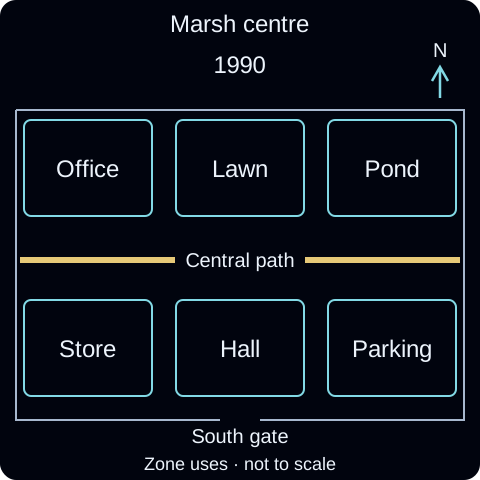
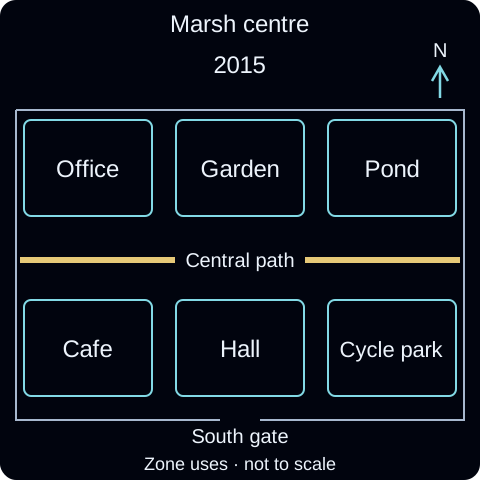
Map note: These are schematic zone uses, with north up and no scale or building-footprint detail. Both plans show the same site boundary, central east–west path and southern gate.
Reporting decision: Which sentence fits the dates and status?
Choose ONE answer.
Difficulty 1/5 · 100 coins + a small bonus on first completion today
The later observed plan is dated 2015 and shows Cafe; the earlier 1990 plan shows Store. No exact opening year is given. Report the later state or bounded change period rather than inventing a date.
Original schematic teaching maps:
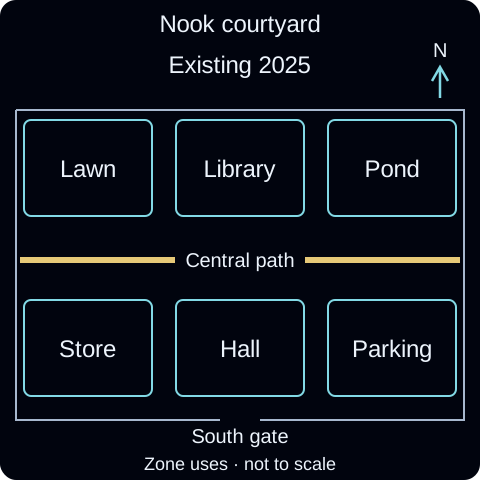
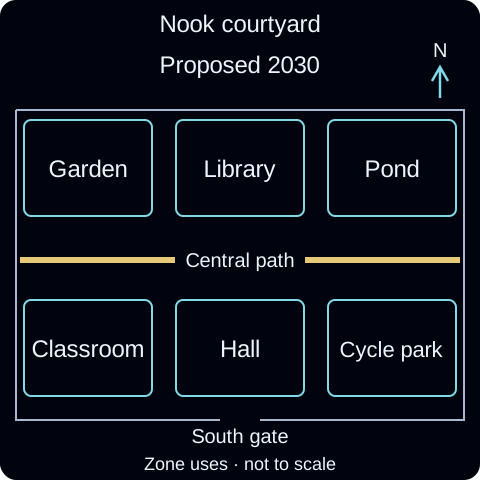
Map note: These are schematic zone uses, with north up and no scale or building-footprint detail. Both plans show the same site boundary, central east–west path and southern gate.
Reporting decision: Which statement distinguishes the two snapshots?
Choose ONE answer.
Difficulty 1/5 · 100 coins + a small bonus on first completion today
The south-west changes Store to Classroom only on the proposed plan. Library stays north-central. Proposal status does not establish completion, and comparisons must keep each use attached to the correct snapshot.
Original schematic teaching maps:
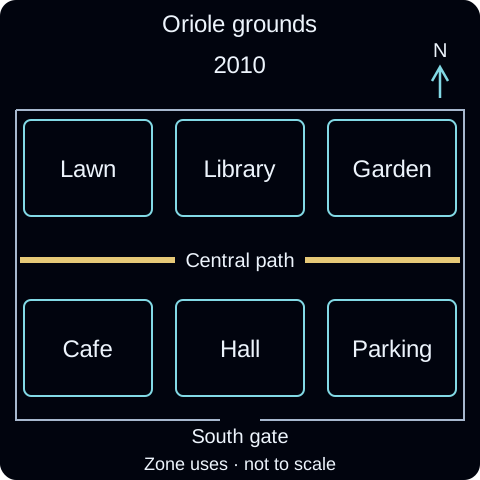
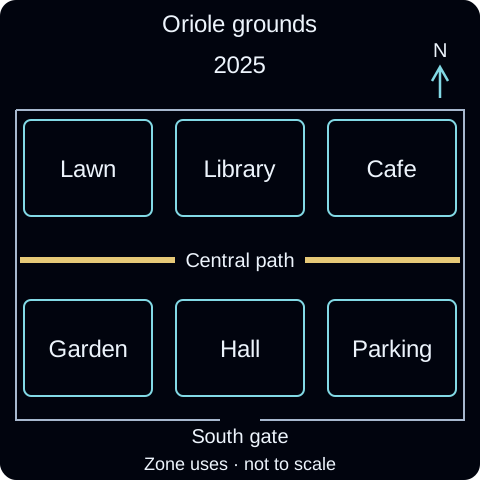
Map note: These are schematic zone uses, with north up and no scale or building-footprint detail. Both plans show the same site boundary, central east–west path and southern gate.
Reporting decision: Which statement recognises location change?
Choose ONE answer.
Difficulty 1/5 · 100 coins + a small bonus on first completion today
Cafe shifts from south-west to north-east, while Garden shifts the other way. Library and Hall are stable. A retained facility name alone does not establish a retained position or the identity of a building.
Original schematic teaching maps:
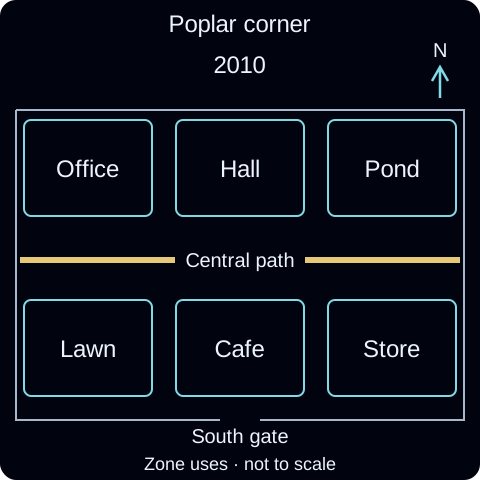
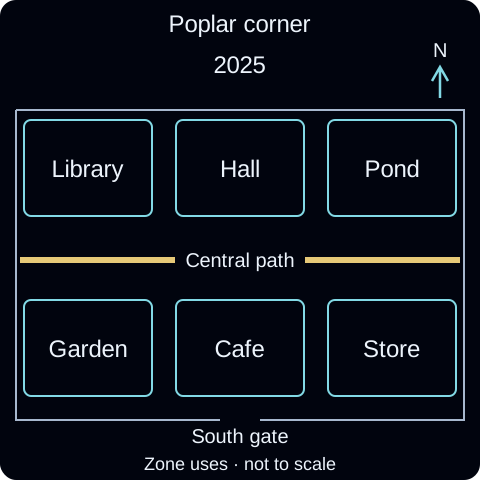
Map note: These are schematic zone uses, with north up and no scale or building-footprint detail. Both plans show the same site boundary, central east–west path and southern gate.
Reporting decision: Which construction claim is justified?
Choose ONE answer.
Difficulty 1/5 · 100 coins + a small bonus on first completion today
Office becomes Library in the north-west, but the note withholds footprints and building identity. Retention, added floors and exact area therefore remain unestablished. State the use/location change instead.
Original schematic teaching maps:
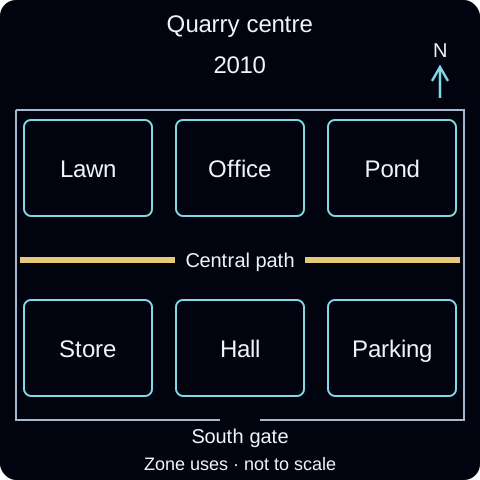
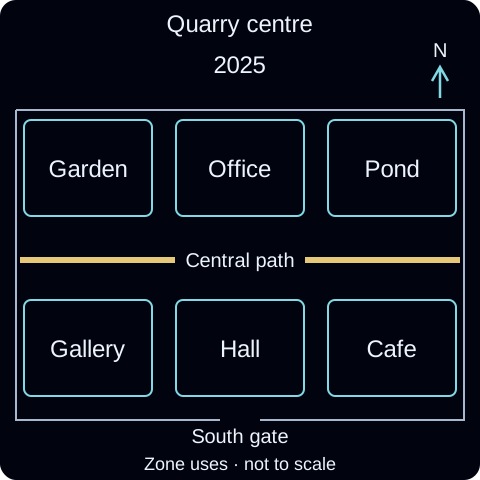
Map note: These are schematic zone uses, with north up and no scale or building-footprint detail. Both plans show the same site boundary, central east–west path and southern gate.
Reporting decision: Which plan groups the changes accurately?
Choose ONE answer.
Difficulty 1/5 · 100 coins + a small bonus on first completion today
North-west Lawn becomes Garden; south-west Store becomes Gallery and south-east Parking becomes Cafe. Office, Pond and Hall stay put. This grouping follows geography without claiming rebuilding or traffic measurements.
Original schematic teaching maps:
Map note: These are schematic zone uses, with north up and no scale or building-footprint detail. Both plans show the same site boundary, central east–west path and southern gate.
Reporting decision: Which description avoids an unsupported extension claim?
Choose ONE answer.
Difficulty 1/5 · 100 coins + a small bonus on first completion today
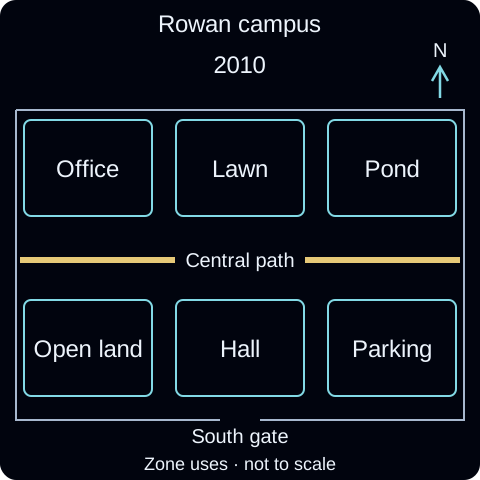
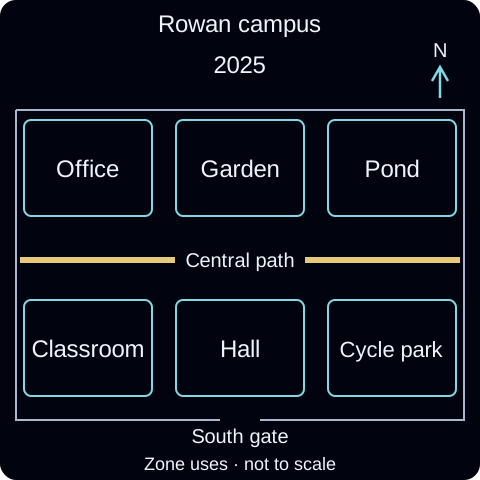
The new classroom occupies south-west Open land, while Office stays north-west. The maps do not identify an office extension or extra floor. Garden and Pond remain outdoor uses; do not turn a nearby new label into a proven structural link.
Original schematic teaching maps:
Map note: These are schematic zone uses, with north up and no scale or building-footprint detail. Both plans show the same site boundary, central east–west path and southern gate.
Reporting decision: Which sentence uses the shown orientation correctly?
Choose ONE answer.
Difficulty 1/5 · 100 coins + a small bonus on first completion today
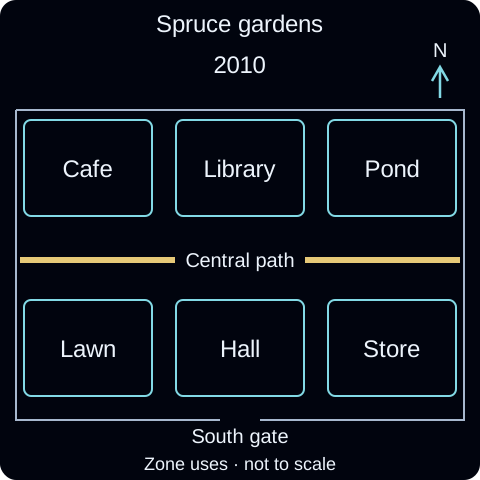
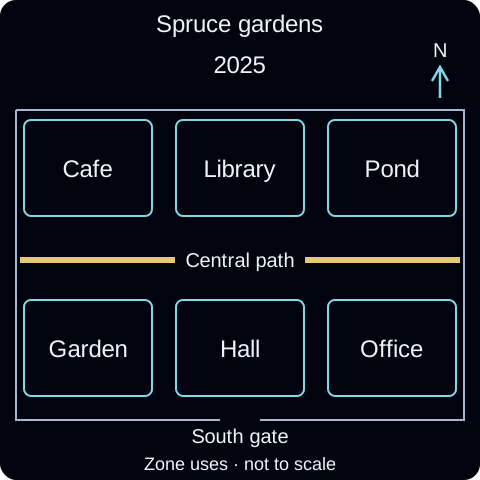
North is up: Cafe is north-west, Library north-central and Garden south-west. Pond is north-east. Describe relative positions consistently rather than switching left/right into reversed compass directions.
Original schematic teaching maps:
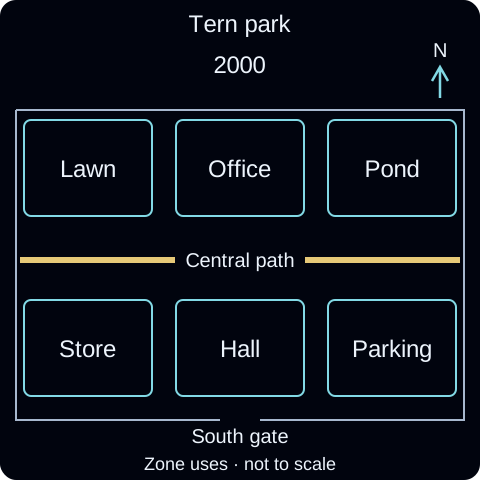
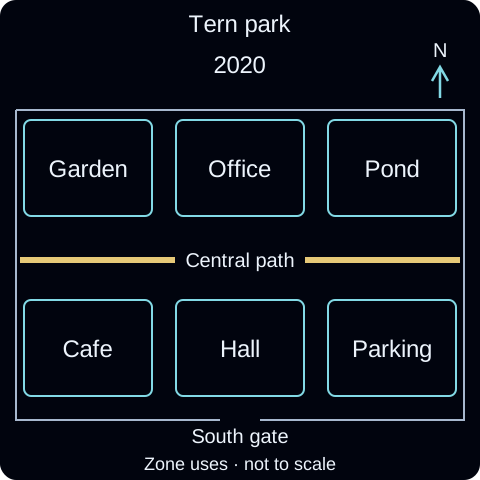
Map note: These are schematic zone uses, with north up and no scale or building-footprint detail. Both plans show the same site boundary, central east–west path and southern gate.
Reporting decision: What can be said about when the store use changed?
Choose ONE answer.
Difficulty 1/5 · 100 coins + a small bonus on first completion today
The observations bound what is shown at two dates but do not identify a precise opening year. The old label is Store and the later one Cafe. Do not infer a midpoint or make the later snapshot date the only possible construction date.
Transfer: three decisions from one shared centre
- Three checks reuse the Hillside centre pair. It is one shared source, not three independent maps. Select its main comparison, locate a changed use and check the evidence for a proposed policy sentence. Do not borrow a cause, dimension or building claim from an earlier source merely because the topic sounds similar.
- Plan an introduction, main picture and useful detail groups. Check that your overview agrees with the retained features as well as the changes. Choose comparisons that clarify the site rather than listing every label without a relationship.
Original schematic teaching maps:
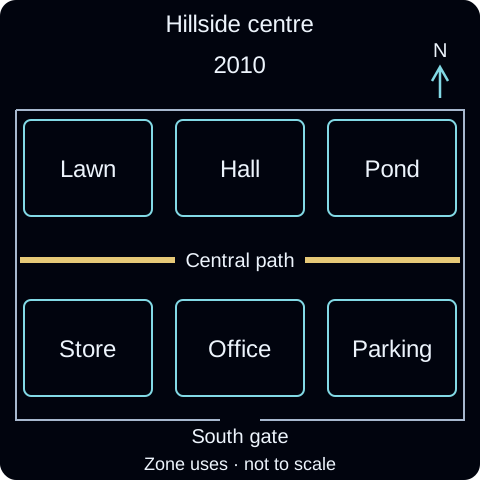
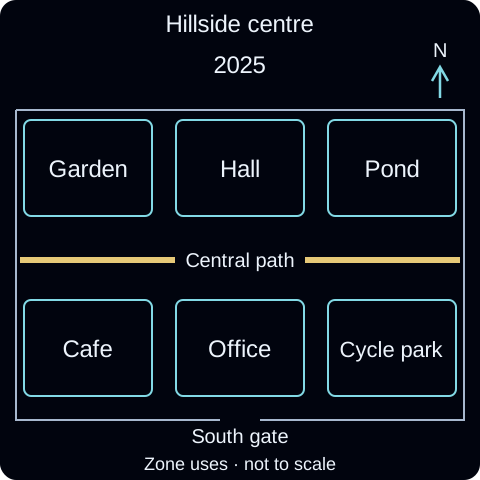
Map note: These are schematic zone uses, with north up and no scale or building-footprint detail. Both plans show the same site boundary, central east–west path and southern gate.
Reporting decision: Which overview covers change and retention?
Choose ONE answer.
Difficulty 1/5 · 100 coins + a small bonus on first completion today
Lawn becomes Garden, Store becomes Cafe and Parking becomes Cycle park. Hall, Pond and Office remain. This is one shared source for three decisions, not three independent map pairs.
Original schematic teaching maps:
Map note: These are schematic zone uses, with north up and no scale or building-footprint detail. Both plans show the same site boundary, central east–west path and southern gate.
Reporting decision: Where is the later cafe shown?
Choose ONE answer.
Difficulty 1/5 · 100 coins + a small bonus on first completion today
Cafe occupies south-west and Office south-central. Cycle park is south-east. Locate the current use relative to a stable anchor and match the same zone to its earlier label.
Original schematic teaching maps:
Map note: These are schematic zone uses, with north up and no scale or building-footprint detail. Both plans show the same site boundary, central east–west path and southern gate.
Reporting decision: Which proposed sentence adds an unsupported policy?
Choose ONE answer.
Difficulty 1/5 · 100 coins + a small bonus on first completion today
The parking-use change does not state a complete vehicle-access policy. The other sentences describe visible zones and positions. A removed car park does not by itself prove an all-car ban.
Write a complete report of observed park changes
- Use the fresh Brook park pair in the task to write at least 150 words in connected prose before opening the models. Official Academic Task 1 uses about 20 minutes; practise untimed first if needed, then try that allocation. The local page does not enforce length, assess your writing or predict a band. Planning notes do not replace a connected report.
- Compare the complete weaker and improved responses only after drafting. Use the annotations, alternative organisation and five criteria to revise one specific coverage, position, tense or evidence issue in your own report. Your draft stays on this page; copy it before leaving. A model demonstrates choices, not a paragraph to memorise.
Original schematic Academic Task 1 map pair:
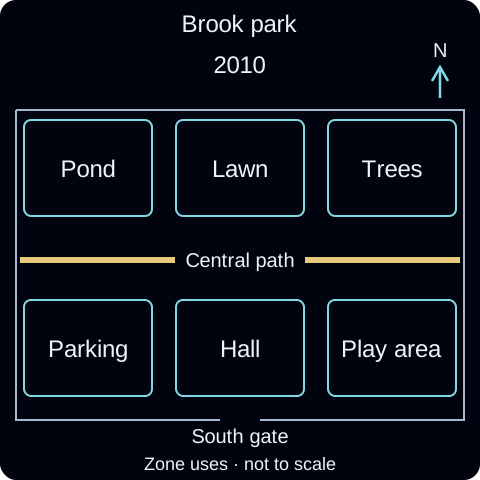
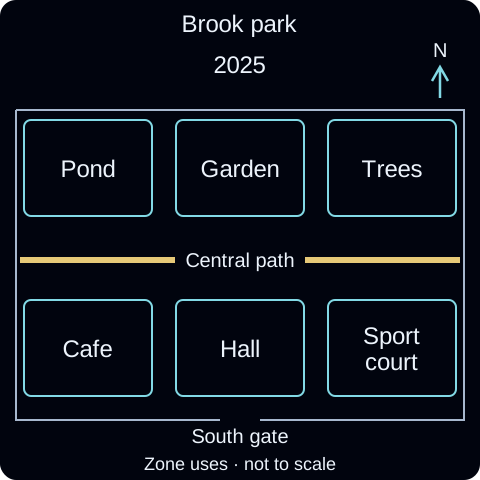
Map note: These are schematic zone uses, with north up and no scale or building-footprint detail. Both plans show the same site boundary, central east–west path and southern gate.
Write at least 150 words in connected prose, summarising the main features and relevant comparisons. Draft before opening the complete models, then revise one coverage, position, tense/status or evidence error. This page does not grade writing or enforce length. Your draft stays on this page; copy it before leaving.
Several reports can preserve the same map evidence. Compare the support and paragraph jobs rather than matching model phrases. This is private comparison and revision, not automatic writing evaluation, demonstrated proficiency or a calibrated band.
Write again from an existing plan and a proposal
- This fresh college-courtyard task requires your own comparison of its two plans. Read their dates and status, select the main features and draft at least 150 words before opening the models. Do not carry over a phrase from the previous report without checking whether it fits this source.
- Revise your own report against both maps and the comparison notes. Several organisations and wordings can work. Recording comparison and revision is self-review, not independent writing evaluation, demonstrated proficiency or an IELTS mark. Repair an unsupported claim before polishing its vocabulary.
Original schematic Academic Task 1 map pair:
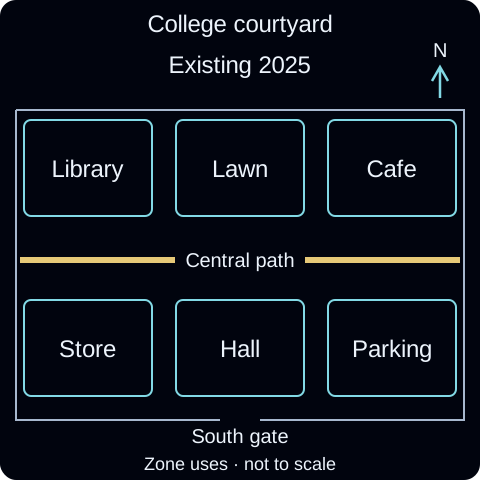
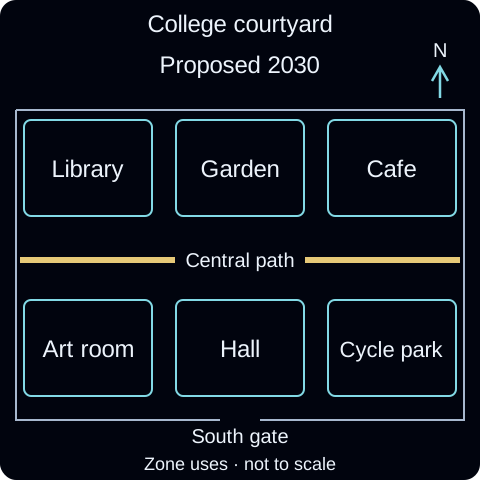
Map note: These are schematic zone uses, with north up and no scale or building-footprint detail. Both plans show the same site boundary, central east–west path and southern gate.
Write at least 150 words in connected prose, summarising the main features and relevant comparisons. Draft before opening the complete models, then revise one coverage, position, tense/status or evidence error. This page does not grade writing or enforce length. Your draft stays on this page; copy it before leaving.
Several reports can preserve the same map evidence. Compare the support and paragraph jobs rather than matching model phrases. This is private comparison and revision, not automatic writing evaluation, demonstrated proficiency or a calibrated band.
Later review: a changed use and a proposed use
- After a break, use the fresh school and square pairs before reopening worked examples. Explain what makes the rejected alternative fail: its feature, zone, date, proposal status or added measurement. Then write a corrected sentence that preserves the map evidence.
- For another visual-report structure, continue with process diagrams and reports. For accurate quantitative overviews, revisit selection and reporting; for precise quantity phrases, use the language of change. General Training Task 1 instead requires purposeful letters.
Original schematic teaching maps:
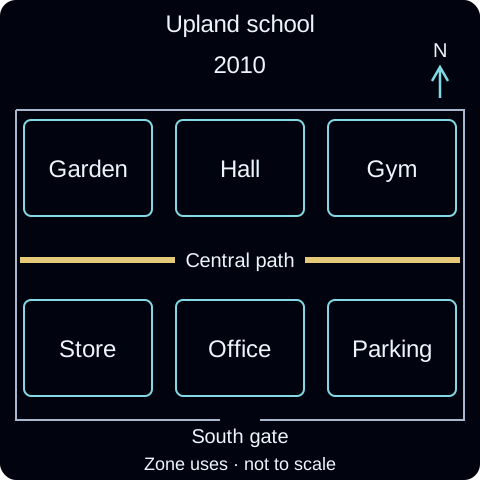
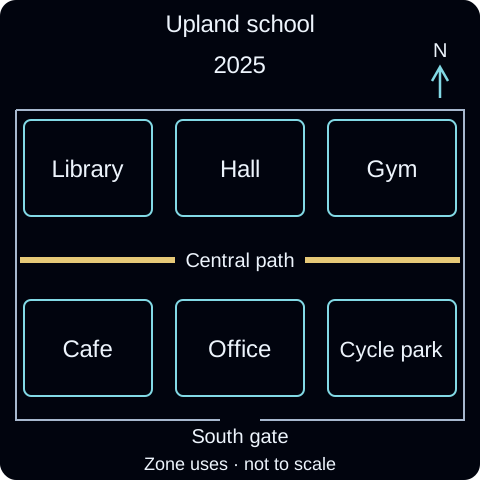
Map note: These are schematic zone uses, with north up and no scale or building-footprint detail. Both plans show the same site boundary, central east–west path and southern gate.
Reporting decision: Which comparison is supported?
Choose ONE answer.
Difficulty 1/5 · 100 coins + a small bonus on first completion today
Garden becomes Library in the north-west; Gym remains north-east. Hall stays north-central. Schematic zone boxes do not provide a measured area fraction.
Original schematic teaching maps:
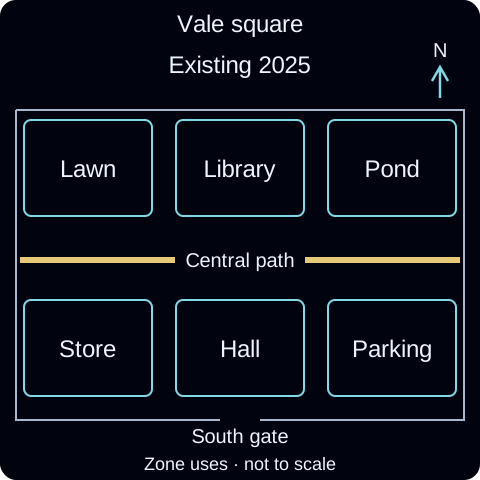
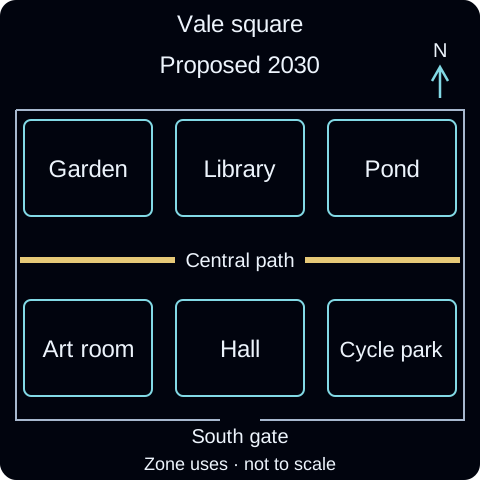
Map note: These are schematic zone uses, with north up and no scale or building-footprint detail. Both plans show the same site boundary, central east–west path and southern gate.
Reporting decision: Which sentence preserves proposal status?
Choose ONE answer.
Difficulty 1/5 · 100 coins + a small bonus on first completion today
Art room is on the proposed plan; Store is on the existing one. Library retains its north-central position. Proposal status is not completion evidence.
Compare what is shown, where it is and when it applies
- Recap: identify the main changes and significant retained features, group meaningful comparisons and support them with accurate locations. Preserve the dates, status and source limits. Neither equal-looking schematic boxes nor a plausible reason can supply missing measurements or construction facts.
- Format checked on 19 October 2026 against the official IELTS Academic Writing guide. Every plan, question and model here is original schematic teaching. Independent subject, language, key, rights and learner reviews remain pending. These are not official tasks, calibrated model bands or demonstrated writing outcomes.