Your learning plan · Continue · Review →
Matching sentence endings — grammar and meaning together
DiperkenalkanPosisi tersimpan Anda tetap berada di browser ini. Melanjutkan tidak menyelesaikan pelajaran atau menjawab pertanyaannya.
A smooth sentence can still say the wrong thing
- Outcome: join a supplied beginning to an ending supported by the passage, preserving cause, contrast, time, scope and conditions. Start with Reading orientation and the matching overview. Read the complete joined sentence rather than choosing a familiar phrase on its own.
- In matching sentence endings, you select from supplied endings. In sentence completion, you may instead need to copy a permitted number of passage words into a gap. These are different response tasks. The short radio questions here are original focused practice, not a full Reading interface or a band estimate.
Worked limit: clearer appearance is not proof of greater strength
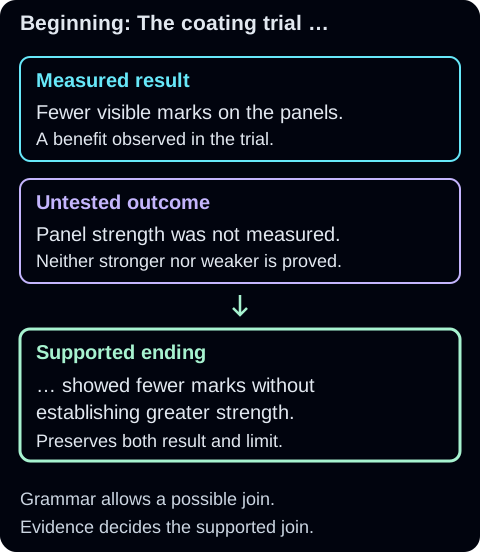
- Original passage: “The new coating left fewer visible marks on the panels. The trial did not measure whether the panels became stronger.” Beginning: “The coating trial …” Both showed fewer marks without establishing greater strength and proved greater strength because the panels looked cleaner can form grammatical sentences. Only the first preserves what was measured and what was not.
- The second ending adds an unsupported result and causal link. Do not claim that strength decreased either: it was not tested. Grammar checks whether the parts can join; evidence checks whether they should join here. A sentence can put on a very tidy jacket and still tell the wrong story.

Worked time: keep the condition attached to its period
- Original passage: “During repairs to its roof, the reading room was closed. Visitors could still use the garden. The room reopened when the repairs finished.” Beginning: “While the roof work was in progress, visitors …” Supported ending: could use the garden but not the reading room. The time phrase identifies the temporary arrangement.
- Could use the reading room after the garden closed reverses the access facts; lost access to both places permanently changes both scope and duration. Neither is rescued by grammatical fit. Compare during, after, until and still with the event they qualify.
Worked condition: a proposal is not an unconditional promise
- Original passage: “The club will open an extra session if two volunteers can attend. One volunteer has agreed, and the organiser is still seeking a second.” Beginning: “The extra session …” Supported ending: depends on finding another volunteer. The required total has not yet been reached.
- Is confirmed because one volunteer has agreed omits part of the condition. Has been permanently cancelled invents a final decision. Join the whole sentence, then check its actor, condition and status. A true detail can be used inside an ending that draws the wrong conclusion.
Guided practice: check grammar, then the relationship
- The next ten original passages include a reading cue. Read the beginning and each ending as one sentence. Check the clause or phrase connection, then ask whether it preserves the passage’s reason, comparison, qualification or change over time. In these tasks, semantic differences matter even when several endings fit grammatically.
- A useful rejection note is specific: wrong cause, earlier result, missing condition, unsupported certainty or a claim belonging to someone else. “It sounds wrong” does not identify what to repair. Keep a partly true ending under scrutiny if its final conclusion goes beyond the evidence.
Original passage: The gallery moved a large model away from the entrance because it narrowed the visitor route. The model remained on display beside the rear wall.
Beginning: The gallery relocated the model …
Choose the ending supported by the passage.
Reading cue: Check the reason rather than merely the shared word model.
Difficulty 1/5 · 100 coins + a small bonus on first completion today
The narrower route explains relocation; the model remains visible. Removal from display and a clear original route contradict the passage, while an unidentified position is not stated.
Original passage: The guide’s first map omitted two small paths. The revised map adds both paths but keeps the same scale and main route.
Beginning: The revised map …
Choose the ending supported by the passage.
Reading cue: Keep what changed distinct from what stayed the same.
Difficulty 1/5 · 100 coins + a small bonus on first completion today
The addition is specific and the two other features remain unchanged. The other endings reverse those changes or invent closure as a reason.
Original passage: Readers found names faster with the new index. The trial did not test whether the names had been transcribed correctly.
Beginning: The index trial …
Choose the ending supported by the passage.
Reading cue: Separate the measured outcome from an untested one.
Difficulty 1/5 · 100 coins + a small bonus on first completion today
Faster access is measured; accuracy is not. No accuracy comparison or universal correctness claim follows from the result.
Original passage: Volunteers may borrow the recorder after completing the equipment introduction. The introduction is required even for volunteers who have used another recorder before.
Beginning: A volunteer can borrow the recorder …
Choose the ending supported by the passage.
Reading cue: Keep the condition and its stated scope together.
Difficulty 1/5 · 100 coins + a small bonus on first completion today
The introduction applies to both experienced and new volunteers. Prior experience is not an exemption, and neither a booking exception nor a no-experience requirement is supplied.
Original passage: A researcher first classified the marks as accidental scratches. Repeated spacing later led her to consider deliberate decoration, although she could not identify the maker.
Beginning: The later evidence …
Choose the ending supported by the passage.
Reading cue: Track the change of interpretation and the remaining limit.
Difficulty 1/5 · 100 coins + a small bonus on first completion today
The interpretation changes and an uncertainty remains. The maker is not identified; spacing is examined rather than ignored, and deliberate action becomes possible rather than ruled out.
Original passage: Two seedlings received the same amount of water. One stood near a window and the other in a dark cupboard so that the trial could compare their responses to light.
Beginning: The trial kept watering constant …
Choose the ending supported by the passage.
Reading cue: Distinguish a controlled condition from the one being compared.
Difficulty 1/5 · 100 coins + a small bonus on first completion today
Equal watering supports a comparison of different light exposure. Water is not the changed variable, and the plants remain in different light settings.
Original passage: The writer quotes a visitor who calls the town deserted. The writer then cites a busy market register to caution against treating that single visit as a description of the whole week.
Beginning: The writer uses the register …
Choose the ending supported by the passage.
Reading cue: Separate a quoted view from what the writer does with it.
Difficulty 1/5 · 100 coins + a small bonus on first completion today
The register qualifies the account’s scope. It neither establishes a fictitious visit nor supports week-long closure; quoting the visitor is not endorsing the broad claim.
Original passage: The workshop planned to replace the old cabinet. When a conservator found that only its hinge was damaged, the team chose a hinge repair instead.
Beginning: The team changed its plan …
Choose the ending supported by the passage.
Reading cue: Read the new evidence before assigning the revised action.
Difficulty 1/5 · 100 coins + a small bonus on first completion today
The limited hinge damage motivates repair instead of total replacement. The alternatives reverse the evidence, its timing or the revised decision.
Original passage: The museum’s paper guide gives a simple route for first-time visitors. Its website offers more detailed plans for people researching the building. Neither version is intended to replace the other.
Beginning: The museum provides the two guides …
Choose the ending supported by the passage.
Reading cue: Preserve the relationship between two complementary resources.
Difficulty 1/5 · 100 coins + a small bonus on first completion today
The two forms serve different purposes. The passage rejects replacement and does not claim identical detail or remove either audience’s need.
Original passage: The new timetable cut the gap between connecting services during the weekday trial. Weekend connections were not observed, so the report makes no claim about them.
Beginning: The report concludes that connections improved …
Choose the ending supported by the passage.
Reading cue: Keep the observation period attached to the conclusion.
Difficulty 1/5 · 100 coins + a small bonus on first completion today
The evidence is limited to the observed weekday trial. It does not establish annual performance, weekend cancellation or an improvement before the change.
Independent endings: twenty fresh mini-passages
- Each question has a different original mini-passage and no reading cue. All four candidates are intended to join the beginning grammatically; choose by evidence. Commit before checking, then identify the exact relationship that defeats the closest alternative rather than memorising an option number.
- Short local tasks do not measure all the navigation and timing demands of a full Reading paper. Spread the unit across sessions if helpful, and use the saved-position choice deliberately when returning. A familiar construction is a tool for reading, not proof that the same ending will fit a new passage.
Original passage: The revised gauge shows smaller divisions on its dial. It covers the same temperature range as the earlier gauge, but users can read smaller differences within that range.
Beginning: The revised gauge …
Choose the ending supported by the passage.
Difficulty 1/5 · 100 coins + a small bonus on first completion today
Smaller divisions improve readable detail within an unchanged range. The other endings confuse scale detail with range or reverse the described change.
Original passage: The first labels used pale grey letters. After visitors reported difficulty reading them, staff printed darker, larger lettering while keeping the wording unchanged.
Beginning: Staff revised the labels …
Choose the ending supported by the passage.
Difficulty 1/5 · 100 coins + a small bonus on first completion today
The visitor problem concerns readability, and the response changes size and contrast. Factual correction, earlier timing and smaller letters are not supported.
Original passage: The upper trail is normally open, but it closes while repairs to its wooden ramp are in progress. The lower circuit remains available during that work.
Beginning: During ramp repairs, visitors …
Choose the ending supported by the passage.
Difficulty 1/5 · 100 coins + a small bonus on first completion today
The closure is specific to the upper trail during the work. The lower circuit remains available, so the other endings reverse the timing, route or scope.
Original passage: A letter suggests that the hall opened in 1890, but the surviving register begins only in 1893. The historian says the register cannot settle the opening date because earlier pages may be missing.
Beginning: The historian treats the register …
Choose the ending supported by the passage.
Difficulty 1/5 · 100 coins + a small bonus on first completion today
A potentially incomplete register cannot alone settle the date. Its surviving start does not prove closure, completeness or absence of earlier pages.
Original passage: The first reading trial used five students; the next used ten different students. The report notes that the groups differed, so the score change cannot be attributed solely to the revised instructions.
Beginning: The report warns that the score change …
Choose the ending supported by the passage.
Difficulty 1/5 · 100 coins + a small bonus on first completion today
The changed groups limit causal attribution. The report does not track the same participants, prove individual improvement or permit ignoring the sample difference.
Original passage: A traveller praised the bridge as safe in all weather. The engineer quoting this account points out that the traveller crossed only on one dry day.
Beginning: The engineer quotes the traveller …
Choose the ending supported by the passage.
Difficulty 1/5 · 100 coins + a small bonus on first completion today
The engineer limits a broad all-weather claim using the narrow observation. The passage establishes neither storm conditions, comprehensive testing nor the traveller’s role in design.
Original passage: During three measured weeks, the new tap used less water than the old one. Winter conditions were not measured, and the team withheld an annual savings estimate.
Beginning: The team reported lower use …
Choose the ending supported by the passage.
Difficulty 1/5 · 100 coins + a small bonus on first completion today
Lower use is observed in a limited period; an annual estimate is withheld. The other endings add winter evidence, reverse the winter comparison or deny the readings.
Original passage: The automatic log records a temperature every minute. The handwritten book records each day’s maximum but not when it occurred within that day.
Beginning: The automatic log can locate a brief peak in time …
Choose the ending supported by the passage.
Difficulty 1/5 · 100 coins + a small bonus on first completion today
The frequent readings provide within-day timing absent from a daily maximum. The book is not equally frequent, and discarding the intermediate record would remove the useful information.
Original passage: The first edition called the panel original. A later repair invoice showed that it had been replaced after a fire, so the catalogue entry was corrected.
Beginning: The catalogue entry changed …
Choose the ending supported by the passage.
Difficulty 1/5 · 100 coins + a small bonus on first completion today
The invoice motivates a correction from original to replacement. The alternatives reverse the timing, invoice meaning or resulting identification.
Original passage: One fabric stretched after repeated dampening; another kept its shape. Both had held the same load when dry. The team said dry strength alone was insufficient for selecting an outdoor canopy fabric.
Beginning: The dampening test …
Choose the ending supported by the passage.
Difficulty 1/5 · 100 coins + a small bonus on first completion today
Moisture exposes different behaviour despite equal dry-load performance. The other endings erase that difference or turn dry equality into a guarantee.
Original passage: Members may borrow the projector for use in the meeting room. It must be returned to the desk before the member leaves the centre; taking it home is not permitted.
Beginning: A member borrowing the projector …
Choose the ending supported by the passage.
Difficulty 1/5 · 100 coins + a small bonus on first completion today
The passage sets both an on-site-use and same-visit-return condition. A later home return, unrestricted use or required home use contradicts those limits.
Original passage: The online guide can be downloaded at no charge. Printed copies carry a small charge to cover printing; both versions contain the same route description.
Beginning: The guide is provided …
Choose the ending supported by the passage.
Difficulty 1/5 · 100 coins + a small bonus on first completion today
The medium explains the charge, not different route content. The other endings invent content differences, withdrawal or reversed pricing.
Original passage: The survey recorded more night-time animal visits after a camera was installed beside the pond. It did not observe daytime visits and made no claim about total daily use.
Beginning: The survey’s findings …
Choose the ending supported by the passage.
Difficulty 1/5 · 100 coins + a small bonus on first completion today
The observations are night-time only. Lack of daytime data is not evidence of no daytime visits, nor does it establish an all-day pattern.
Original passage: After the café changed its table layout, queues became shorter. Staffing increased at the same time, so the manager did not attribute the change solely to the layout.
Beginning: The manager recorded shorter queues …
Choose the ending supported by the passage.
Difficulty 1/5 · 100 coins + a small bonus on first completion today
Two changes occur together, preventing an isolated causal claim. The alternatives add certainty, reverse timing or deny the staffing change.
Original passage: The club normally charges for a lost key, but it waives the charge when a police report confirms that the key was stolen. The member must still report the loss to the club.
Beginning: The club’s stated exception …
Choose the ending supported by the passage.
Difficulty 1/5 · 100 coins + a small bonus on first completion today
The waiver has an evidence condition and does not remove notification. The other endings broaden the exception, omit a continuing duty or negate the waiver.
Original passage: The first budget included equipment purchase but omitted delivery. The revised budget adds delivery without changing the equipment price estimate.
Beginning: The revised budget …
Choose the ending supported by the passage.
Difficulty 1/5 · 100 coins + a small bonus on first completion today
Delivery is newly included; the equipment estimate stays fixed. Reducing equipment, removing an earlier delivery line and changing every cost misrepresent the specific revision.
Original passage: Volunteers first copied names from photographed pages without marking doubt. The revised procedure asks them to flag uncertain letters for a second reader instead of guessing.
Beginning: The revised procedure …
Choose the ending supported by the passage.
Difficulty 1/5 · 100 coins + a small bonus on first completion today
Flagging preserves uncertainty for review. Doubt is not a confirmed error, photographs are not withdrawn, and a second reading is not guaranteed to settle every case.
Original passage: The organisers initially proposed buying a new stage. After a carpenter found that the existing platform could be repaired, they chose repair and kept the purchase plan as a later option.
Beginning: The organisers …
Choose the ending supported by the passage.
Difficulty 1/5 · 100 coins + a small bonus on first completion today
The immediate choice changes to repair, while purchase remains possible. The other endings invent a completed purchase, a permanent ban or retention of the initial immediate plan.
Original passage: The new display combines a simplified model with a photograph. The model reveals internal joints, while the photograph shows surface wear omitted from the model.
Beginning: The curator retained both views …
Choose the ending supported by the passage.
Difficulty 1/5 · 100 coins + a small bonus on first completion today
Each representation contributes a different kind of detail. The alternatives exchange the roles, deny the model’s simplification or claim identity rather than complementarity.
Original passage: To avoid moving the fragile bowl, staff kept it in storage and sent a replica to the school. The label made clear that the replica differed in material from the original.
Beginning: The school displayed a replica …
Choose the ending supported by the passage.
Difficulty 1/5 · 100 coins + a small bonus on first completion today
The replica permits display without moving the fragile original, with transparent labelling. Identical material, destruction and unlabelled substitution contradict or exceed the evidence.
Transfer: share a surplus list across three beginnings
- Read the entrance-queue passage and match three beginnings to a common list of five endings. The beginnings follow the passage’s information order. For this local task, use each ending at most once; two remain unused. The passage repeats for review context but is one text, not three independent passages.
- In official matching-sentence-endings tasks, the beginnings follow information order and the list has surplus endings. Use that to locate evidence, not to skip reading the full sentence. The no-reuse direction above belongs to this local task; do not invent a universal rule for every matching family.
Original passage — an entrance-queue study
The initial trial measured waiting time only at the uncovered entrance of a visitor centre. Staff wanted to know whether adding shelter might help visitors during summer opening.
The revised trial measured queues at a roofed entrance and an uncovered entrance during the same summer weeks. It recorded waiting time at both, but did not measure all aspects of comfort.
The final report described those summer observations and withheld claims about winter conditions. It did not establish year-round comfort at every entrance.
Shared endings: A. included a roofed queue as well as an uncovered queue; B. limited its conclusion to the observed summer conditions; C. measured waiting time only at the uncovered entrance; D. established year-round comfort at every entrance; E. replaced visitor observations with staff predictions.
For this local three-beginning task, use each ending at most once. Two endings remain unused. The beginnings follow the passage’s information order. The passage repeats for later review; it is one shared text.
Beginning: The initial trial …
Choose its ending.
Difficulty 1/5 · 100 coins + a small bonus on first completion today
C preserves the initial one-entrance design. A belongs to the revised trial; B concerns the final report. Neither year-round comfort nor staff predictions is established.
Original passage — an entrance-queue study
The initial trial measured waiting time only at the uncovered entrance of a visitor centre. Staff wanted to know whether adding shelter might help visitors during summer opening.
The revised trial measured queues at a roofed entrance and an uncovered entrance during the same summer weeks. It recorded waiting time at both, but did not measure all aspects of comfort.
The final report described those summer observations and withheld claims about winter conditions. It did not establish year-round comfort at every entrance.
Shared endings: A. included a roofed queue as well as an uncovered queue; B. limited its conclusion to the observed summer conditions; C. measured waiting time only at the uncovered entrance; D. established year-round comfort at every entrance; E. replaced visitor observations with staff predictions.
For this local three-beginning task, use each ending at most once. Two endings remain unused. The beginnings follow the passage’s information order. The passage repeats for later review; it is one shared text.
Beginning: The revised trial …
Choose its ending.
Difficulty 1/5 · 100 coins + a small bonus on first completion today
A captures the added comparison under the same summer period. C belongs to the initial trial. The revised trial does not establish year-round comfort or replace observations with predictions.
Original passage — an entrance-queue study
The initial trial measured waiting time only at the uncovered entrance of a visitor centre. Staff wanted to know whether adding shelter might help visitors during summer opening.
The revised trial measured queues at a roofed entrance and an uncovered entrance during the same summer weeks. It recorded waiting time at both, but did not measure all aspects of comfort.
The final report described those summer observations and withheld claims about winter conditions. It did not establish year-round comfort at every entrance.
Shared endings: A. included a roofed queue as well as an uncovered queue; B. limited its conclusion to the observed summer conditions; C. measured waiting time only at the uncovered entrance; D. established year-round comfort at every entrance; E. replaced visitor observations with staff predictions.
For this local three-beginning task, use each ending at most once. Two endings remain unused. The beginnings follow the passage’s information order. The passage repeats for later review; it is one shared text.
Beginning: The final report …
Choose its ending.
Difficulty 1/5 · 100 coins + a small bonus on first completion today
B preserves the stated seasonal limit. D directly contradicts that caution; C and A describe earlier trial designs. E is not reported. A, B and C are used; D and E remain unused in this task.
Repair a sentence whose ending overclaims
- The private task gives a completed sentence that confuses faster access with proof of accuracy. Write a supported version and explain the changed relationship. Draft before opening the model, then revise one inference, condition or grammatical connection.
- Several complete sentences can preserve the same evidence; identical wording is unnecessary. Your draft stays in this page, so copy it before leaving. The checklist records self-review rather than automatic correctness, proficiency or an IELTS score.
Original passage: After a new catalogue was introduced, search time fell from fourteen minutes to six in a local trial. The trial did not check whether every entry was accurate.
A reader writes: “The new catalogue made every entry accurate because searches became faster.” Revise this into one supported sentence, then explain the change in one sentence. Keep the measured benefit and its limit. Draft before comparing the model, then revise one relationship. Your draft stays in this page; copy it before leaving.
Several sentences can preserve the benefit and limit. Compare evidence and relationships rather than identical model wording. Recording self-review is not automatic correctness or an IELTS score.
Later review: a new comparison and an unresolved detail
- After a break, try the two new review passages without reopening the worked cases. Read the joined sentence aloud or in your head, then explain its evidence. If an ending is wrong, distinguish grammatical fit from a false relationship rather than calling the entire sentence impossible English.
- Continue with completion and short answers for word-source and answer-limit decisions, or matching features for ownership and conditions across people or objects. The same passage can support different tasks with different response checks.
New original passage: The new survey included side streets as well as the main road. Because the area changed, a higher shop total did not by itself establish that new shops had opened.
Beginning: The higher count …
Choose the supported ending.
Difficulty 1/5 · 100 coins + a small bonus on first completion today
Wider coverage can change a total without demonstrating new openings. The alternatives claim proof, unchanged scope or closures that the passage does not supply.
New original passage: The repair team could restore the clock’s movement but lacked evidence of its original case colour. They left the case unchanged rather than guessing a historical colour.
Beginning: The repair team …
Choose the supported ending.
Difficulty 1/5 · 100 coins + a small bonus on first completion today
Repair of the movement and restraint over the colour are compatible. Uncertain original colour neither confirms the current colour nor prevents the movement repair.
Keep the full sentence and its evidence together
- Recap: locate the beginning’s evidence, join each candidate grammatically, preserve the passage’s relationship, then compare scope and time. A true phrase followed by an invented conclusion still makes a misleading sentence. Unmeasured does not mean disproved, and a temporary condition does not mean permanent closure.
- Source checked on 19 October 2026: official IELTS Reading task guidance. All passages, questions and the meaning map here are originally authored teaching. Independent specialist review and learner trials remain pending; a local completion is not an official test result.