Randomness and simulation
This page needs a recent browser (with SharedArrayBuffer support). Please update Chrome, Edge, Firefox or Safari to the latest version.
What we'll do
- Some programs need chance, like games or experiments.
- Python can make random numbers for us.
- We will also build a tiny simulation (a model of something real).
Import random
- The random tools live in a module named
random. - Write
import randomat the top of your program. - Then you can use its functions, like
random.randint.
import random

number = random.randint(1, 6)
print(number)
random.randint(a, b)
random.randint(a, b)gives a whole number fromatob.- Both ends are included:
randint(1, 6)can be1,6, or anything between. - Run it again and you may get a different number.
import random

for i in range(3):
    print(random.randint(1, 6))
Same numbers with a seed
- A seed sets the random start point.
- With the same seed, you get the same numbers every time.
- This is useful for testing, so results can be repeated.
import random

random.seed(42)
print(random.randint(1, 6))
print(random.randint(1, 6))
A tiny simulation
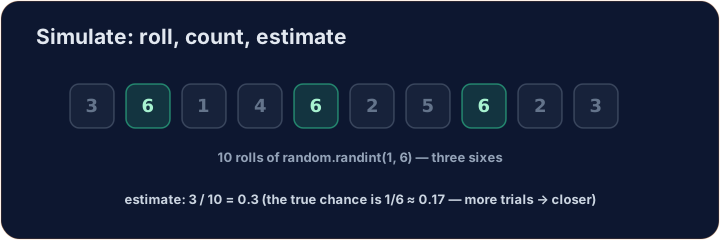
- A simulation models a real process with code.
- Here we model flipping a coin many times and counting heads.
- Running many trials helps us see the long-run pattern.
import random

random.seed(1)
heads = 0
for i in range(10):
    flip = random.randint(0, 1)   # 0 = tails, 1 = heads
    if flip == 1:
        heads = heads + 1
print(heads)
In AP CSP pseudocode
- The exam writes random numbers with
RANDOM. RANDOM(a, b)gives a whole number fromatob, the same idea asrandom.randint(a, b).
roll ← RANDOM(1, 6)
DISPLAY(roll)
Common mistakes
- A simulation uses random values to model chance.
- Run it many times to see the overall pattern.
Now you try
- Some tasks check a property (like "the roll is between 1 and 6").
- Some tasks use a seed so the output is the same every time.
- Press Check answer to test your code.
Difficulty 3/5 · 200 coins + a small bonus on first completion today
Write roll_die() (no parameters) that returns a random whole number from 1 to 6 using random.randint. Remember import random.
Click Run to see the output here.
Difficulty 3/5 · 200 coins + a small bonus on first completion today
Write roll_two() that rolls two dice (each 1 to 6) and returns their total. The total is always between 2 and 12.
Click Run to see the output here.
Difficulty 3/5 · 200 coins + a small bonus on first completion today
Copy this exactly: set random.seed(7), then flip a coin 20 times with random.randint(0, 1) (1 means heads), count the heads, and print the count. With this seed the answer is always the same.
Click Run to see the output here.