Data compression
Why compress data
- Data takes up space to store and time to send.
- Compression makes a file smaller so it is cheaper to save and faster to share.
- There are two kinds: lossless and lossy.
Lossless compression
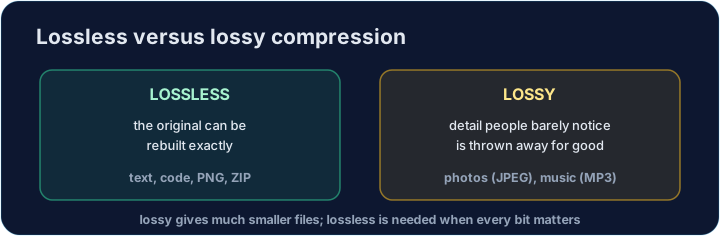
- Lossless makes a file smaller but keeps every bit of the data.
- When you open the file, you get back the exact original.
- It works by finding patterns and writing them in a shorter way.
Original:  AAAAAAAA-BBB
Shorter:   8A-3B          (8 A's, then 3 B's)
Open it:   AAAAAAAA-BBB   (exactly the same again)
Lossy compression
- Lossy makes a file much smaller by throwing away some data.
- It drops details that people can barely see or hear.
- You cannot get the exact original back — but it is "close enough".
Photo (large)  --lossy-->  Photo (small)
A few colors and fine details are gone,
but your eye hardly notices.
The trade-off: size vs quality
- Lossless keeps full quality, but the file stays larger.
- Lossy gives a much smaller file, but quality goes down a little.
- You choose based on what matters more: perfect data or small size.
When to use each
- Use lossless when every detail must be exact.
- Use lossy when a small drop in quality is fine and small size matters.
Lossless:  text, code, a .zip file, a spreadsheet
Lossy:     photos (JPEG), music (MP3), video
Key idea
- Compression trades size against quality (or against work to undo it).
- Lossless = smaller and perfect; lossy = much smaller but not exact.
- Good engineers pick the right kind for the job.
Run-length encoding
- Run-length encoding (RLE) is a simple lossless method.
- A run is a stretch of the same character repeated. RLE stores a count instead of the repeats.
- We will store each run as a pair
[character, count]inside a list.
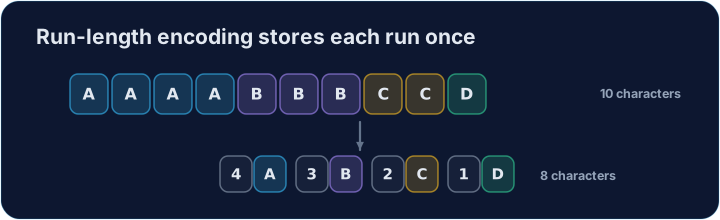
"AAAB"                ->  [["A", 3], ["B", 1]]     (3 A's, then 1 B)
[["A", 3], ["B", 1]]  ->  "AAAB"                   (decode it back — exact again)
Common mistakes
- Lossless compression can be reversed exactly; lossy throws away detail.
- More compression can mean lower quality.
Now you try
- Build RLE yourself: an encoder, a decoder, and a length helper.
- Each task checks your function on several inputs. Press Check answer.
Lossless compression
Run-length encoding replaces a run of repeats with count + symbol.
Difficulty 2/5 · 140 coins + a small bonus on first completion today
Write encode(text) for run-length encoding. Return a list of [character, count] pairs, one per run of repeats. Example: encode("AAAB") → [['A', 3], ['B', 1]]. For the empty string return [].
Click Run to see the output here.
Difficulty 2/5 · 140 coins + a small bonus on first completion today
Write decode(pairs) that reverses the encoder: given a list of [character, count] pairs, rebuild the original string. Example: decode([['A', 3], ['B', 1]]) → 'AAAB'. For [] return ''.
Click Run to see the output here.
Difficulty 2/5 · 140 coins + a small bonus on first completion today
Without decoding, write original_length(pairs) that returns how many characters the original text had — just add up the counts. Example: original_length([['A', 3], ['B', 1]]) → 4.
Click Run to see the output here.