Graphs
Graphs
- A graph is a set of nodes (also called vertices) joined by edges (connections).
- Graphs model networks: friends, roads between cities, links between web pages.
- A tree is really a special graph; a general graph can have cycles and many links per node.
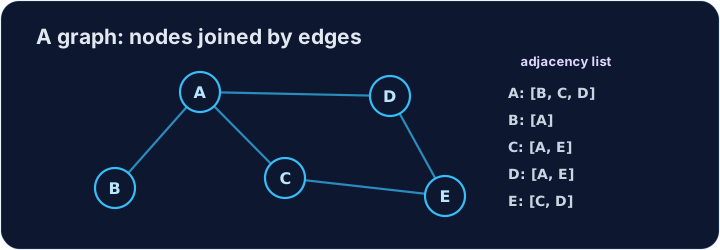
Representing a graph: adjacency list
- One common way is an adjacency list: a dictionary mapping each node to its list of neighbours.
graph["A"]is the list of nodes directly connected toA.- This is compact when each node has only a few connections.
# A graph as a dict: each node maps to its list of neighbours
graph = {
    "A": ["B", "C"],
    "B": ["A"],
    "C": ["A"],
}
print(graph["A"])    # ['B', 'C']  -- A connects to B and C
print(graph["B"])    # ['A']
Adding an edge
- In an undirected graph, an edge
A—Bgoes both ways. - So adding it means appending
BtoA's list andAtoB's list. - If a node is new, start it with an empty list first.
def add_edge(graph, a, b):
    if a not in graph:
        graph[a] = []
    if b not in graph:
        graph[b] = []
    graph[a].append(b)
    graph[b].append(a)

graph = {}
add_edge(graph, "A", "B")
add_edge(graph, "A", "C")
print(graph)    # {'A': ['B', 'C'], 'B': ['A'], 'C': ['A']}
Walking the neighbours
- To explore from a node, you read its neighbour list and visit each one.
- A node that is not in the graph has no neighbours — return an empty list, not an error.
- This neighbour lookup is the first step of bigger jobs like searching the whole graph.
Directed vs undirected
- In an undirected graph an edge works both ways (a friendship).
- In a directed graph an edge points one way only (a one-way street, a "follows" link).
- For directed edges you would append in one direction only.
Common mistakes
- A graph is nodes joined by edges; an edge can be one-way or two-way.
- A tree is a graph with no cycles — do not confuse the two.
Now you try
- Build the adjacency-list operations:
add_edge,neighbours, andcount_edges. - Each task checks your function on a small graph.
- Press Check answer to test it.
Difficulty 5/5 · 400 coins + a small bonus on first completion today
Write add_edge(graph, a, b) for an undirected graph stored as a dict of neighbour lists. Append b to graph[a] and a to graph[b]. If a node is not in the graph yet, give it an empty list [] first. Change the dict in place.
Click Run to see the output here.
Difficulty 5/5 · 400 coins + a small bonus on first completion today
Write neighbours(graph, node) that returns the list of nodes directly connected to node. If node is not in the graph, return an empty list [] (do not raise an error).
Click Run to see the output here.
Difficulty 5/5 · 400 coins + a small bonus on first completion today
Write count_edges(graph) for an undirected graph: count how many edges it has. Add up the lengths of every neighbour list, then divide by 2 (each edge is stored in both nodes' lists). Example: a triangle A–B–C has 3 edges.
Click Run to see the output here.